In that part of Rajasthan, the land does not give. It withholds.
No rain worth the name. No crop that survives the asking. Water carried from far, and never enough of it. To work there is not the same as to work elsewhere. The sun does not permit an ordinary man to be ordinary. You must be extraordinary simply to come home at dusk with something in your hands.
He was young then, and he had a family to feed, and he was failing. Not for want of trying. He worked the way men work when there is no alternative, until the body complains, and then past the complaint. It still was not enough. There is a specific shame in that, known only to the man who carries it: to labour honestly all day and still watch your people go short.
His friends knew what to do. Everyone there knew what to do.
The First Time
Take this. It kills the pain before the pain reaches you. It holds off sleep. It stretches the day past its natural end. It hands you energy you did not earn.
And it was not expensive. And it was not hidden. Opium in those villages was not a vice smuggled in from outside. It was woven into the fabric of the place. Offered at gatherings. Passed between elders. Sanctioned, accepted, almost respectable. Nobody warned him, because to the eyes around him there was nothing to warn about.
He took it. And it worked exactly as promised.
He worked longer. He earned more. His family ate. For the first time, the arithmetic of his life came out right. Understand this clearly, because everything that follows depends on it: it solved his problem. That is how the trap is built. Not from weakness. From something that genuinely, undeniably helps, until the day it stops helping and starts owning.
The Morning He Understood
One day there was none.
What happened to him that day, he could not name at the time. His hands would not obey. His mind came apart into something loud and clawing. He watched himself behave like a man he did not know. Could not stop, could not reason, could not sit still inside his own skin. His family saw it too.
Then he got the dose. And within the hour he was returned to himself, calm, lucid, recognisable. And it was in that terrible clarity that he understood what had been done to him.
He was obeying it.
To live, to work, to behave like a human being, to sleep, to wake, to be. Every one of these now required permission from a substance. He was not its user. He was its servant. Forty years of servitude were in front of him and he could already see them.
Three Attempts
He tried to leave it. Three times.
He did it properly: the medical way, the prescribed regimen, everything he was told. Three times he did what he was supposed to do, and three times it did not hold, and he came back to it.
There is a particular exhaustion that arrives after the third failure. It is not dramatic. It is quiet. It says: this is simply what my life is. This is my fate. And he accepted it, because acceptance hurt less than another attempt.
The body kept its own accounts. Asthma came. Miss a dose and it would seize him. His work, the one thing that had ever been his, began to slip; he had less to give each year. By the end he could not walk ten steps without stopping to breathe. The pump went everywhere with him. A man who had once outworked the desert now measured his day in metres.
Everything Taken
He was in his late sixties when his only son was murdered.
What is there to write about that. There is no sentence that carries it. A man past sixty, who has already surrendered his body and his work, is handed the death of his child, and not a death that can be explained away as illness or age, but one that someone chose.
Then the rest went, one piece after another. His wife could no longer stand properly. His daughter-in-law left them. And his grandson, the boy who was the last of the line, the one he might have hoped would hold his arm as he walked, beat him. Abused him in his own house.
Old. Sick. Enslaved to opium. Son buried. Wife unable to rise. Beaten by his own grandson under his own roof.
Nowhere to go. Nowhere to look. Nothing left that could be taken, because it had all already been taken.
This is the point in a life at which we normally stop telling the story. We say: it was too late for him. We say it kindly, and we mean it as mercy, and it is the cruellest thing we do.
He Told No One He Was Leaving
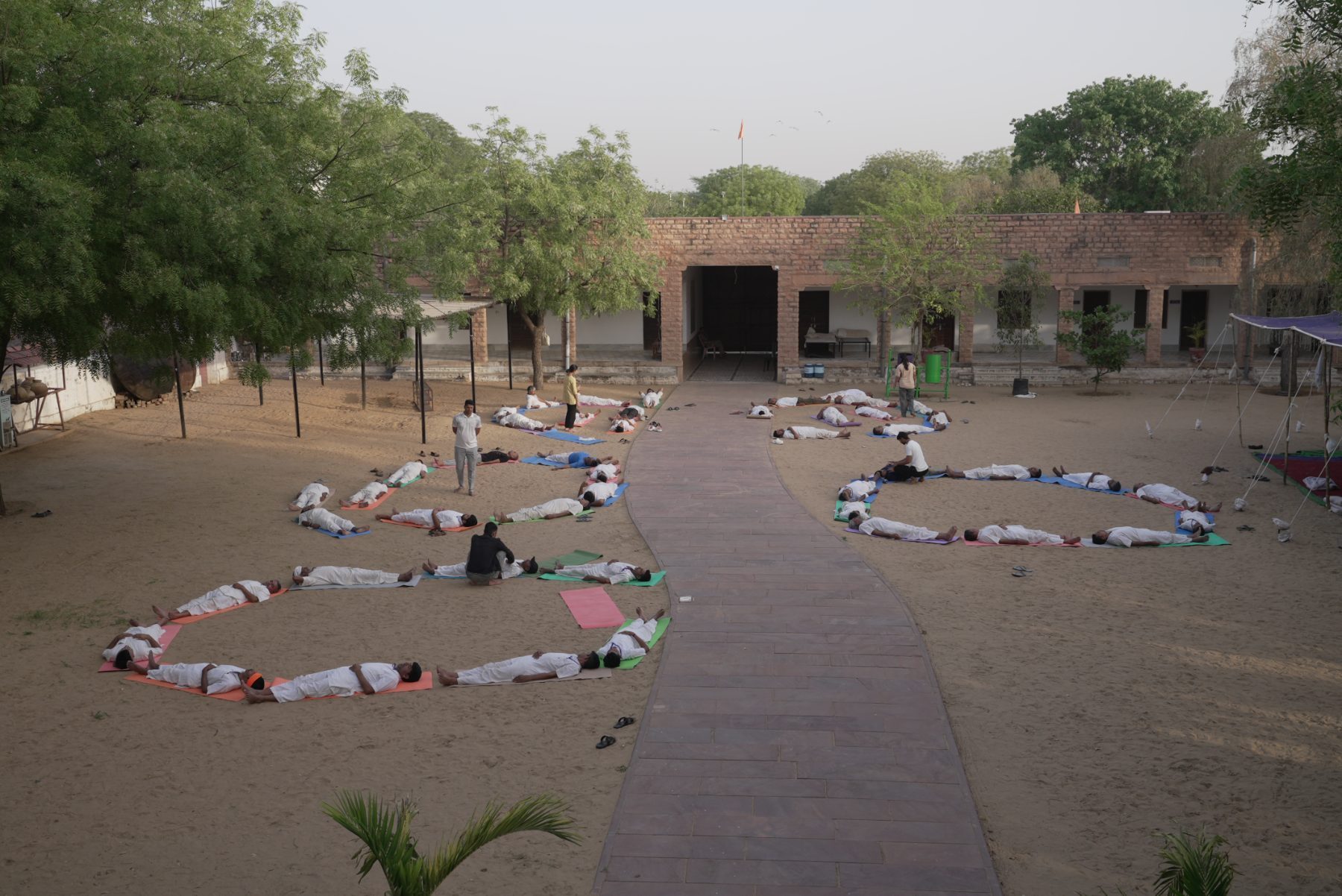
Word reached him of a residential camp. One month. Integrated Yoga Training, for de-addiction. Jyotirgana.
He did not discuss it. Who was there to discuss it with? He simply went, carrying the clothes he stood in and his asthma pump. That was the whole of it. That was everything a man had after seventy years.
And when he arrived, he did not demand a place. He pleaded to be let in. Picture that, and hold it for a moment: a man of seventy, who has lost his son, begging strangers for permission to try one more time.
Everything had been taken from him except the wish.
They let him in.
The First Week
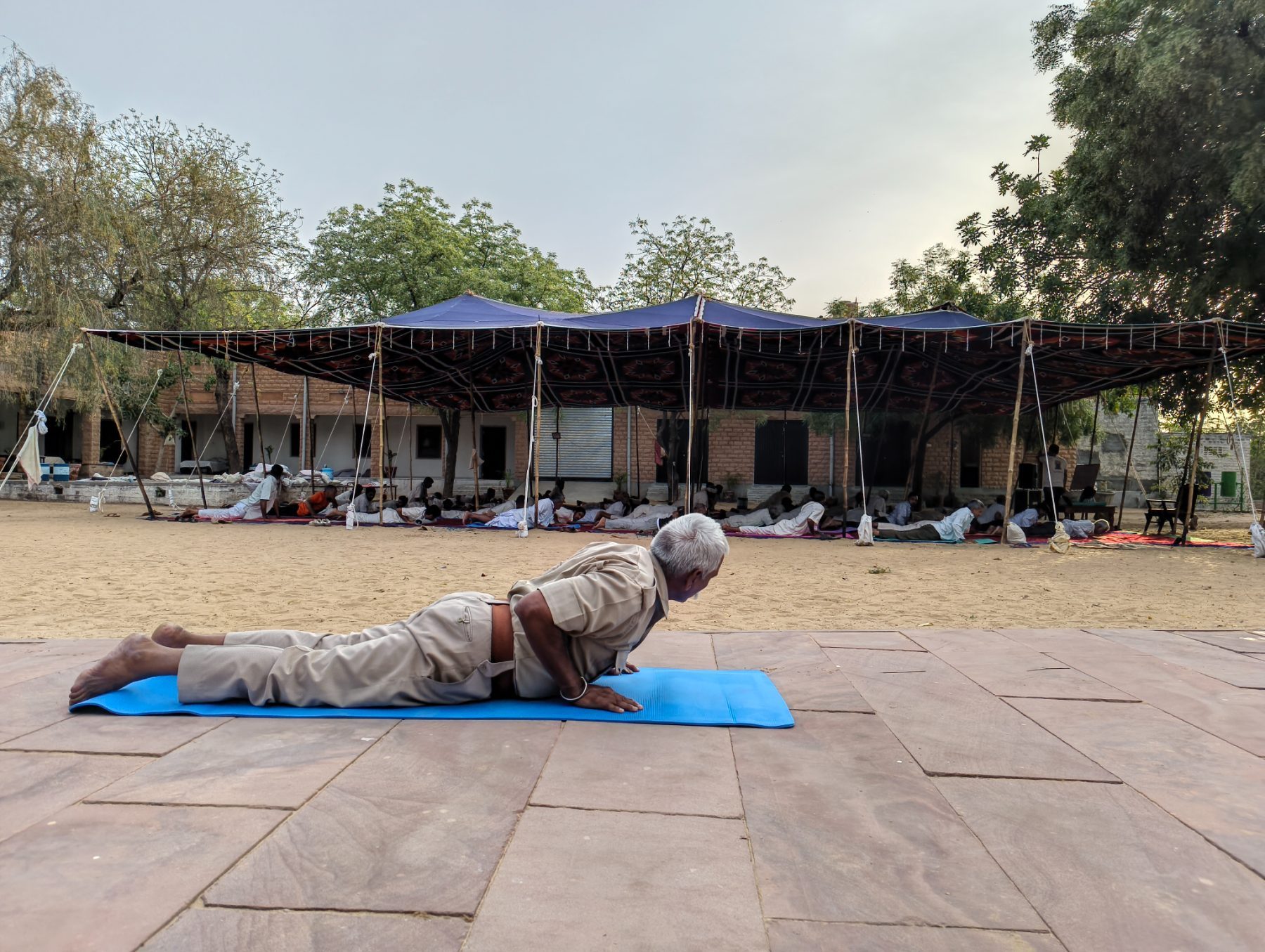
He did everything. Not selectively. Everything. Āsana. Prāṇāyāma. Concentration. Meditation. Whatever was placed in front of him, at whatever hour, he did it, in a body that could not walk ten steps.
Within a week he was waking at four in the morning. First to bathe. First into the yoga hall. Seventy years old, forty years on opium, and he was ahead of every man in that camp.
And then the thing that no one had told him was possible: he found that he could walk through the day. The whole day. Without reaching for the pump. The lungs that had failed him for years began, quietly, to do their work.
He is not part of our published study. He came to a later camp, and his own data belong to research still underway. But what he described had already been measured in the men who came before him. In our pilot study, thirty men completed the same one-month protocol with spirometry before and after: estimated lung age fell by an average of 6.72 years, the volume of air the lungs could hold rose by 0.61 litres, and the force of the breath out rose by more than a third.
So when he put down the pump and kept walking, it was not a miracle and it was not imagination. It was the thing we had already watched happen, happening again. See the published findings →
He laughed. People noticed it before they noticed anything else: this old man, laughing. Cheerful from morning to night, for no reason anyone could point to.
Then he started turning around to face the others.
He guided the men who were struggling. Sat with the ones who wanted to leave. Pushed the ones who had stopped trying. He had not been in the camp a fortnight and he had become its encouragement, because when a seventy-year-old opium-bound asthmatic tells you it can be done, there is no argument left to make.
Thirty Days
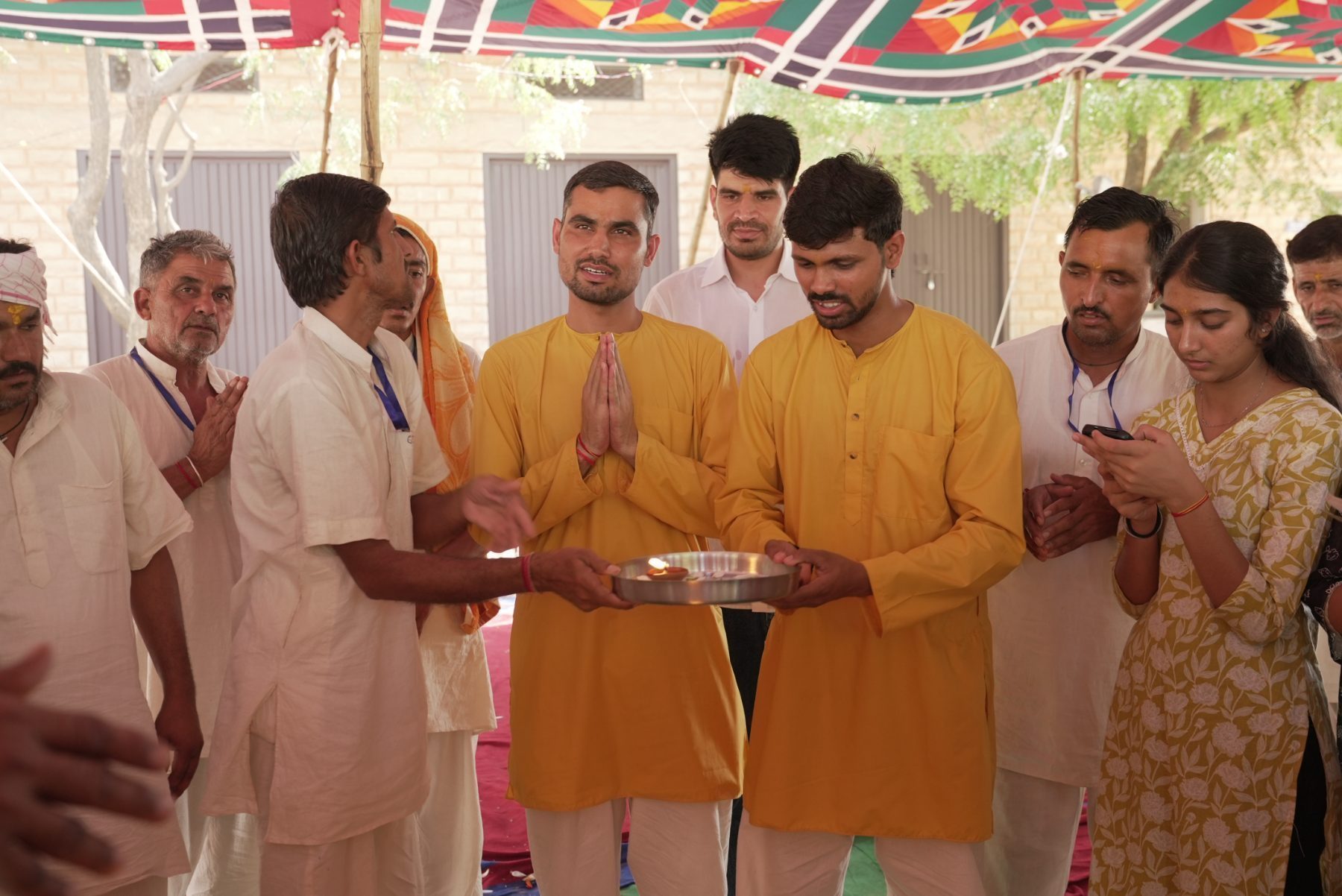
He completed the month.
He had begun the programme on the standard medical support, as everyone does. He finished it on none. He walked out of that camp carrying no substance and no prescription, after four decades.
What the Village Saw
He went home and did not announce anything. He simply began to live.
He milks the cow. He makes the tea. He does the work of the house. The man who could not cross a courtyard now does the work of the house. And people who have known him his whole life watch him move through the day and use the same word, over and over: he runs. Like a child, they say. He runs like a child.
Seventy years old, and he has been given a second birth.
But this is the part that matters, and it is the reason this project exists at all.
In his village they are now coming forward. Eighteen years old and eighty years old and every age in between, men and women who had privately decided their own case was hopeless, who had made their peace with the dark exactly as he once did, and who now want out.
No campaign reached them. No pamphlet, no doctor, no government notice. One man they had watched fall, walking past their houses with his arms full of firewood, laughing.
He became it.
This is what the word means. A single firefly is almost nothing, a flicker over a black field, easy to miss. But a firefly is enough to be seen by the next one. And then there are two. And what began as one old man's last unreasonable wish becomes, over a season, a field full of moving light.
Jyotirgaṇa. A host of lights.
He is one of them now. If you are reading this in the dark, so are you. You simply have not been lit yet.