Most people who complete treatment go back.
This is the fact that sits underneath the whole field. Detoxification works. Medication works. Therapy works. And still, a large share of people who finish a programme return to the substance, which means the thing being treated is not the thing that is actually holding them.
Underneath most addiction is escape. Not pleasure. Escape. From unbearable pain, from an unstable sense of who you are, from a situation with no exit. The substance offers a few hours of relief from a problem it cannot touch. The problem returns, larger, with the substance's own damage now added to it. So you use again. Eventually the substance becomes the whole problem, and whatever first drove you there is forgotten by everyone, including you.
Now look at what conventional treatment asks of a person: avoid your triggers, avoid your friends, avoid your village square, stay away, keep coming back to us.
and then wonder why it does not hold.
There is a deeper cost. To be told you are permanently vulnerable, that the substance will always be stronger than you, that you must remain within reach of clinical help for the rest of your life. This teaches a man that he is weak by nature. He may stop using. He rarely stops believing it.
We wanted to know what would happen if we said the opposite thing.
This world was not built with random bricks of Chance,
A blind god is not destiny's architect;
A conscious power has drawn the plan of life,
There is a meaning in each curve and line.
Sri Aurobindo · Savitri
There is a meaning in each curve and line.
Read that last line again, and then apply it to forty years of opium.
If nothing in a life is accidental, then the years lost to a substance are not simply wreckage to be mourned. They are something learned, learned the hardest way available, at a price nobody would choose to pay, but learned nonetheless.
Consider what a man in long dependence actually knows. He knows exactly how a craving announces itself, and how many minutes he has before it wins. He knows every lie he told himself and the precise order he told them in. He knows how it feels to mean a promise completely and break it by evening. He knows which kind of concern from a family member makes a person use more.
No university teaches this. No clinician can acquire it. It is a curriculum, and he completed it.
It was, without his consent, his training.
This is the Protector Paradigm. The person in front of us is not a patient defined by an affliction, waiting to be repaired. He is a trainee, someone who has already survived the difficult half of an education, and now needs the other half: the practices, the physiology, the skills, and the responsibility.
And the substance stops being a demon to flee for the rest of his life. It becomes the subject he happens to be an expert in.
Nothing in that argument is about opium.
Read it back with the word changed. The woman who came through a depression knows what the inside of one sounds like, and which reassurance makes it worse. The man who lost a child knows what the second year is like, when everyone else has moved on and the casseroles have stopped. The person whose body failed them knows the specific humiliation of asking for help with something they could do last year.
Every one of them completed a curriculum nobody would enrol in. And every one of them is treated by the world as damaged rather than as qualified.
That is the whole claim, and it is not a claim about a substance. It is a claim about what suffering leaves behind in a person, and about who is best placed to use it.
We have built this out properly in one domain so far: opium, in western Rajasthan, with a protocol, a published paper and stated limits. The principle is wider than that. Our evidence, so far, is not. We will keep those two facts visible at the same time.
We had to change the words first.
A paradigm that lives only in a paper changes nothing. It has to reach the vocabulary people are addressed with every morning, because that is what they come to believe about themselves.
This is not decoration. A man who is told for thirty days that he is in training behaves differently from a man told for thirty days that he is ill.
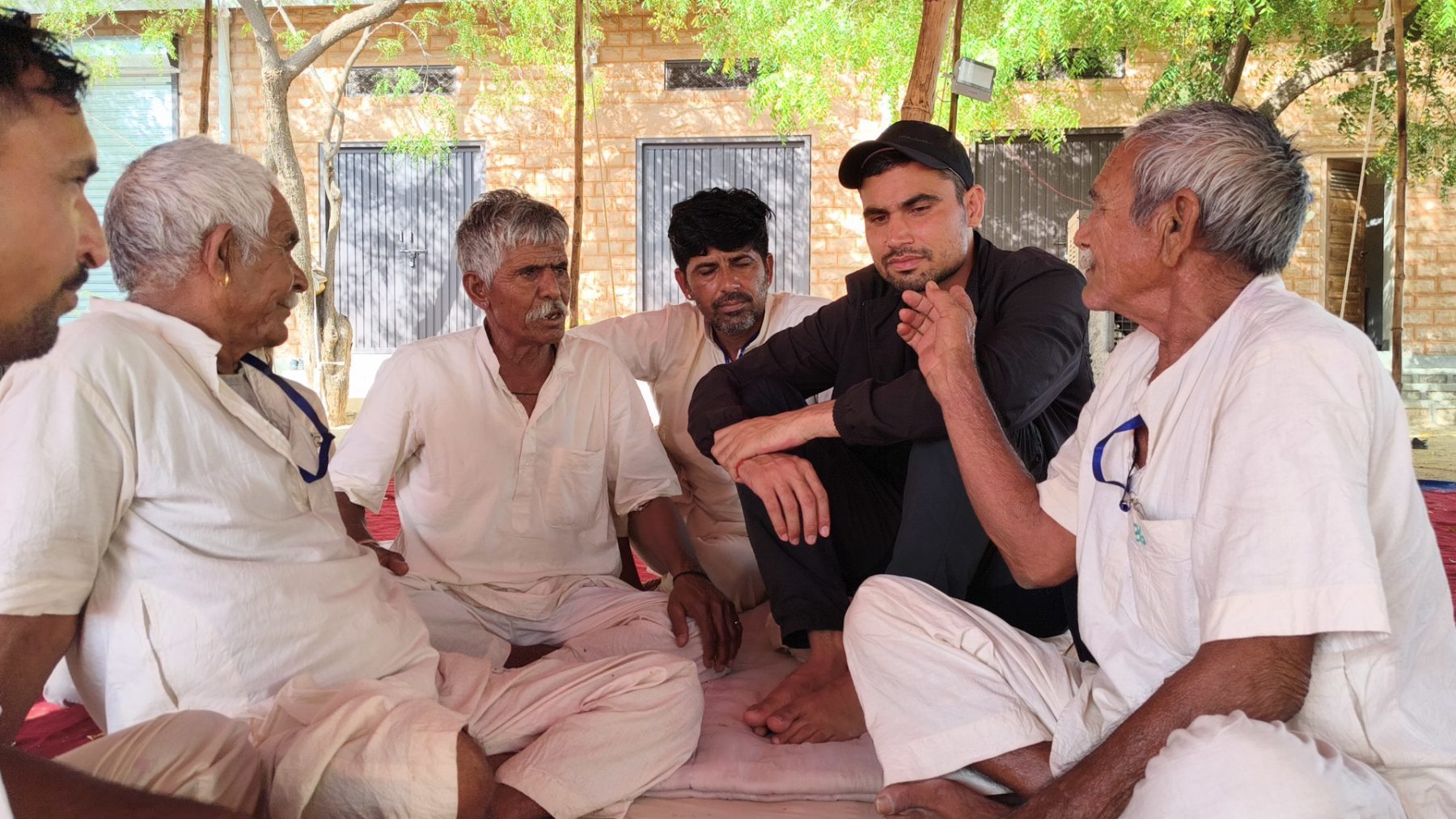
The twelfth step was right.
Alcoholics Anonymous discovered something profound long before any of us: that carrying the message to another person suffering does more for the carrier than any amount of being cared for. Millions of lives rest on that insight. Our paradigm would be dishonest if it did not begin by acknowledging it.
Where we differ is on one word: identity.
"Once an addict, always an addict." Said in a room of people who need humility, it protects against complacency, and it has kept many people alive. But said to a labourer in western Rajasthan who has already been told by everyone that he is finished, it can confirm the sentence rather than lift it. A permanent label of vulnerability, plus a lifelong requirement to keep attending, can quietly become another dependence, this time on the programme.
We think the identity should be allowed to move. Not addict-forever, but: someone who went through the dark, learned it thoroughly, and now carries a light by which others can find their way out. The past is not denied and it is not worn as a wound. It is used.
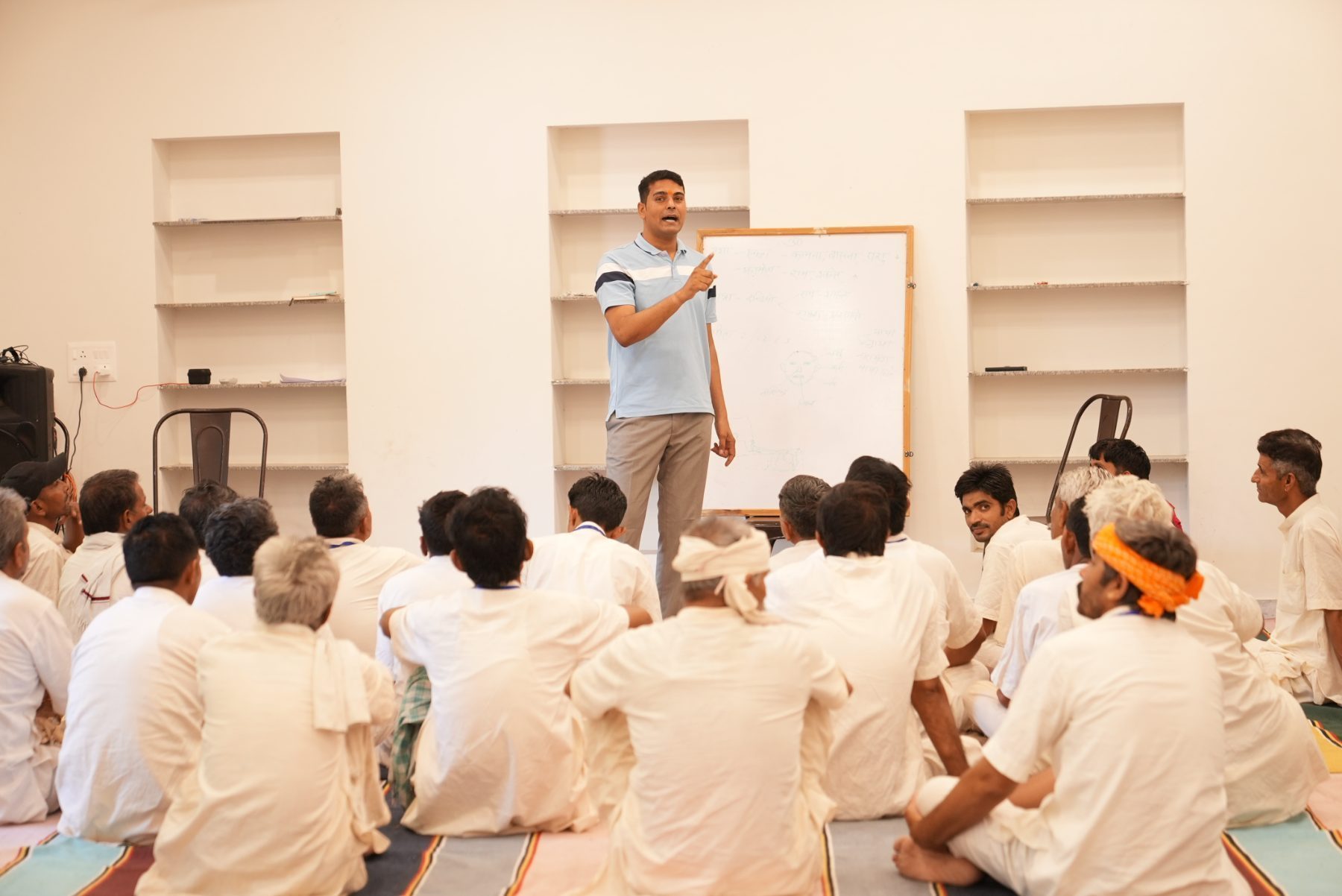
Six phases. One month. 150+ practices.
The paradigm is the reason. This is the method. Each phase opens what the next one needs. You do not sit for meditation in a body that cannot yet sit, and you do not lead others before you have steadied yourself.
Sūkṣma & Sthūla Vyāyāma
LooseningThe subtle and gross body movements as envisioned by Dhirendra Brahmachari, kept in their original form. We begin here because a body that has run on opium for decades cannot be asked for an āsana on day one. Joint by joint, the body is made available again.
Breathing Practices & Ṣaṭkarma
Yogic detoxBreathing practices developed and researched at SVYASA, alongside the six classical cleansing kriyās. This is where the measured lung improvement begins, and where the body is cleared enough for everything that follows.
Āsana: nine flows
Strength and stillnessNot a list of postures but nine groups, each arranged as a continuous flow. The idea is borrowed from vinyāsa; the sequencing is not. Each flow is ordered around what a body in withdrawal can actually sustain and what it needs to recover.
Prāṇāyāma
The breath as instrumentCraving arrives in the breath before it arrives in the mind. A person who can find his breath under pressure has a few seconds of warning, and a few seconds is the whole difference between using and not using. One of these practices is on this site.
Dhāraṇā & Dhyāna
Concentration and meditationAddiction is attention captured. Concentration is attention taken back, deliberately, a minute at a time. Meditation is then sitting with what the substance was covering. It is the hardest phase, and the one that decides whether any of it lasts.
Peer Learning
The point of all of itThe phase the other five exist to make possible. The trainee turns around and begins to guide the men who arrived after him. This is not a graduation ceremony added at the end. It is the aim of the module, and the moment a person becomes Jyotirgana.
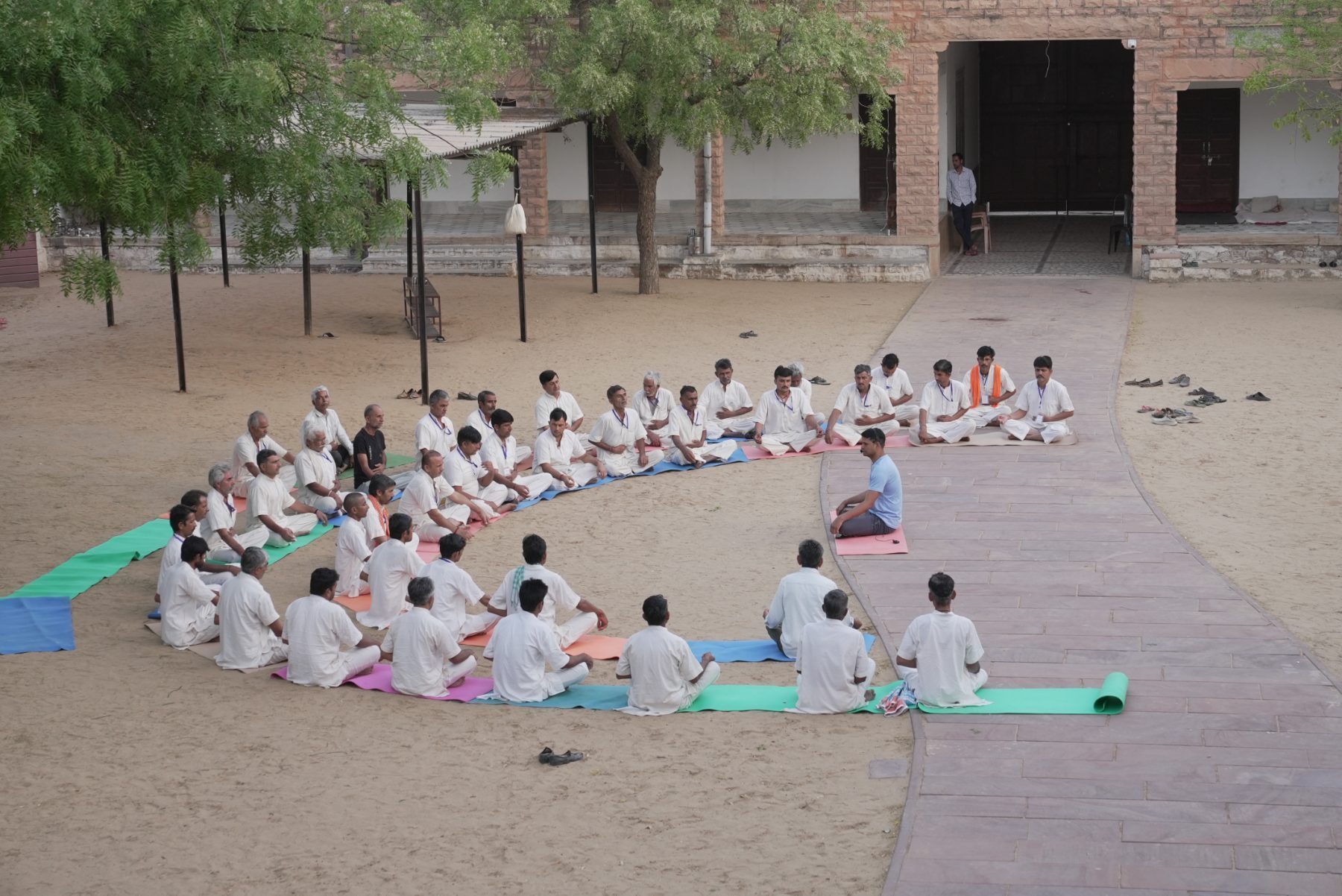
Do it. Understand it. Teach it.
Every one of the 150+ practices passes through the same three stages. A man who has only been instructed can follow. A man who understands can adapt. A man who can teach it will not lose it.
Practice
The practice as instructed by the teacher. Body first, before explanation. You do it before you know why.
Understand
The educative session. What this practice is, why it is in the protocol, how it is to be performed, and exactly which complication it is working on. The trainee stops obeying instructions and starts knowing his own treatment.
Lead
He teaches it to someone who arrived after him. This is the aim of the module, not its reward. After one month he is equipped to help himself, and to help another.
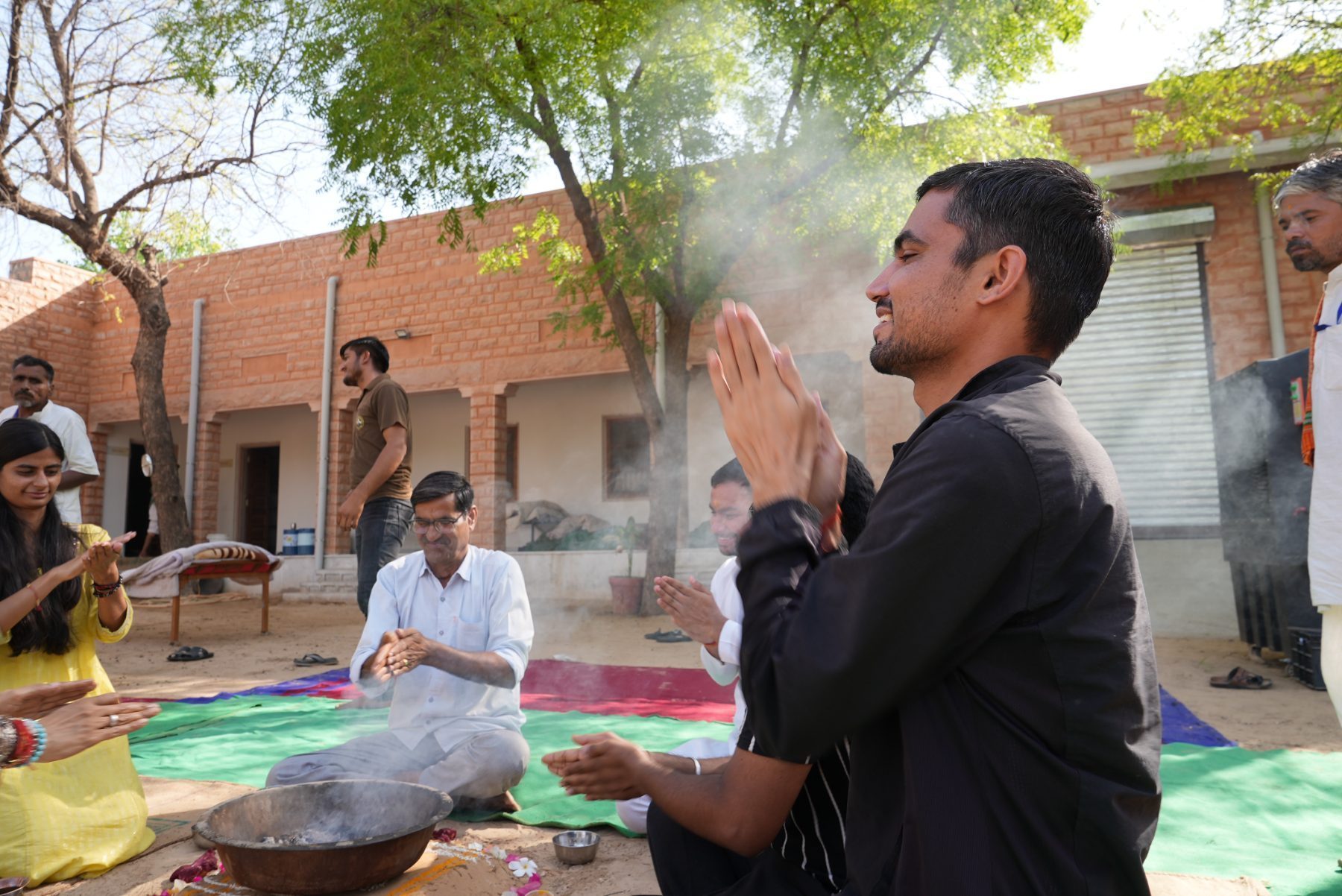
One man walked out of that month and lit a whole village.
Read how it happenedYou do not have to finish reading this. Call now.
Free. Confidential. 24 hours. In your language.
Yoga supports recovery; it does not replace medical care. Withdrawal from opioids, alcohol and some sedatives can be dangerous without supervision. Do not stop a substance abruptly on your own. Call 14446 or see a doctor first.