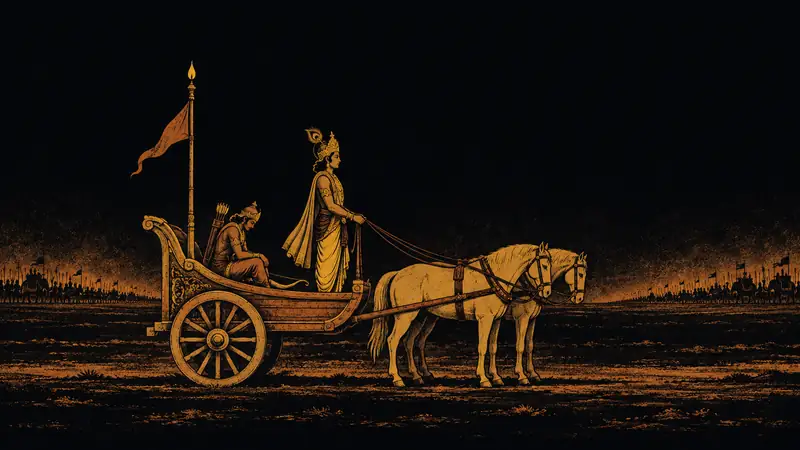
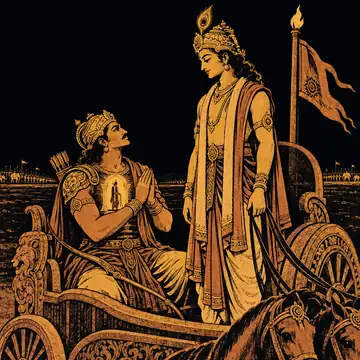
सेनयोरुभयोर्मध्ये · between the two armies. He has already turned. The other has not yet looked up.
Why this book is on this site
The Gītā is not spoken in a temple or a forest. It is spoken in the gap between two armies, in the last minute before the worst day of somebody's life, to a man who has just found that everything he lived by has stopped working at once.
He asks to be driven into the middle so he can see what he is about to do. And in the middle he goes to pieces. His hands shake, his mouth dries, the bow falls, he cannot stay on his feet. He says so out loud, in front of everybody. That is chapter one, and the chapter is named after it.
Nobody tells him to compose himself. Nobody tells him to come back when he is better. The one who answers him is already in the same chariot, holding the reins, facing the same field. That is what a सारथि is. Not somebody on a seat above, giving instructions from a distance. The one who drives, who goes wherever you go, and who got in before you asked.
And why we think it belongs to you in particular
On this site nobody is described by what happened to them. A man is not his worst year, and we read a life forward, for what is possible in it, rather than backward for where it went wrong. So let us say the rest of it plainly, because it is the reason this section exists at all.
Somebody who has been through dependence has lost a great deal, and we will not pretend otherwise. But along with it he has lost some things that stand in most people's way for a whole lifetime. The running account of his own virtues. The performance of being somebody. The certainty of being right. The position that has to be defended every morning. Most people spend forty years trying to set those down and cannot. He did not set them down. They were taken from him. That is a hard road to an open hand, and it is still an open hand.
We are not saying these lives are better than other lives. We do not weigh lives against each other and we never will. We are saying something narrower and much more exact. For this knowledge, at this hour, he is ready, and most people are not. Ready to listen, because nothing else has worked. Ready to let go, because the grip has already failed. Ready to learn, to know, to grow, to become. The questions that other people postpone for a lifetime are already standing in front of him and will not move: who am I, what is this world, whom am I living for.
And the one name he is left with, the one everybody else uses about him, is not an identity at all. It is the absence of one. An absence is room.
Which is very close to what Sri Aurobindo says the Gītā is for
Essays on the Gita holds that every Scripture carries two things at once: an element that belongs to its own period and country and will pass, and an element that is eternal and holds in every age. It says that only those books which are constantly renewed and relived stay of living importance, and that the rest stand as monuments of the past with nothing left to give. So it does not ask us to reconstruct what the men of that time meant by it.
What we can do with profit is to seek in the Gita for the actual living truths it contains, apart from their metaphysical form, to extract from it what can help us or the world at large and to put it in the most natural and vital form and expression we can find that will be suitable to the mentality and helpful to the spiritual needs of our present-day humanity.Sri Aurobindo, Essays on the Gita, Our Demand and Need from the Gita
That is not a liberty we are taking. It is the instruction, and this section is an attempt to follow it in the plainest Hindi and English we can manage.
The same essay says one more thing that matters here, and says it without qualification: the teaching of the Gītā is universal, whatever may have been its origins. It is not the property of any one religious system, and nothing on these pages asks you to belong to anything, believe anything, or stop being whoever you already are. Spiritual, never religious. That rule holds on this site without exception.
The eighteen
Eighteen chapters, and a chariot wheel has spokes. The lit ones are the doors that are open. The rest are dark for now, and will be opened slowly, some of them one verse at a time, and this page will grow.
the wheel of eighteen · lit where a door is open
 1 doors01अर्जुनविषादयोगThe Yoga of Arjuna's Despondency
The collapse. It begins at the bottom, and the bottom is given a name and called the first yoga.
 not yet02साङ्ख्ययोगThe Yoga of Knowledge
What in you does not die, and the first instruction, which is: stand up.
 not yet03कर्मयोगThe Yoga of Works
You cannot stop acting. Nobody can. So the question was never whether to act.
 not yet04ज्ञानकर्मसंन्यासयोगThe Yoga of Knowledge and Works
This has been given before and is given again, whenever and wherever it is needed.
 not yet05कर्मसंन्यासयोगThe Yoga of Renunciation of Works
Giving work up, and doing it without gripping it. Which of the two is the real letting go.
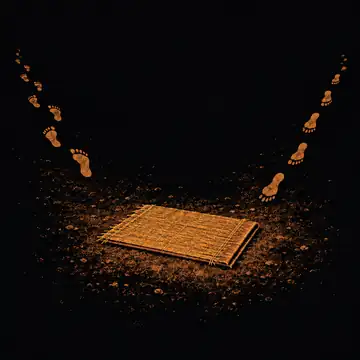 not yet06आत्मसंयमयोगThe Yoga of Self-Mastery
The seat, the hour, the measure. And then the question we ask here more than any other: what becomes of the one who tried and fell.
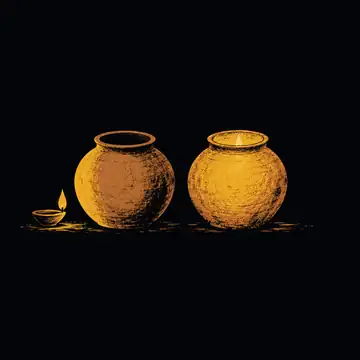 not yet07ज्ञानविज्ञानयोगThe Yoga of Knowledge and Realisation
Knowing about a thing, and knowing it.
 not yet08अक्षरब्रह्मयोगThe Yoga of the Imperishable
What a man holds at the end, and what that asks of him now.
 not yet09राजविद्याराजगुह्ययोगThe Yoga of the Royal Secret
The king-secret. That even now, exactly as you are, you were never outside it.
 not yet10विभूतियोगThe Yoga of Divine Manifestations
Where to look for it, for a man who cannot yet see it everywhere.
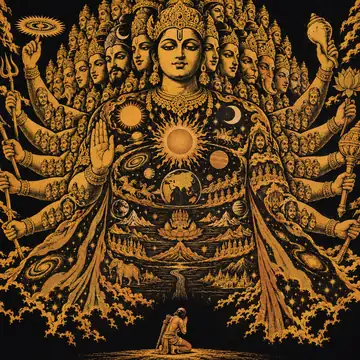 not yet11विश्वरूपदर्शनयोगThe Yoga of the Vision of the All
Seeing the whole of it at once, and not being able to bear it.
 not yet12भक्तियोगThe Yoga of Love
For the one who cannot hold an idea in his head: love is enough, and it is the easier road.
 not yet13क्षेत्रक्षेत्रज्ञविभागयोगThe Field and its Knower
The field, and the one who knows the field. You are not your body and you are not your history.
 not yet14गुणत्रयविभागयोगThe Three Modes of Nature
The three forces that have been running you, and what it is to stop being run.
 not yet15पुरुषोत्तमयोगThe Yoga of the Supreme Person
The tree with its roots above. What you have been living inside without knowing its shape.
 not yet16दैवासुरसम्पद्विभागयोगTwo Natures in Man
Two sets of qualities, and the honest question of which one you have been feeding.
 not yet17श्रद्धात्रयविभागयोगThe Three Kinds of Faith
Faith, food, speech and giving, each of three kinds. A man is made of what he trusts.
 not yet18मोक्षसंन्यासयोगThe Yoga of Liberation
The whole of it gathered up. And the last word, which asks for nothing first and is: do not grieve.
How it is kept
Each chapter is a door, and inside each chapter a śloka or a small group of ślokas is a door of its own, with its own ground under it, made from what that passage is about. Nothing here is a course and nothing has to be finished. One door on a morning when there is a question is the whole of the method.
The verses are in Devanāgarī with transliteration, and then in plain speech, which is a rendering and not a word-for-word translation. Sri Aurobindo is quoted from Essays on the Gita and always named. The essays are read chapter by chapter as we go rather than all at once, so that each reading is fresh against the verse in front of us, and where an essay has not yet been read for a chapter, nothing is quoted from it.