Numb, nothing
Numbness is a place too. From here the stopped mind is asked to move.
Do thy lower members still suffer the shock of sin and sorrow? But above, seen of thee or unseen, thy soul sits royal, calm, free and triumphant. Believe that the Mother will ere the end have done her work and made the very earth of thy being a joy and a purity.
Sri Aurobindo, Thoughts and Aphorisms 279 (CWSA 12, p. 461) the whole of it →1the story
राहJaḍa Bharata, whom everyone took for a fool›
हिरनThe deer
Bharata had been a king and a sage. He had given up his kingdom for the forest, and there, out of pity, he raised an orphaned fawn. He came to love it so much that his practice slipped away from him, and he died with his mind on the deer, and was born a deer. But he remembered. Grieving, he saw exactly how he had fallen, left his mother doe, and lived quietly near a holy place until that life was done. 5.8.26 to 31
मूर्खThe fool
Then he was born the son of a learned brahmin. He remembered all his lives, and he was afraid of being caught again by the love of his own people. So he kept his mind on the Lord, and to the world he showed himself as mad, dull, blind and deaf. 5.9.1 to 3
His father tried to teach him, and he got everything wrong, on purpose, in front of him. When the father died, his brothers gave up on him. People called him mad, dull, deaf, dumb, and he answered them in the same way. He did whatever work anyone set him, for pay or for nothing. He ate whatever came, much or little, good or rotten, as if it were nectar. He lay on the bare ground in sun, wind and rain, unwashed, covered in dust, and the Bhāgavata says he was like a great jewel whose light the dust hid. His brothers set him to guard their fields, and he did not know whether the ground was level or not. And all the while, inside, he was in the joy of his own self, which nothing outside had given and nothing outside could take. 5.9.4 to 11
One night robbers took him from the fields to offer him to the goddess Bhadrakālī. He sat before her, bound, with the sword raised over him, and was not afraid. The goddess herself burst out of the image and turned on the robbers. A man at peace, the Bhāgavata says, is guarded on every side. 5.9.12 to 20
पालकीThe palanquin
King Rahūgaṇa of Sindhu and Sauvīra was travelling along the river Ikṣumatī, and his men were short of a bearer. They saw a young man, well built, strong enough, they thought, to pull a load like an ox, and they seized him and put the king's palanquin on his shoulder. He carried it. But he walked looking an arrow's length ahead, so as not to tread on any living thing, and the palanquin went unevenly. 5.10.1 to 2
The king grew angry and mocked him. Oh, poor brother, you must be so tired, carrying this all alone for so long, you who are not fat, not strong, and so old. He said nothing, and carried on as before. The palanquin jolted again, and the king shouted: What is this? You are a dead man walking. Do you defy your master? I will cure you, as a judge cures a criminal, and bring you to your senses. 5.10.5 to 7
वे बोलेHe speaks
Then, for the first time, he spoke, as if smiling, though there was no pride left in him to smile with. What you say is true, he said, if the load were mine to carry and the road were mine to walk. The wise do not say a man is fat because of the heap of flesh he walks in. 5.10.8 to 9
स्थौल्यं कार्श्यं व्याधय आधयश्च क्षुत्तृड्भयं कलिरिच्छा जरा च।
निद्रा रतिर्मन्युरहं मदः शुचो देहेन जातस्य हि मे न सन्ति॥Bhāgavata 5.10.10
Fat and thin, sickness of body and of mind, hunger, thirst, fear, quarrel, desire and age, sleep, pleasure, anger, pride, intoxication and grief: these belong to the one who is born with a body. They are not mine. 5.10.10
उन्मत्तमत्तजडवत्स्वसंस्थां गतस्य मे वीर चिकित्सितेन।
अर्थः कियान्भवता शिक्षितेन स्तब्धप्रमत्तस्य च पिष्टपेषः॥Bhāgavata 5.10.13
I have gone into my own state, like one mad, or drunk, or dull. What would your cure do for me, hero? What would you teach me? To punish one who is past it is to grind flour that is already ground. And having said that much, he took up the palanquin again, and carried it. 5.10.13 to 14
तुम कौन होWho are you
The king heard, and something in his heart came untied. He jumped down from the palanquin, put his head at the bearer's feet, and asked forgiveness, all his pride as a king gone. 5.10.15
कस्त्वं निगूढश्चरसि द्विजानां बिभर्षि सूत्रं कतमोऽवधूतः।
कस्यासि कुत्रत्य इहापि कस्मात्क्षेमाय नश्चेदसि नोत शुक्लः॥Bhāgavata 5.10.16
Who are you, going about hidden among the twice-born, wearing the sacred thread? Which of the free ones are you? Whose son, from where, and why here? I fear nothing, not Indra's thunderbolt, not Śiva's trident, not Death's staff. I fear only having dishonoured one like you. You move about like a dull man, unattached, your knowing hidden; your words are beyond what my mind can open. 5.10.16 to 19
धूल के नीचेUnder the dust
Some nights a Jyotirgana feels nothing at all. Not anger, not fear, not grief: a flatness, as if he had been emptied. He may have been called dull, useless, half dead, a load that has to be carried. He may have come to believe it.
This story does not say that his numbness is peace. Jaḍa Bharata's dullness was a hiding, chosen, with the joy of the self underneath it; the flatness after years of a substance is something else, and the story does not pretend otherwise. What it does say is this: what looks like nothing from outside is not the measure of a man. Under the dust was a great jewel, and the dust did not make it less.
And nothing was lost even in his fall. A king and a sage loved a deer too much and became a deer, and he came out of it remembering, and the memory was what made him free. The one everyone took for a fool was the one the king got down on the road to ask: who are you?
This lamp is for the night when nothing is there. It does not ask him to feel anything. It asks him only to sit, and to let what is under the dust be there, seen or unseen.
The story: the Bhāgavata Purāṇa, 5.8.26 to 31, 5.9 and 5.10.1 to 19, read in Sanskrit in the GRETIL e-text (Ulrich Stiehl); the verse numbers are that text's. Much of the fifth book is prose; the Sanskrit shown is its verse. The telling in English is ours, and so is what it means for him.
2the doing
First, if you want: बूँद, the drop →Single notes into silence. Then come back here for the sitting.4the word
A whole page of the Mother's diary, Prayers and Meditations, as she wrote it on this day: a prayer to the Divine, given entire. That it stands at this lamp is our choice.
The Mother · December 7, 1912
Like a flame that burns in silence, like a perfume that rises straight upward without wavering, my love goes to Thee; and like the child who does not reason and has no care, I trust myself to Thee that Thy Will may be done, that Thy Light may manifest, Thy Peace radiate, Thy Love cover the world. When Thou willest I shall be in Thee, Thyself, and there shall be no more any distinction; I await that blessed hour without impatience of any kind, letting myself flow irresistibly toward it as a peaceful stream flows toward the boundless ocean.
Thy Peace is in me, and in that Peace I see Thee alone present in everything, with the calm of Eternity.
The Mother, Prayers and Meditations, CWM 1, p. 11
Do thy lower members still suffer the shock of sin and sorrow? But above, seen of thee or unseen, thy soul sits royal, calm, free and triumphant. Believe that the Mother will ere the end have done her work and made the very earth of thy being a joy and a purity.
Sri Aurobindo, Thoughts and Aphorisms 279 (CWSA 12, p. 461)From Thoughts and Aphorisms: about 1913 Sri Aurobindo wrote them in one notebook, under three headings, Knowledge, Works and Devotion, and never prepared them for publication. The Mother read them all aloud, one by one, from 1958 to 1970, and commented; that is On Thoughts and Aphorisms. Below: what stands beside this line, her comment on it, and why it is here.
Beside it, Sri Aurobindo
If thy heart is troubled within thee, if for long seasons thou makest no progress, if thy strength faint and repine, remember always the eternal word of our Lover and Master, “I will free thee from all sin and evil; do not grieve.”
Sri Aurobindo, Thoughts and Aphorisms 280 (CWSA 12, p. 461)The Mother, on it
Here, what Sri Aurobindo calls the soul is the Divine Presence in each one of us; and the certitude of this constant Presence within us will alleviate all our sorrow by convincing us of the ultimate victory which is certain.
The Mother, On Thoughts and Aphorisms, CWM 10, p. 293, 10 January 1970Why it is here
For the man who feels nothing: the calm is there, ‘seen of thee or unseen’. The aphorism after it is the Gita’s word (18.66), and the Mother says what ‘soul’ means here: the Divine Presence in each one of us. That reading is ours.
Read every aphorism with the Mother’s comments, on the Ashram’s site →
one long breath
5the sitting
Each group's cautions come with its own steps (Group 9's neck caution and the others).
What will you carry?
The sitting
Begin the sitting →Choose what you will carry, and the sitting opens.
It begins aloud, slow, and slows a little in each posture, to about six breaths a minute. Each line is read in the mind as the breath comes in, white, and said aloud as it goes out, gold.
- ĀsanaOne posture of The Sun, for as long as you stay.
- BreathGāyatrī · as it is said in sandhyā
- JapaThe same word, seated.
- RestŚaśāṅkāsana or Śavāsana, either. Nothing to count.
Or one piece alone: Āsana · Breath · Japa · Rest
विश्राम · Rest
Śaśāṅkāsana or Śavāsana, either. Nothing to count.
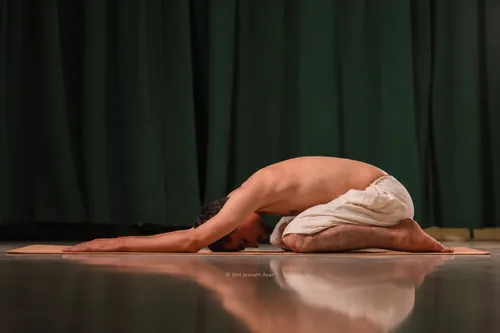 शशाङ्कासन
Sit the hips back onto the heels. Forehead to the mat, arms stretched forward. Now hum, with the mouth closed. Three times.
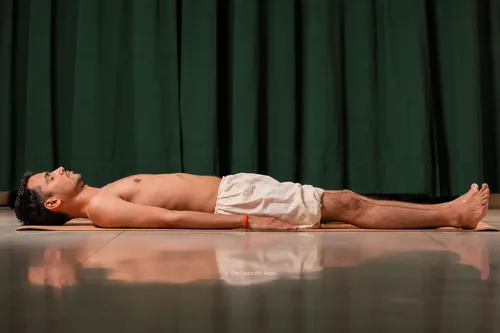 शवासन
Straighten the legs and lie down on your back. Legs a little apart, arms beside the body. Eyes closed. Now chant AUM three times, and feel the resonance travel the whole body.
6onward
Śānta is the centre: every road from the other lamps ends here.
Why this
Bharata names eight rasas, and śānta is not among them. One manuscript adds a passage on śānta that Ghosh calls spurious (his note to VI.82). So it has no colour, deity or note from Bharata. Its lamp is the site's own gold, turned low, and that colour is ours.
Bharata gives śānta no tempo and no voice. Its beginning, aloud and slow, is ours.
Bharata wrote for an actor and an audience. Here you are both, and all of it is turned toward God. That turn is ours, not Bharata's.
It is the breath for numbness, and on that path it is the word as well. When nothing is felt the mind has stopped, and this verse asks for one thing, that it be set moving.
गायत्री: A request for the mind to be set moving, made to the light that moves everything else.
On this site it serves: The long grey, Attention and memory.
Of Prahlāda's nine ways of bhakti (Śrīmad Bhāgavatam 7.5.23), this sitting really contains these: कीर्तन, aloud · स्मरण, in the mind · वन्दन, bowing. That every rasa can be turned toward God is Rūpa Gosvāmī's teaching, in his Bhaktirasāmṛtasindhu.