Photographs, and what is inside them

What it takes to be a Jyotirgana

Thirteen pictures from one month in western Rajasthan.
Every one of them holds something you could never know by looking.

Everyone assumes it is the yoga.

It is not. The yoga rebuilds a body that has been borrowed against for years, and that matters, and we have measured it. But what makes a Jyotirgana happens long before any of us arrive, and it is not something a person would ever choose.

You have to have lost it all.

A man who still holds his standing, his savings, his family's good opinion of him, has something left to protect. And a person with something to protect surrenders nothing. The man who has already lost every one of those things has no defences left worth defending.

That is not his tragedy. In this work it turns out to be his qualification.

Surrender all that we are, and become what we truly are.

Everything below is that sentence, happening to somebody.

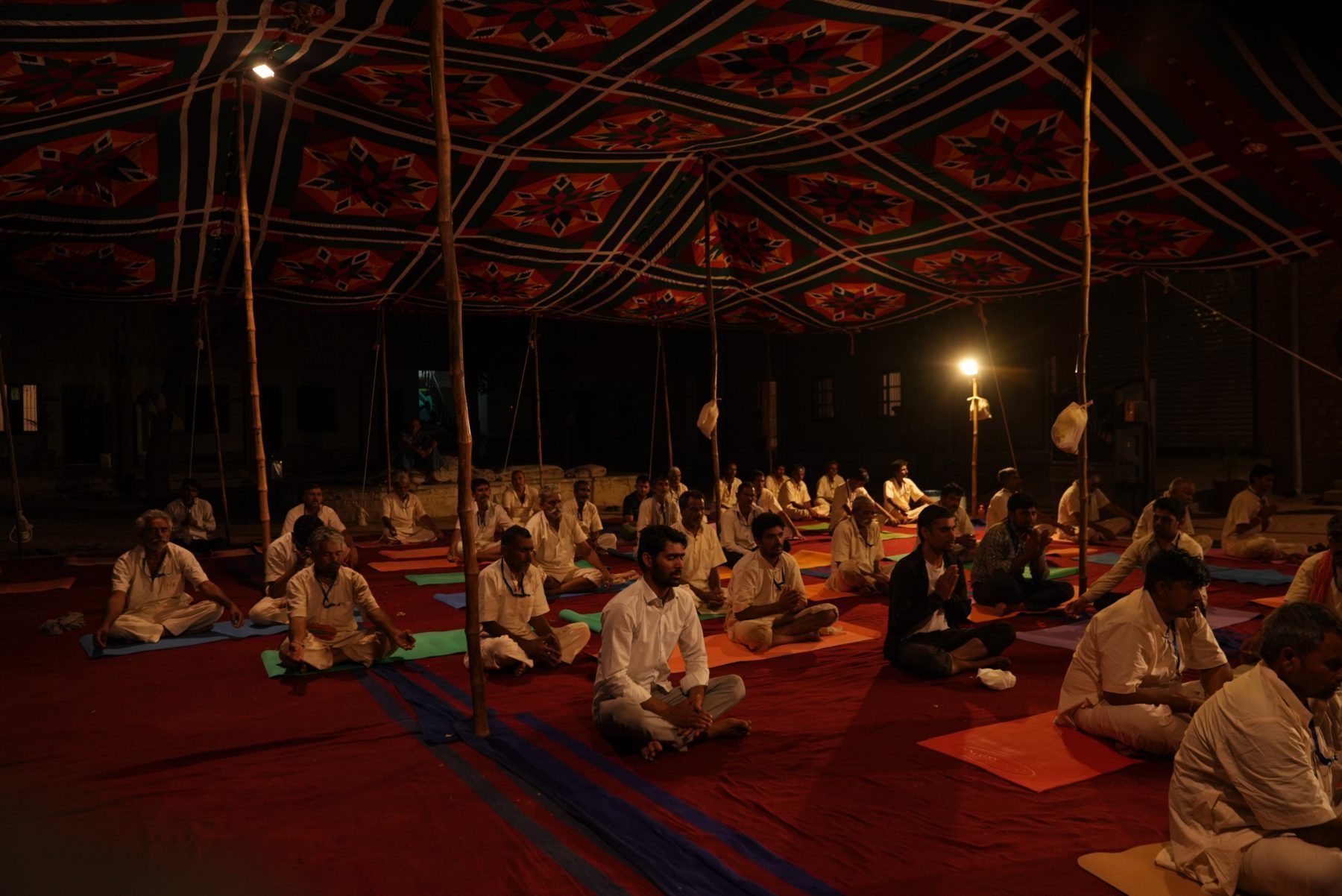
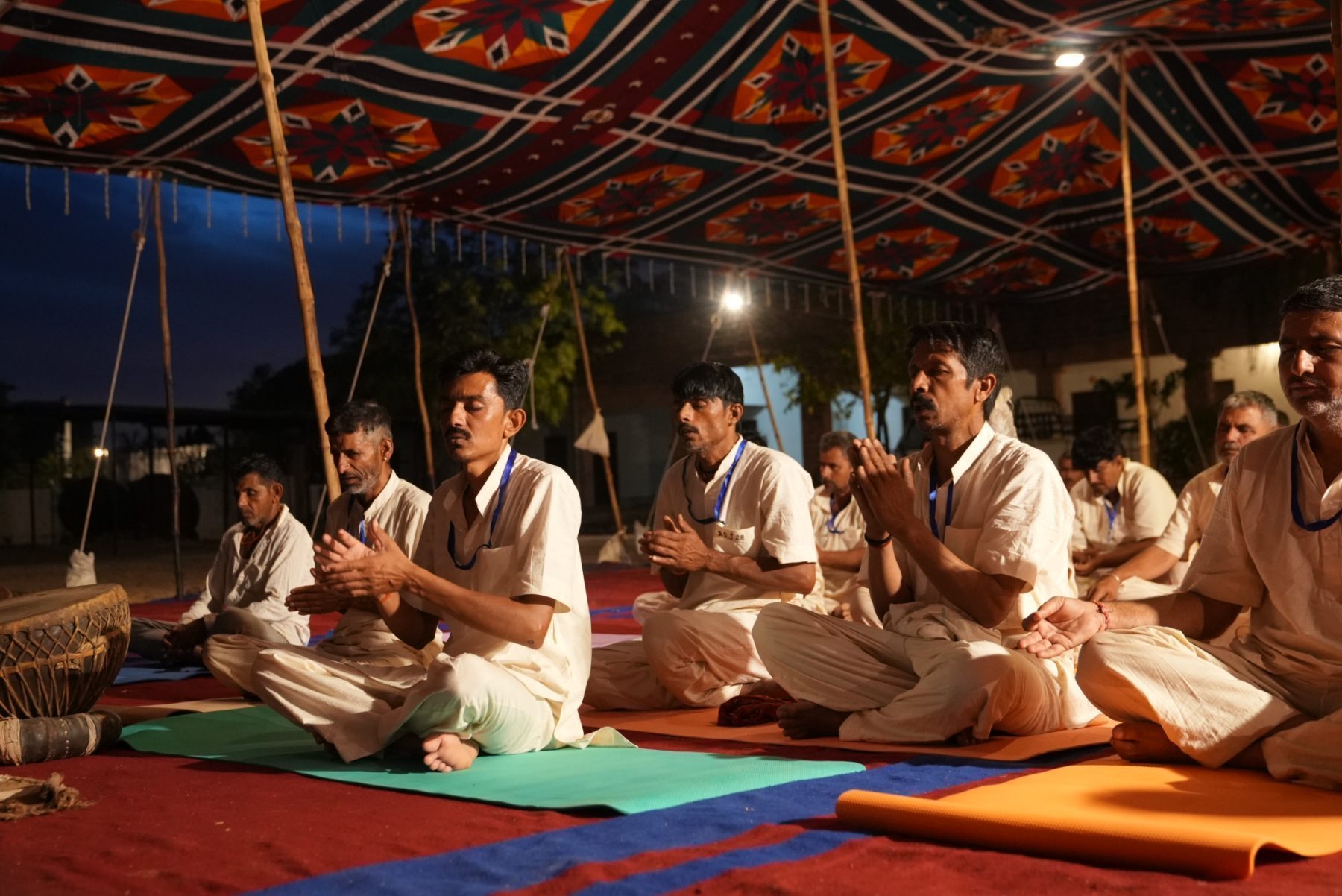
Men seated on the ground under a patterned canopy at night, hands joined, eyes closed, a drum at the edge of the frame.
01

When there was no one left to tell

They are speaking to the only one who never turned away.

The story

Nobody decides to become a Jyotirgana. You cannot apply for it. You cannot qualify by being strong, or clever, or good, and if you could, not one of the men in this photograph would be sitting here.

You arrive at it the way you arrive at the bottom of a well.

First the friends stop coming. Then your brother stops arguing with you, which is worse, because as long as he argued he still believed you could be reached. Then your wife stops crying where you can see her and starts crying somewhere else. Then your son learns to walk quietly past the room.

Nobody slams a door. They simply run out. One by one, softly, every person you could have gone to becomes a person you cannot go to, and you are left standing in a house full of your own family with nothing you can say to any of them.

This was taken at dusk. Look at their hands. Look at their eyes, which are closed. There is nobody in front of them. No counsellor, no doctor, no relative arrived to check whether they have taken it today, nobody with a form and a pen.

They are speaking to the only one who never turned away. Who never once asked where the money went. Who was never ashamed to be seen with them.

They had already lost everything. So at the end of the day they gave that away too, which was the only thing they had left to give.

A Jyotirgana does not belong to us, and does not belong to the programme, and does not in the end belong even to himself. He belongs to the One who kept the light burning the whole time he was gone.

The whole camp seated on coloured mats across a red floor covering at night, lit by a single lamp.
02

One mat

Look for the staff in this photograph. You will not find them.

The story

There is no row at the front. No chairs at the side for the people running things. No separate arrangement for the ones with degrees. The instructors and the researchers are sitting on the same floor, on the same mats, in the same dark, doing the same thing at the same time.

This matters far more than it looks.

Every man here has spent years being handled from above. Doctors above him. Police above him. Elders above him. His own children, in the end, above him. Everybody speaking down. He has been a case, a problem, a burden and a shame, and even the kindness arrived from a height.

Here nobody is above anybody, because the roof is the sky and the one being spoken to is the same for all of them.

In front of the Divine there is no addict and no researcher, no one who cannot read and no one with a doctorate, nobody from the village and nobody from the city. There are only children, and not one of them is the favourite.

Ask us where the recovery actually happens and we will not point you to the morning class. We will point you here.

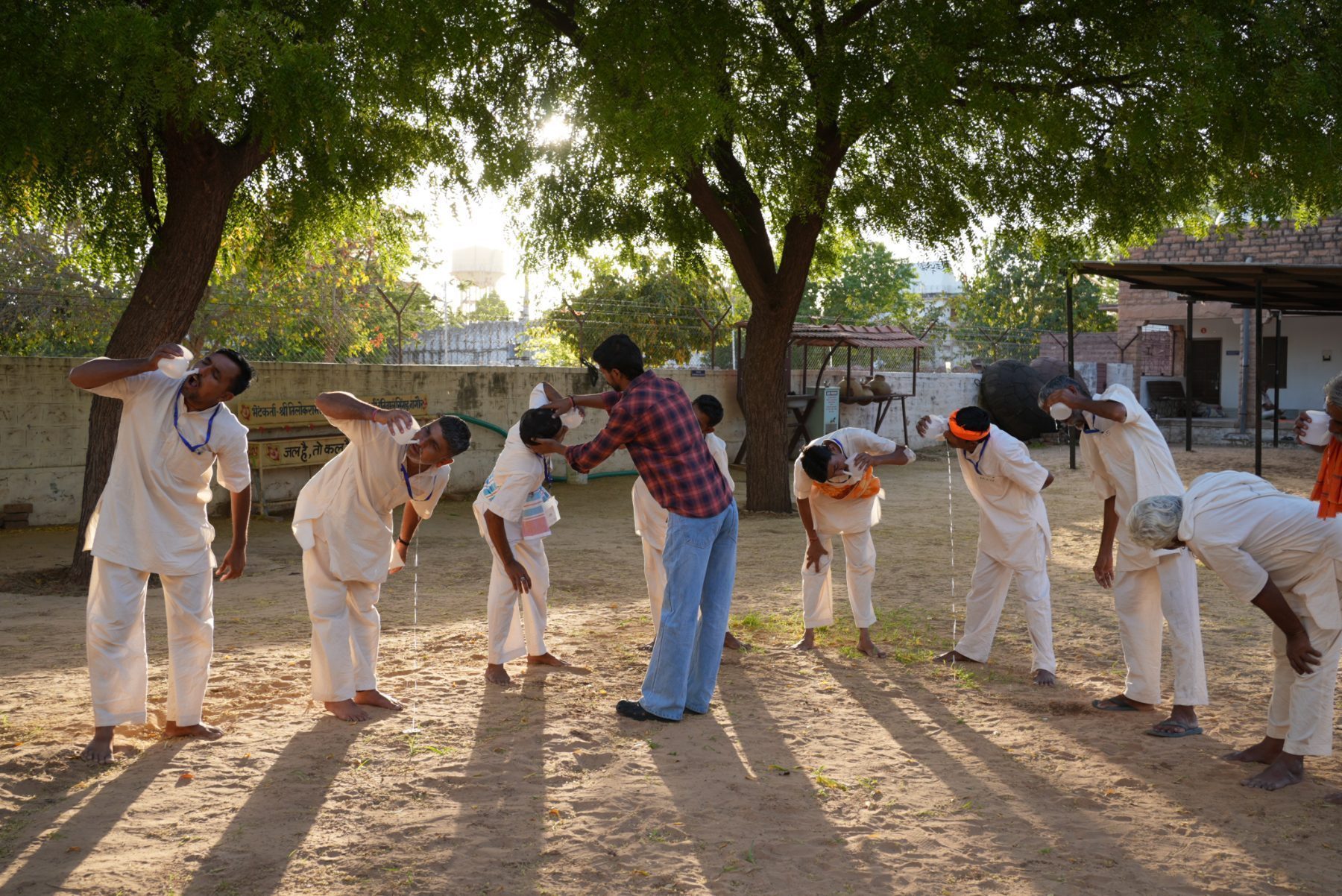
Men bent forward in a sandy yard at sunrise during a cleansing practice, one of the team pouring water and steadying a head, long shadows across the ground.
03

The one who drank the poison

He is not the failure of that village. He is the one it handed the poison to.

The story

You are looking at a yogic cleansing at sunrise, in the open, where everybody can see. Before you decide what that is, let us tell you what we think we are watching.

When the ocean was churned, the first thing to rise was not the nectar. It was the halāhala, the poison, and it was so terrible that neither the gods nor the demons would go near it. Everything that had been done was about to be wasted, because somebody had to take the poison before anybody could have the nectar, and nobody would.

Then Śiva came and drank it. Not because it was his fault. Not because he deserved it. He took it because it was there, and because somebody had to, and because he was the one who could hold it in his throat and live.

Only after that did the amṛta come.

The ones who follow Śiva are called his gaṇa. Look at who they are in every story we have. The strange ones. The ones who do not fit. The ones no respectable household would seat at a wedding.

We call these men Jyotirgaṇa, and we mean it exactly.

A village has an appetite for opium that runs through its ceremonies, its condolences, its hospitality and its harvests. It is offered by elders. It is handed across at gatherings. And somewhere in that village a man ends up carrying the whole weight of it in his own body. It is his name that gets ruined. It is his family that is pitied. Everybody else carries on.

He is not the failure of that village. He is the one it handed the poison to.

Now look again at what he is doing at six in the morning with his eyes streaming.

He is getting it out. All of it. So that the nectar can come, and not for himself alone. For the wife who stopped crying in front of him. For the son who learned to walk past the room. For the boy in his lane who is fifteen and has just been offered his first one.

Nobody thanked him for taking it. He is going to hand back the nectar anyway.

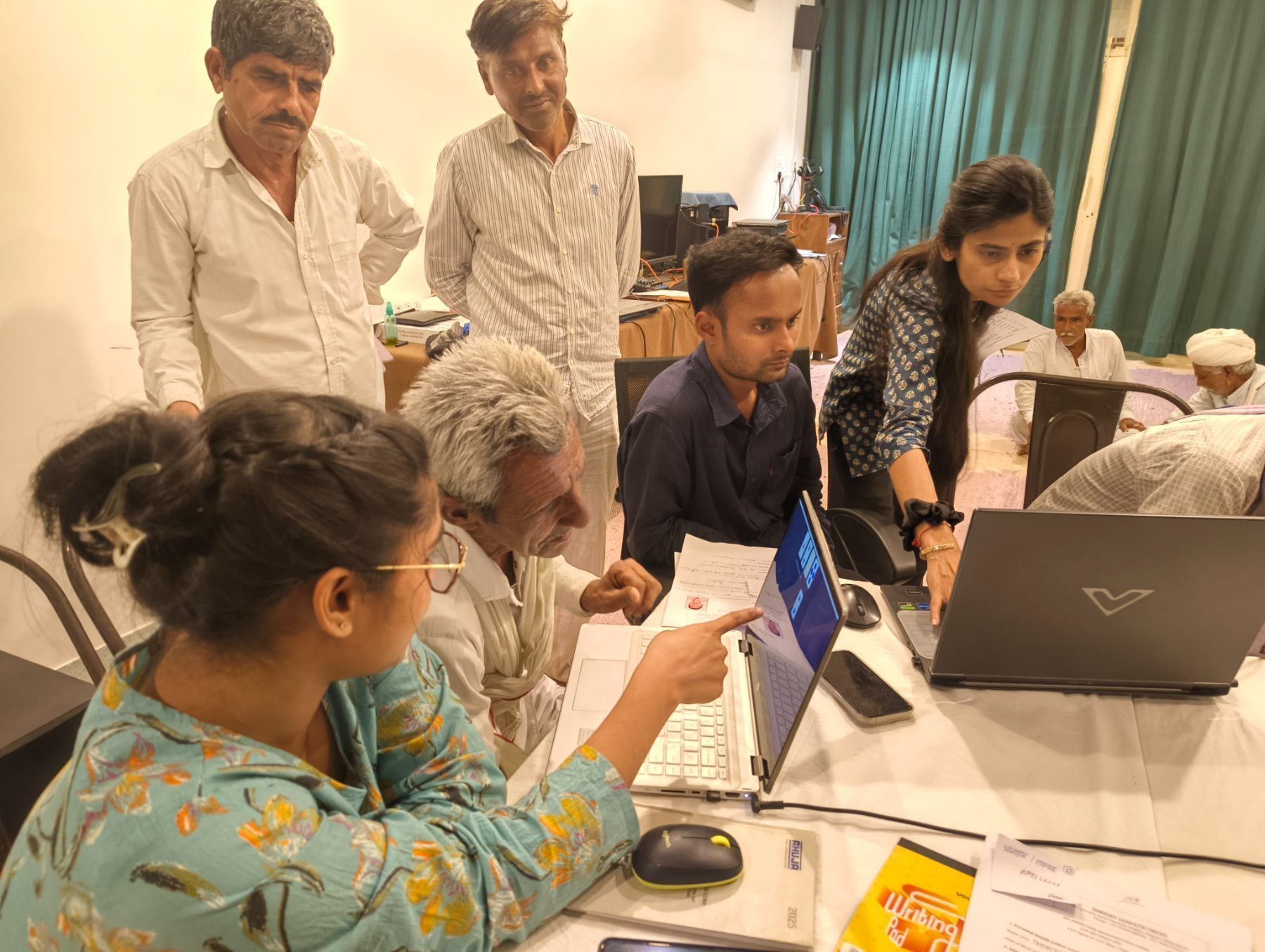
Two young women from the research team guiding participants through a computer-based assessment, an older man concentrating at the screen, others waiting their turn behind.
04

The way you would explain it to your own grandfather

There is a version of this project in which this photograph does not exist.

The story

This is a cognitive function test.

In that other version of the project, somebody sensible says: these are farmers, most of them did not finish school, several cannot read what is on that screen, it will take all day, and what exactly is the point. The hard assessments quietly get dropped for the hard population. Nobody writes that decision down anywhere. Everybody agrees it was practical.

We did not do that. Every man in this camp was offered every assessment. There was no literacy bar. Nobody was set aside as too old, too rural or too far gone to be worth measuring properly.

And it was hard. Look at the man seated at the screen, in his sixties, concentrating with his whole face. Behind him others are waiting their turn on their feet, because they would not sit down while it was somebody else's turn.

Now look at the young women.

They are leaning in, pointing at the screen, saying it again. And then again, another way. The way you explain something to your own father when he cannot follow it and you love him, so you do not sigh, and you do not glance at the clock, and you keep finding new words until one of them lands.

Not one question was treated as a stupid question. Every single one was treated as the asset it actually is.

A man who has been written off by everybody is handed a test that assumes he can do it, and somebody stays beside him until he can. That is not data collection. That is the first time in years that anyone has expected something of him and then waited.

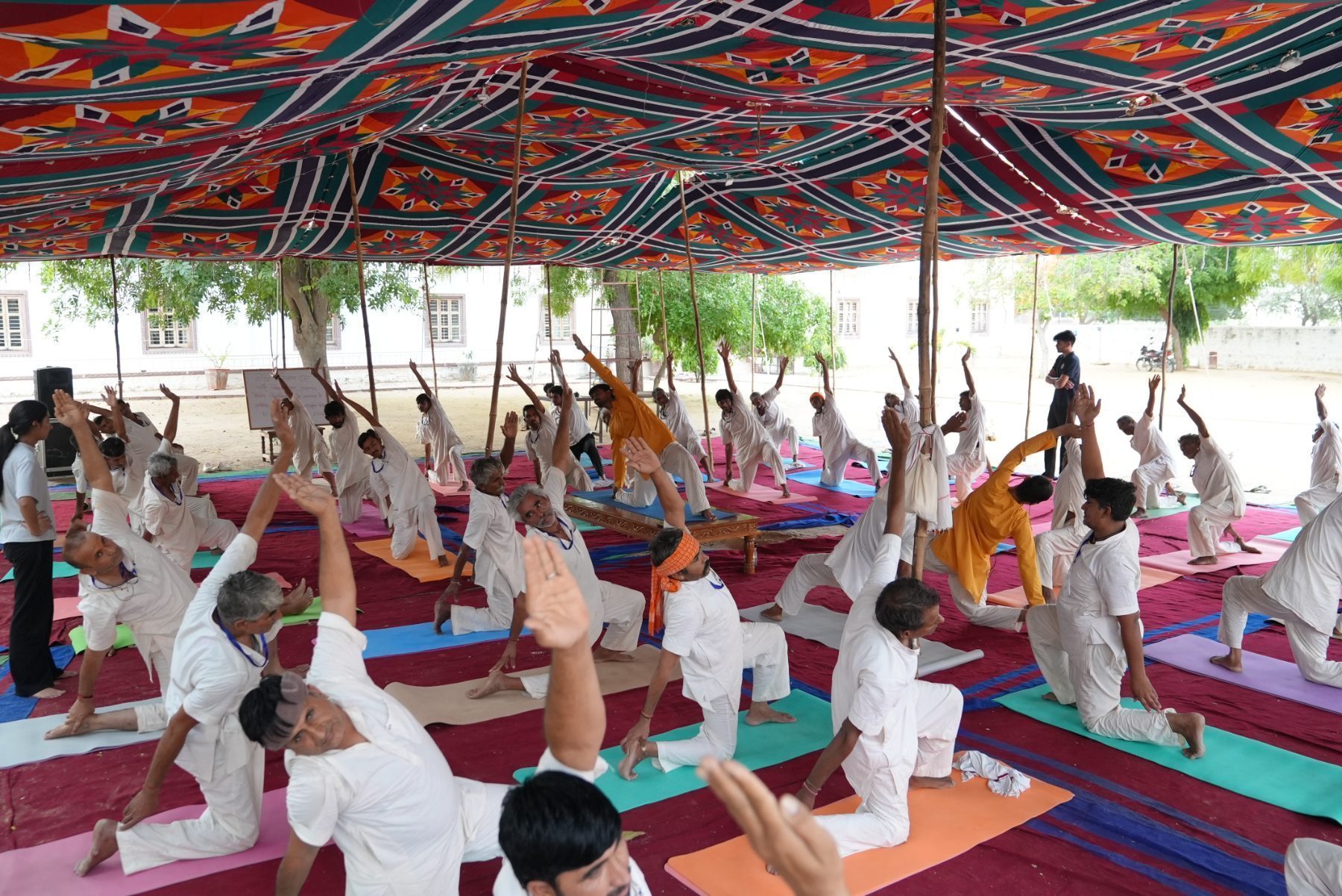
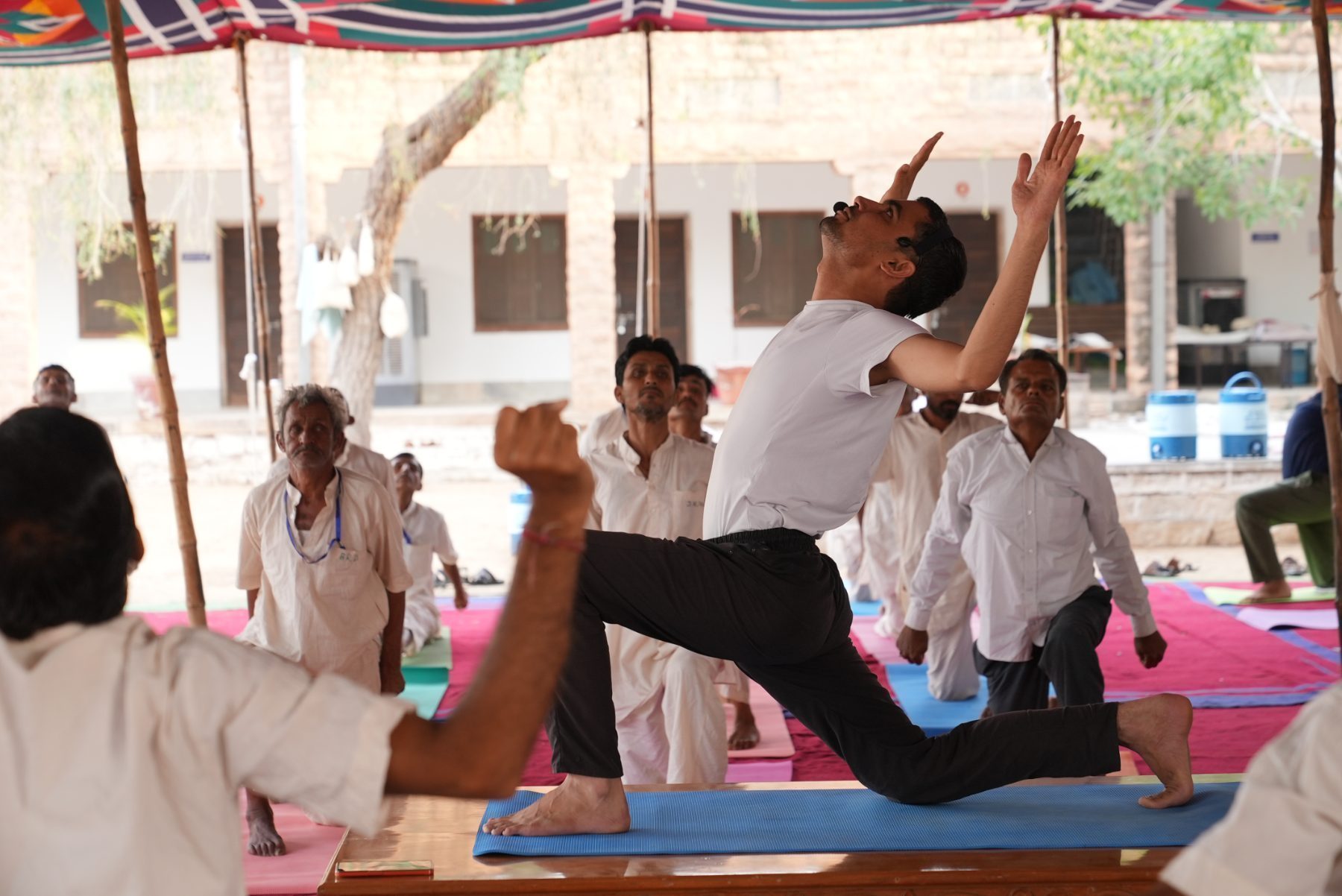
A full class holding a demanding kneeling posture with arms raised beneath a bright canopy, an instructor demonstrating on a low wooden bench.
05

A rehearsal for the craving

He is not learning a posture. He is meeting the man who was in there all along.

The story

Nobody explains this part properly, so let us.

The postures started easy. Over the weeks they got harder, and then genuinely demanding, until these men were holding shapes their bodies did not want to hold, for longer than their bodies wanted to hold them.

That was the point, and it was never about fitness.

Here is what a craving actually is. A sensation arrives in the body. It is not an idea and you cannot argue with it. It says now, and it says it in the chest and the gut and the skin, and it will not stop saying it. Every man in this photograph knows that voice better than he knows his own. And every one of them had learned, over many years, that when the body speaks in that voice, the body wins.

Now look at what he is doing.

He is holding a posture. His thighs are burning. His shoulders are asking to come down. The sensation is loud and physical and immediate and it is saying now, and he is not obeying it. He is breathing. He is staying. He is letting it be as loud as it wants to be.

And then it passes.

He has just rehearsed, in his own muscles, the exact thing he will have to do alone in his village in two months' time.

While he holds it he is taught to move his attention slowly through his body. Here is where it hurts. Here is where it is quiet. Here is where the pain is already going. For a man who has spent twenty years leaving his body, this is an extraordinary thing to do. He is going back inside it, room by room, finding out what was done to it while he was away, and in the same breath finding out what it can still do.

He is not learning a posture. He is meeting, a few seconds at a time, the man who was in there the whole while, underneath everything the substance piled on top of him.

That man was never destroyed. He was buried. And every morning, for a little longer than the morning before, he gets out.

An instructor demonstrating a deep chest-opening lunge on a low wooden platform while the class follows beneath the canopy.
06

Jāmbavān's work

Hanumān sat on the shore and did not volunteer. He had forgotten what he was.

The story

There is a moment in the Rāmāyaṇa that nobody puts on a poster.

The army has reached the sea. Somebody has to cross it, and nobody can, and the whole campaign is about to end there on the shore. Hanumān is sitting among them. He does not volunteer. He does not think it is him. He has forgotten what he is.

So Jāmbavān stands up and does the only thing that was needed. He does not give Hanumān strength. He tells him what he already has. He reminds him whose son he is, and what he did as a child, and what is still in him.

And Hanumān stands up and crosses the ocean.

That is the whole of this photograph.

These are the postures dedicated to Hanumān, and the Bajrang Bāṇ is playing on the speaker while they are done. Notice the shapes. Almost all of them open the chest. The heart goes forward and up, the arms go back, the throat is exposed. Then the lunge, the body gathered and tilted like something about to leap. Then the palms folded.

Courage. The plunge. Devotion. In that order, every morning.

A man who has been called an addict for fifteen years does not need to be told he is weak. He has heard it. He believes it. He agrees with it, which is the worst part.

What he needs is somebody to stand up like Jāmbavān and remind him what is still in there. Not to give him anything. To tell him what he already has.

The ocean these men have to cross is not made of water, and the Laṅkā they are going to burn is not a city. But look at the chest in this photograph, and the folded hands, and tell us that is not somebody remembering who he is.

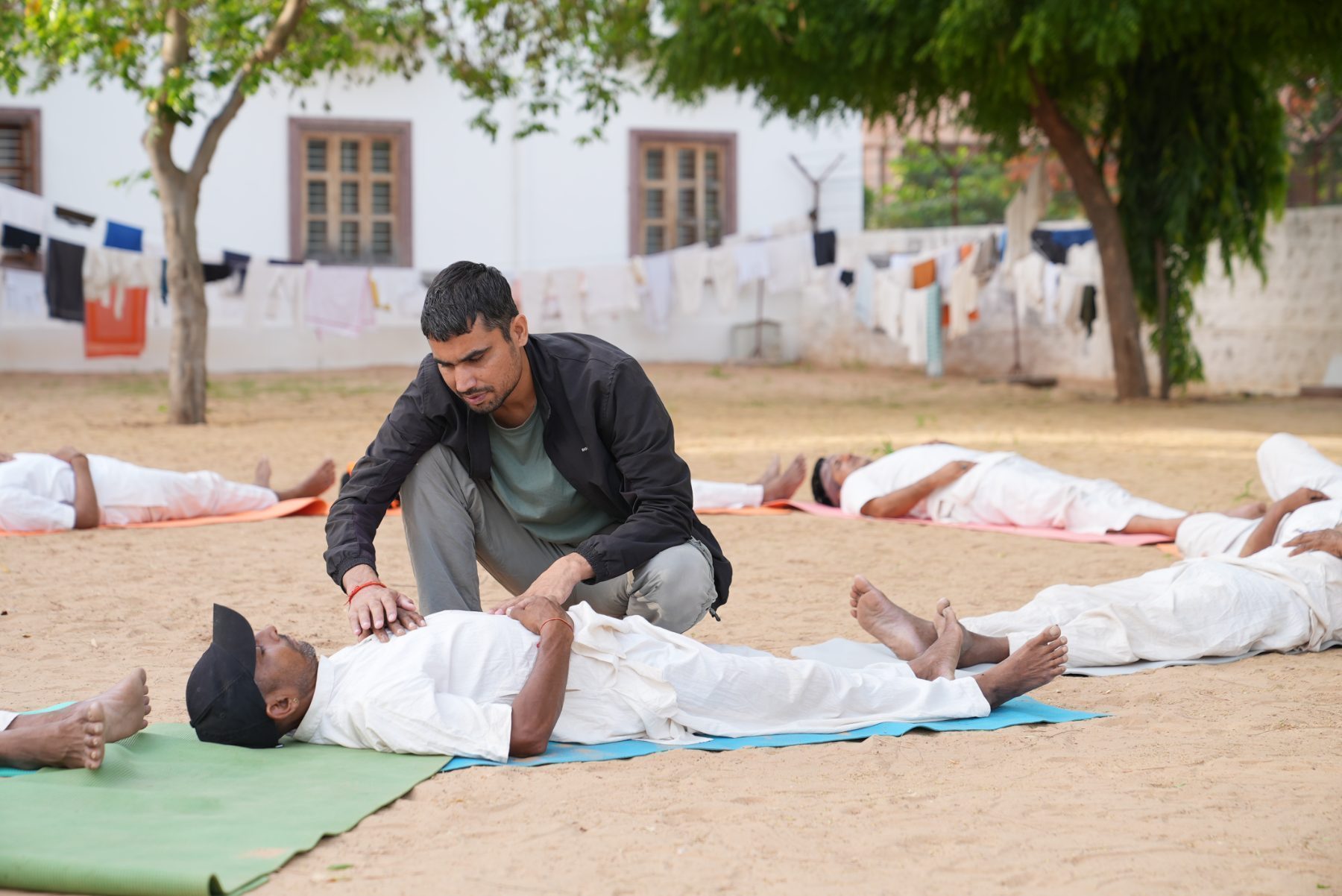
An instructor kneeling in the sand with both hands resting on the chest of a man lying in shavasana wearing a black cap, others resting nearby.
07

The cap

He asked for a cap the way a boy asks his father. Somebody took off his own.

The story

This is the most important thing about the programme, and it is not in the protocol, and it cannot be taught in a training.

You cannot reach these men with technique. You can be perfectly correct, follow every step, sequence it beautifully, and get nothing. They are not difficult. They are the opposite of difficult. They are like children, wide open and completely without defence, and a child knows instantly whether you love him or are managing him.

So you do not teach. You do not instruct. You do not counsel.

You love them. All the time. When they cooperate and when they revolt, when they are grateful and when they are unfair, when it is easy and when they have said something that would make anybody else walk away. You just love them, and you keep loving them, and that does the work nothing else could.

Here is what that looks like on an ordinary afternoon.

One of the men had his head shaved. The others were teasing him about it, the warm sort of teasing, but he felt it. He came to one of our seniors the way a boy goes to his father, and said:

I need a cap.

The man took the cap off his own head and put it on his.

That is all that happened. Nobody made a speech. And he wore that cap every day afterwards, and not because his head was cold. He wore it like a medal. On the days when the pull came back, and it comes back, that cap was somebody saying you are one of us without having to say it.

He is wearing it in this photograph. He is lying down, and somebody's hands are on his chest, and he is being taught how to breathe.

Think about that. Nobody had ever taught these men to breathe. Nobody had ever thought to check. The world was too busy being disappointed in them to notice whether they were getting enough air.

So we put a hand on the chest. Not as a technique. As the thing a hand is. And under a hand that means you are loved, the breath goes deeper on its own, because the body finally believes it is safe enough to let go.

They learn it in minutes. Not because we are good teachers. Because it was given by love, and love is the only language they were ever fluent in.

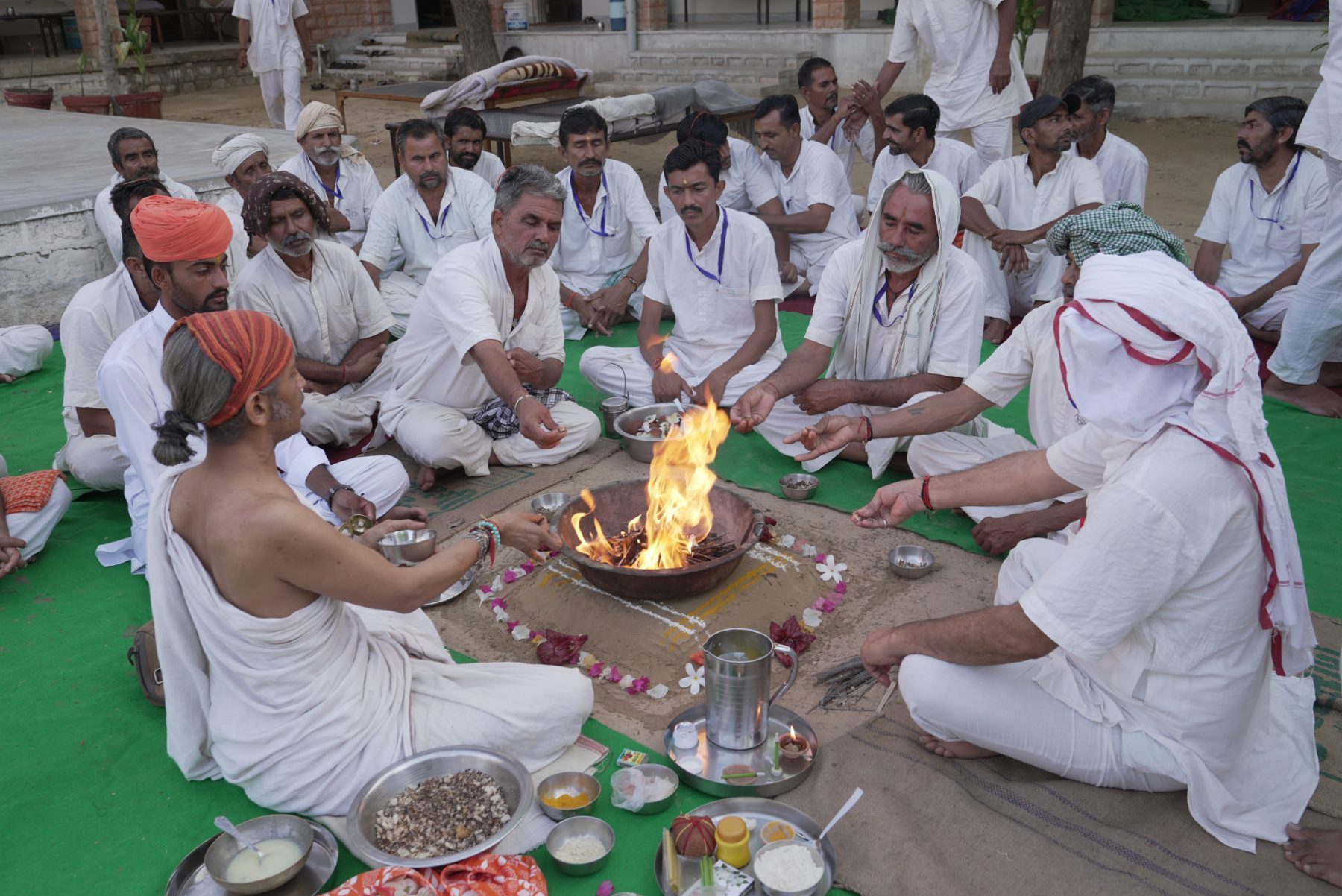
A havan in progress: a copper vessel with fire on a bed of sand ringed with flower petals, offerings being made by seated participants.
08

Are we pure enough?

It may be a sin for us to sit there, they said. They were not refusing. They were frightened.

The story

Ask any of them what they are, and for years the answer had only one word in it.

Not father. Not brother. Not son, not neighbour, not the man who repaired your pump last summer. Just addict. That is the entire name a village gives you, and once it has been given it is the only name you answer to. You are not called to the wedding. You are not called when the child is named. On the days when the whole street is happy, you are the one everybody hopes will stay indoors.

So when we told them there would be a havan and that they would be sitting at it, several came to us privately. They did not refuse. What they said was more frightening than a refusal.

It may be a sin for us to sit there.

Understand what that sentence costs. These are men who love that fire. They grew up beside it. Their grandmothers taught them to fold their hands to it before they could read. And somewhere along the way they came to believe, because they had been told in a hundred small wordless ways, that their presence would spoil it.

It took constant trust to move them. Not persuading. Insisting, over and over, that they were wanted, and that the fire was theirs as much as anybody's.

And then, in a district that does not let its daughters sit close to a yajña and has certainly never let one lead it, the young women of our team conducted the whole ceremony. They made the arrangements. They sent out the invitations. They sat at the fire and did the priest's work.

And the men who had asked whether they were clean enough to attend were seated as yajamān. The ones for whom the fire is lit. In whose name every offering is made. Without whom there is no ceremony at all.

They were not allowed in at the edge. They were placed at the centre. They were prayed for by name, and then they were asked to pray for everybody else in that courtyard.

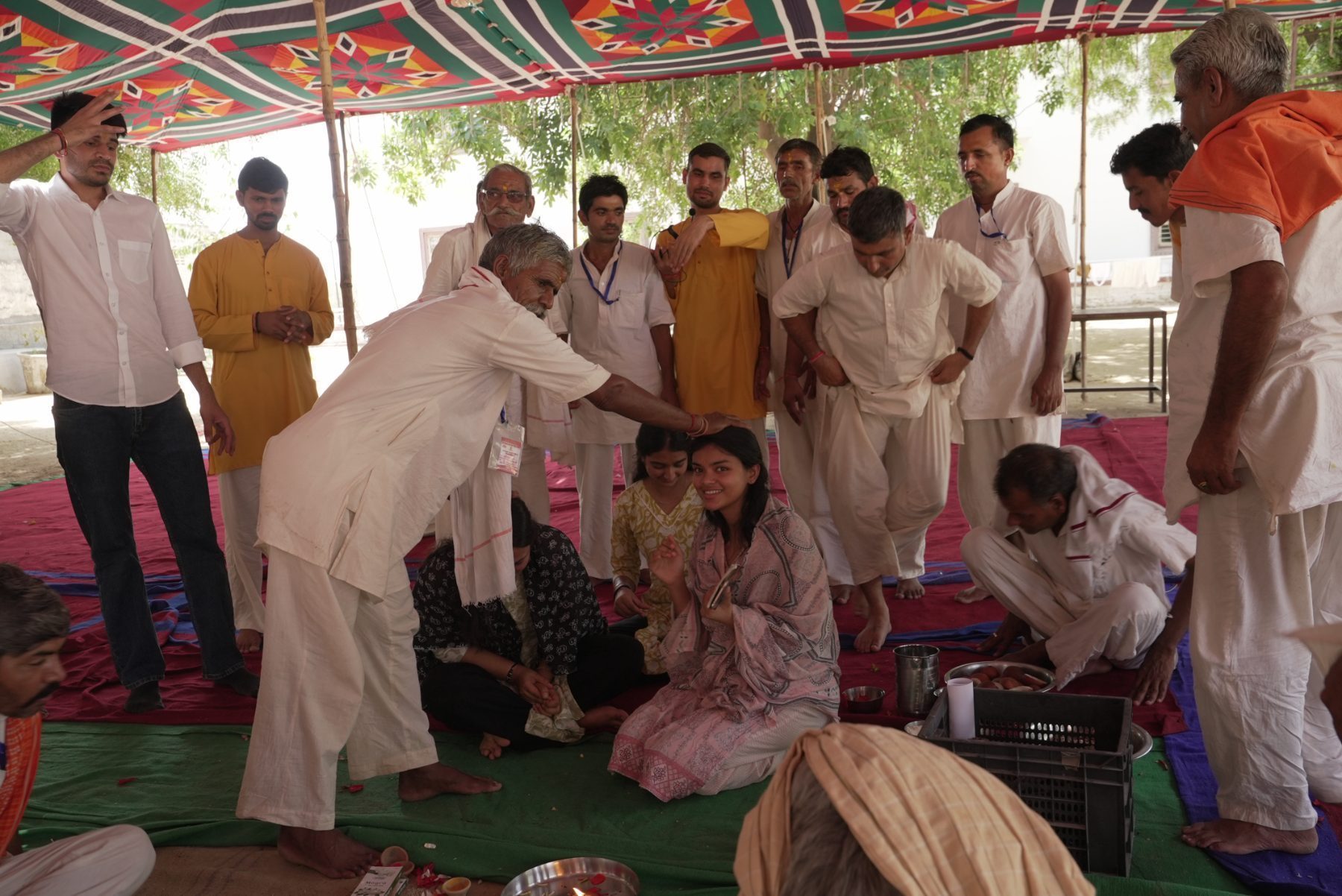
Under the canopy, an older participant leaning down to place his hand on the head of a young woman from the team, who is smiling, with a lamp and offering plate on the ground.
09

Could our girls also learn to do this?

They had no money for dakṣiṇā. So they gave the only thing they had left.

The story

When the fire went out, the men came straight to the young women who had conducted it.

And they were ashamed, because you are meant to give dakṣiṇā to the one who performs your rites, and not one of them had a rupee.

So they gave the only thing they had left. They put their hands on the heads of girls their own daughters' age, and they blessed them.

And then one of them asked the question.

Could our girls also learn to do this?

Nobody was lectured that day about the worth of daughters. Nobody was told their customs were backward. Nobody from outside corrected anybody. They watched, and something turned over in them, and they went home having decided that their own girls would learn to sit at that fire.

The region has a reputation. These men do not. In one afternoon they changed the thing that no campaign and no outsider had managed to change, and they changed it themselves, because they wanted to.

We had gone to that district to treat opium dependence. That is what the study measures and that is what we will defend in front of anybody.

But a camp is never really about the addiction. It is about what becomes possible in a person once he has nothing left to protect.

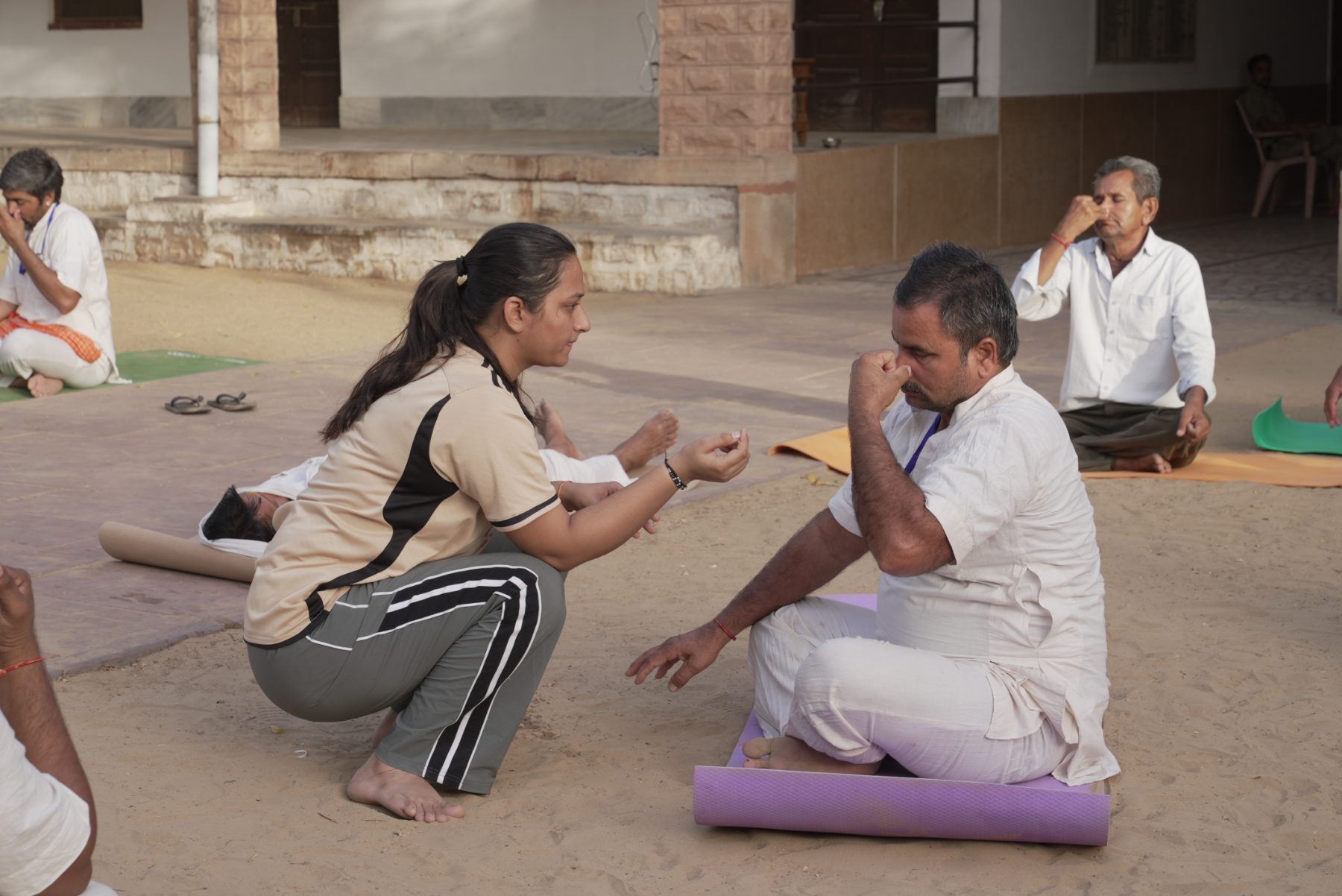
A young woman instructor crouching in a sandy courtyard, showing the hand position for alternate-nostril breathing to an older man seated on a mat.
10

Guided, the way you guide your own father

He is listening. Carefully. To her.

The story

Nobody here is mocked. Nobody is made to feel slow.

Watch how it is actually done. A young woman crouches down beside a man old enough to be her grandfather and shows him where the fingers go, and shows him again, and waits.

It is exactly how a grown daughter helps her ageing father with something he cannot manage any more. Close, unhurried, without a trace of impatience, and above all without making him small for needing it.

Remember where this is happening. This is a part of the world where a girl is not expected to lead anything, and certainly not to instruct her elders.

Now look at his face while she teaches him.

He is listening. Carefully. To her.

Nobody argued him into that. It happened because she was patient and she knew what she was doing, and because he had stopped needing to be the one who knows.

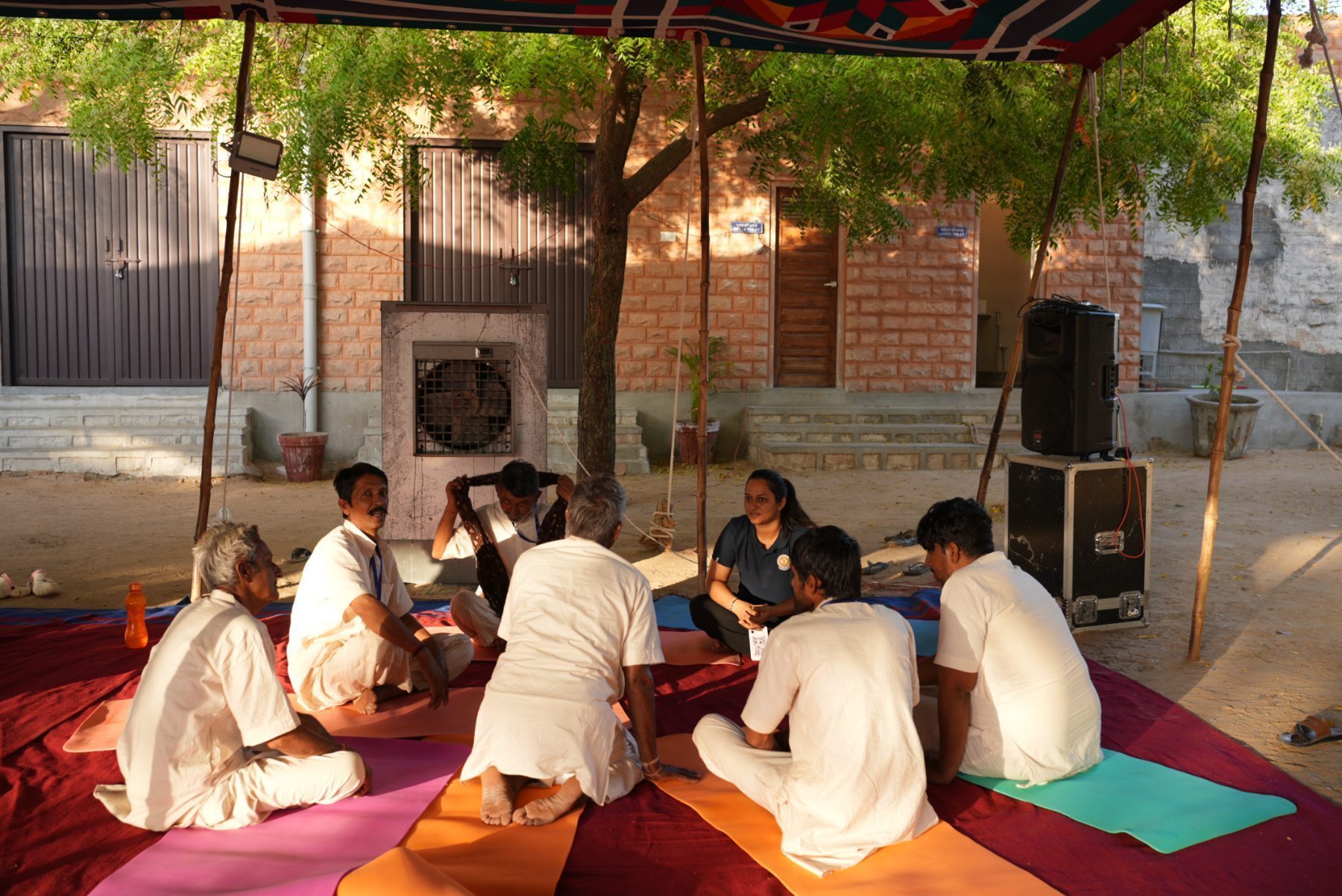
A small circle of participants seated on coloured mats under the canopy with an instructor sitting among them, one man practising with a cloth at his face.
11

Every question is an asset

A man who asks a question has decided he is going to be here tomorrow.

The story

This is peer leader training, and the first thing to notice is who is teaching.

There is no age bar. The older men lead too, and the younger ones sit and learn from them, and then it turns around. One of our instructors is in the circle rather than at the front of it, stepping in only where she is needed.

The second thing to notice is what happens to a question here.

Nothing gets waved away. Nothing is too basic, too repetitive, too obvious. Every single question is treated as valuable, because it is.

In this work a question is not an interruption. It is the best news of the day.

Look at their faces. Look at how comfortable they are, leaning in, listening to each other, saying things out loud in front of other men. These are people who spent years being spoken about and not spoken to.

And once again a young woman is inside that circle and every man in it is listening to her. In that district, that is not a small thing. That is the change, happening quietly, while everybody is busy talking about breathing.

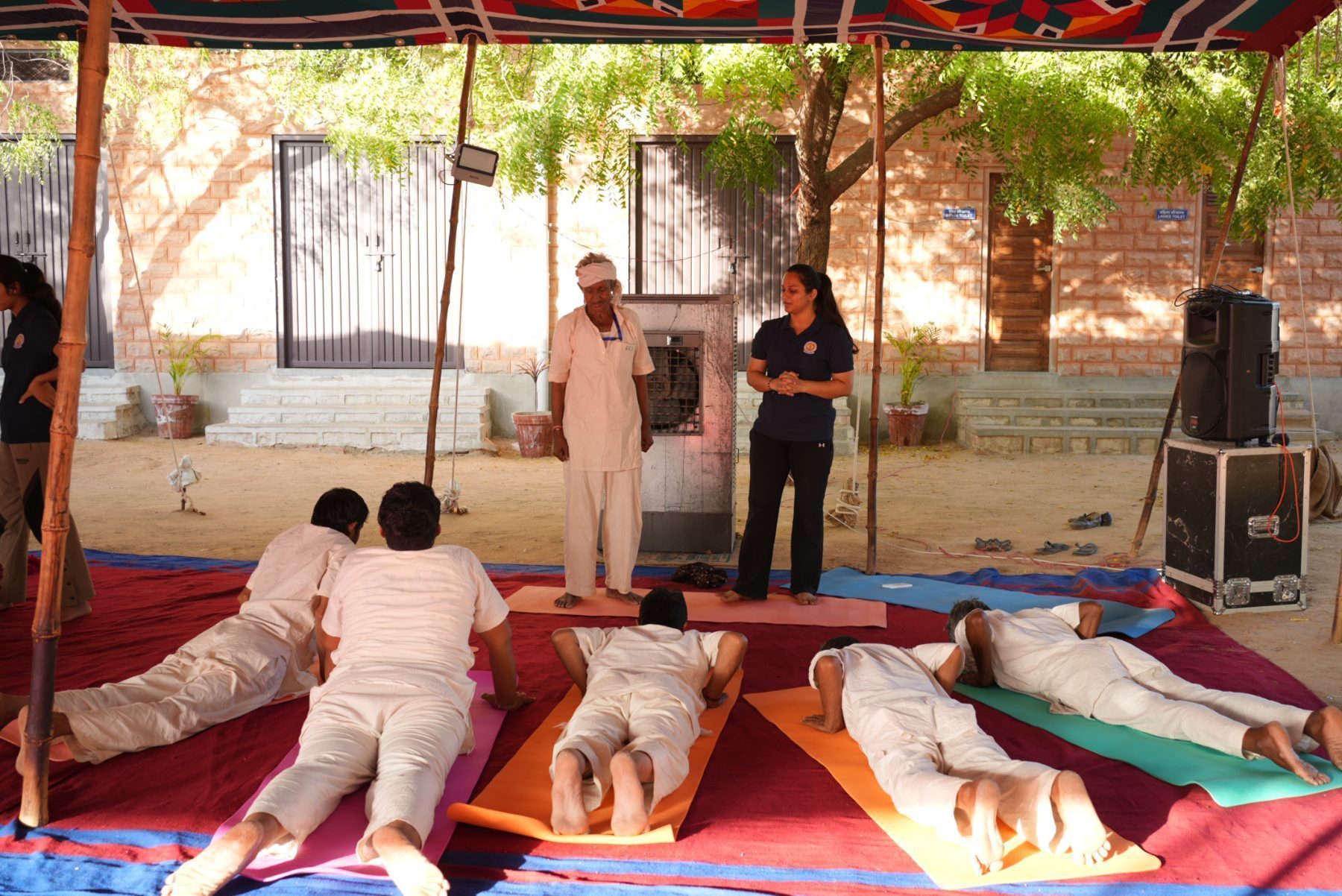
Participants in bhujangasana on coloured mats under the canopy, an older man leading them, instructors standing close by.
12

A commune of their own

The commune that threw him out has been rebuilt out of the people it threw out.

The story

They did this every day for thirty days, and the entire final phase of the training was built on it.

The rule was simple. The roles rotate. Nobody is permanently the one who helps and nobody is permanently the one who is helped. This morning you guide, and tomorrow morning the man you guided guides you. The older ones lead as often as the young ones do.

Our instructors and experts sat at the edge and watched, and stepped in only when they had to. That is the whole method. They are never left alone with it, and they are never taken over.

Read that again, because it is doing something much larger than it sounds.

A man who was thrown out of every gathering in his village has found a gathering that is his. A man who stopped believing anybody would help him is being helped by somebody exactly like him, which is the only kind of help he can still accept. A man who stopped believing there was anything left inside himself is standing in front of others and finding out there is. A man who lost every reason to get up has been handed one, and it is not a reason anybody gave him. It is somebody else's recovery, on the mat in front of him, waiting.

The commune that threw him out has been rebuilt in a courtyard, out of the people it threw out.

All any of them needed was somebody who would stand beside them and believe they could. The rest they can do.

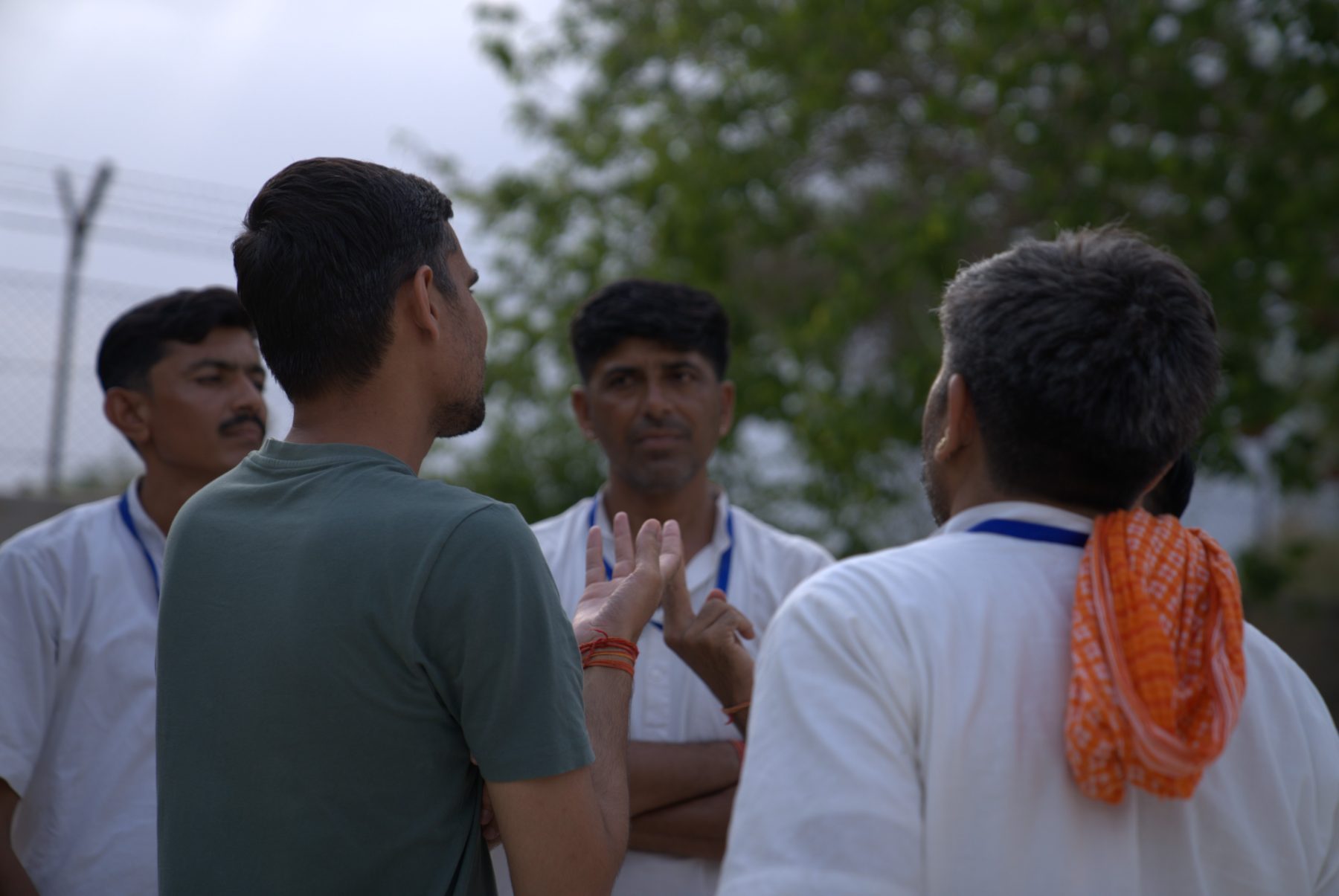
Under a grey sky, a member of the team standing with a small group of participants, one of them speaking with his hand raised, faces serious.
13

The evening before the last day

One day before the end, it nearly collapsed. And then it turned on us.

The story

We are putting this on the website because leaving it out would make everything above it a brochure.

A promise had been made to these men by the administration. It was not kept. And the reason it was not kept was the oldest reason there is: somebody who had come in late looked at them and decided that people like this could not be trusted, and made that feeling into the atmosphere of the place. Then it happened again. And then again.

Try to feel what that does at that particular moment.

They had done the thirty days. They had stood up before dawn. They had held the postures. They had cleaned themselves out in front of each other. They had sat at a fire they were sure would reject them. They were a day away from going home as different men.

And in that last week they were told, without anybody actually saying it, the one sentence they had spent a month learning to disbelieve.

People like you cannot be trusted.

It broke them. Not disappointment. Humiliation. The old, familiar, complete humiliation, arriving at the exact moment they had let their guard down. It felt to them like losing everything all over again.

And then it turned on us.

They did not know what had happened behind the scenes. All they could see was that we were the ones who had brought them here, and a promise had been broken, so it must be us. The suspicion spread. Faults were remembered. A month of trust started coming apart in an evening, and men who had been our brothers that morning were looking at us like people who had used them.

We could not face them at first. We had argued their case with the administration more than once and got nowhere, and we had nothing to show them except the fact that we had lost.

Then we understood what was actually at stake, and it was not our reputation.

If a single one of these men went home believing he had been fooled, that the whole thing had been a performance, that he had let himself hope again for nothing, he was going back into the darkness. And he would not come out of it a second time.

Losing our standing was nothing next to that. So we walked into the middle of them.

We did not defend ourselves. We let them say all of it. The accusations, the anger, the enmity, every bitter thing a month of hope turned inside out can produce. We stood there and took it and did not answer back.

And slowly, because they watch everything far more closely than anybody gives them credit for, something in that circle changed. The shouting stopped. They looked at our faces properly. They came closer. And somebody asked, in a completely different voice:

What actually happened?

So we told them. All of it. What was promised, who had said it, why it had not come, what we had done to try, and where we had failed. Nothing held back. Nothing protected. Not a single thing kept as an administrative matter, because it was not an administrative matter, it was entirely theirs. We knew what it might cost us upstairs. We had already decided that was the cheaper loss.

And the moment we stopped protecting ourselves, it ended.

It did not take an inquiry. It did not take an apology from anyone above us. It took a few minutes of standing in front of people we loved and telling them the whole truth about our own failure.

The cloud lifted off that courtyard and did not come back.

सत्यमेव जयते. We did not win that evening by being right, or by being in charge, or by having anything left to offer. We won it by loving them more than we minded being blamed.
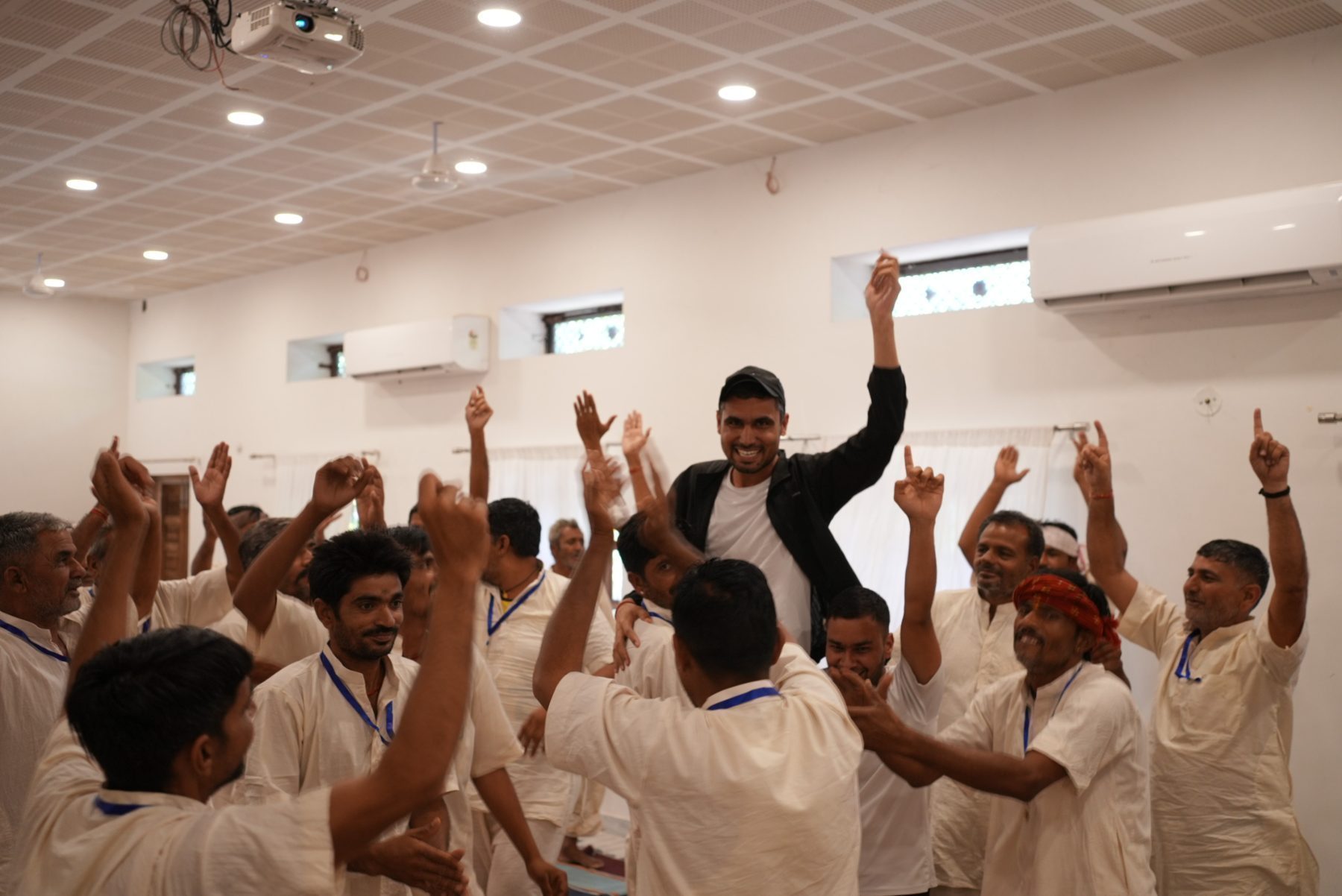
Inside a hall, a member of the team lifted up on the shoulders of participants, everyone with their arms raised and shouting.
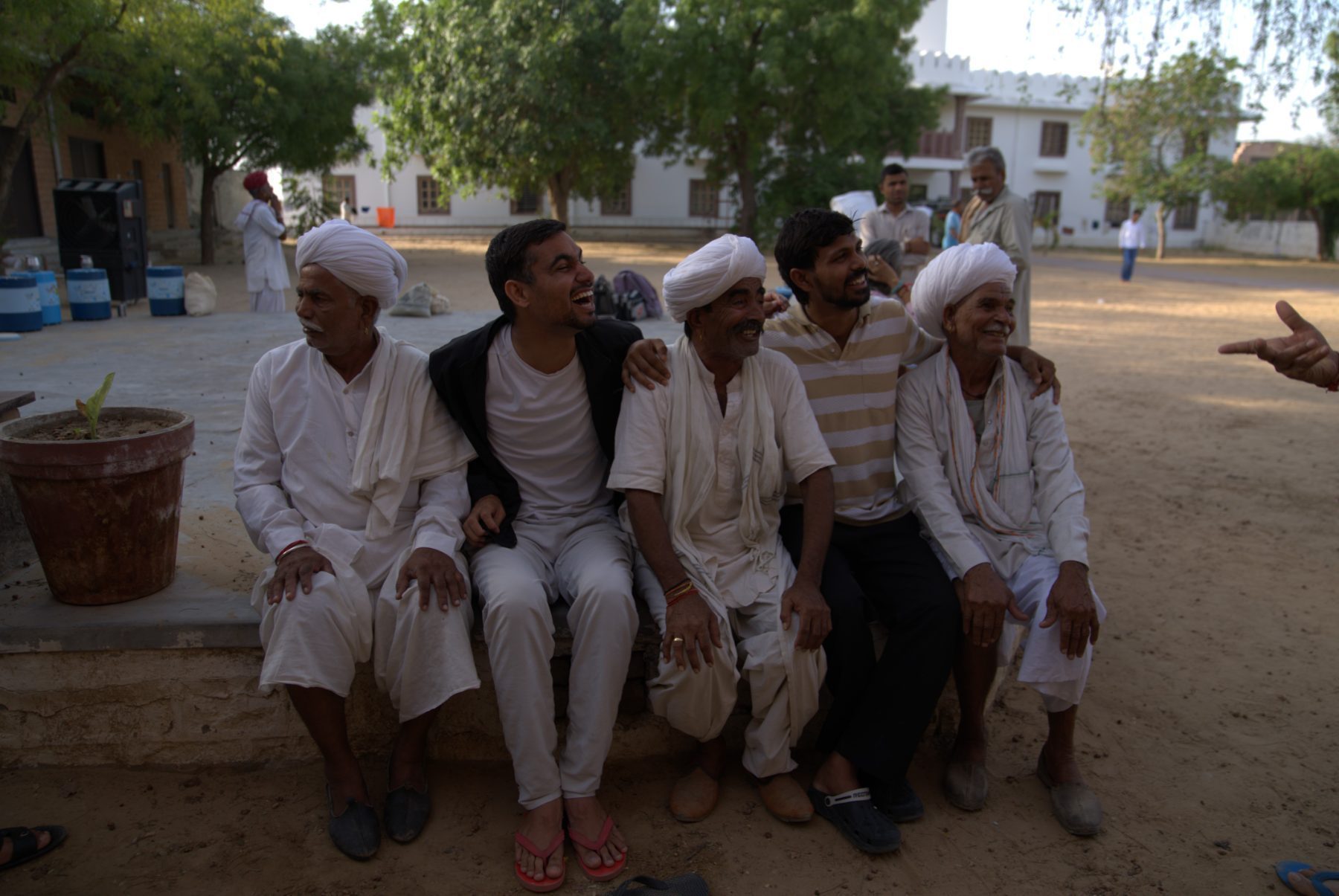
The next day in sunlight: elders in white turbans and members of the team sitting together on a low wall, arms around each other's shoulders, all of them laughing.
14

We won

We had bowed to them for a month. On the last day they picked us up off the ground.

The story

The next day they picked us up and carried us on their shoulders.

The men being lifted in these photographs are not participants. They are our team. Researchers. Professors. People with letters after their names, hoisted into the air by men who had arrived a month earlier believing they were not fit to sit at a fire.

Understand how that became possible.

Every man who walked into this camp left his identity at the gate. Farmer, father, debtor, disgrace, all of it. He had to. You cannot begin from anywhere except the ground.

So we left ours at the gate too.

That is not a courtesy. It is the entry requirement. You cannot stand in front of a man who has been stripped of everything while you are still wearing your designation. He will feel it instantly and he will never open. The degree, the department, the position, the distance: all of it comes off, or nothing happens.

And once it was off, there was no us and them left to speak of. There was only we. We got up in the dark. We sat on the same mat. We got it wrong. We had the fight the night before the end. We came back.

For a month our team had been bowing at their feet. Not as a gesture. Out of plain admiration for what these men were doing every single day, in front of each other, without any guarantee it would work.

So when they lifted us up, it was not gratitude. It was an answer. We had bowed to them, and on the last day they picked us up off the ground.

Bring one drop of love to these men and they hand you back an ocean of it. That is not a saying. That is the second photograph, taken the morning after the worst evening of the camp, with everybody's arms around everybody.

We loved. We lived. We won.

Love won.

More will be added. Every camp leaves behind photographs that carry something you could never learn by looking at them. As those stories are written down, they will appear here. If you would like to know when, write to us.
If today is bad

You do not have to wait for a camp. Call now.

Free. Confidential. 24 hours. In your language.

Please read this. Yoga is powerful and it is not a substitute for medical care. In our study it was delivered within a residential de-addiction programme, alongside standard treatment, not instead of it. Withdrawal from opioids, alcohol and some sedatives can be dangerous and occasionally fatal without supervision. Do not stop a substance abruptly on your own. Call 14446 or see a doctor first.