The idea beneath the practice

Becoming Jyotirgana

Why we stopped treating people as patients and started training them as protectors.

The problem nobody solves

Most people who complete treatment go back.

This is the fact that sits underneath the whole field. Detoxification works. Medication works. Therapy works. And still, a large share of people who finish a programme return to the substance, which means the thing being treated is not the thing that is actually holding them.

Underneath most addiction is escape. Not pleasure. Escape. From unbearable pain, from an unstable sense of who you are, from a situation with no exit. The substance offers a few hours of relief from a problem it cannot touch. The problem returns, larger, with the substance's own damage now added to it. So you use again. Eventually the substance becomes the whole problem, and whatever first drove you there is forgotten by everyone, including you.

Now look at what conventional treatment asks of a person: avoid your triggers, avoid your friends, avoid your village square, stay away, keep coming back to us.

We treat escape with more escape,
and then wonder why it does not hold.

There is a deeper cost. To be told you are permanently vulnerable, that the substance will always be stronger than you, that you must remain within reach of clinical help for the rest of your life. This teaches a man that he is weak by nature. He may stop using. He rarely stops believing it.

We wanted to know what would happen if we said the opposite thing.

This world was not built with random bricks of Chance,
A blind god is not destiny's architect;
A conscious power has drawn the plan of life,
There is a meaning in each curve and line.

Sri Aurobindo · Savitri

The turn

There is a meaning in each curve and line.

Read that last line again, and then apply it to forty years of opium.

If nothing in a life is accidental, then the years lost to a substance are not simply wreckage to be mourned. They are something learned, learned the hardest way available, at a price nobody would choose to pay, but learned nonetheless.

Consider what a man in long dependence actually knows. He knows exactly how a craving announces itself, and how many minutes he has before it wins. He knows every lie he told himself and the precise order he told them in. He knows how it feels to mean a promise completely and break it by evening. He knows which kind of concern from a family member makes a person use more.

No university teaches this. No clinician can acquire it. It is a curriculum, and he completed it.

His addiction was not the ruin of his life.
It was, without his consent, his training.

This is the Protector Paradigm. The person in front of us is not a patient defined by an affliction, waiting to be repaired. He is a trainee, someone who has already survived the difficult half of an education, and now needs the other half: the practices, the physiology, the skills, and the responsibility.

And the substance stops being a demon to flee for the rest of his life. It becomes the subject he happens to be an expert in.

How far this reaches

Nothing in that argument is about opium.

Read it back with the word changed. The woman who came through a depression knows what the inside of one sounds like, and which reassurance makes it worse. The man who lost a child knows what the second year is like, when everyone else has moved on and the casseroles have stopped. The person whose body failed them knows the specific humiliation of asking for help with something they could do last year.

Every one of them completed a curriculum nobody would enrol in. And every one of them is treated by the world as damaged rather than as qualified.

That is the whole claim, and it is not a claim about a substance. It is a claim about what suffering leaves behind in a person, and about who is best placed to use it.

We have built this out properly in one domain so far: opium, in western Rajasthan, with a protocol, a published paper and stated limits. The principle is wider than that. Our evidence, so far, is not. We will keep those two facts visible at the same time.

One centre

The circle, and its turn.

Something was done to you. Perhaps long ago; perhaps every day.

You could not answer it. So it came out on what was near.

Then what was near began to do it back to you.

This is not who you are. It is a circle, and a circle can turn.

Read the whole of it

The circle

It begins with abuse. Somebody, or something, did it to you: a hand, a word, a house, a hunger, a sickness, a year that would not end. It went to the core.

What is done to us has to go somewhere. You could not send it back where it came from; that man was too big, that situation too strong, or it was gone. So it went to what was close at hand. In this land that was opium, and doda post. You did not turn it on a person. You turned it on a substance.

And here the circle closes, without anyone seeing it close. To abuse is to agree that abuse is how things are done. What was done to you, you now do. And what you do comes back: the substance begins to abuse you. The body asks for it at its hour. The mind will not rest without it.

So you abuse it more, and it abuses you more. Each turn is a little wider than the last.

Ring after ring

The circle does not stay between you and the substance.

Your own body turns on you: in pain, in sleeplessness, in the gut. You take more.

Your own mind turns on you at night. You take more.

The family is frightened and ashamed, and shouts. You answer the only way you have learnt; you take more. They shout louder.

The village turns its face away. You take more.

Ring after ring, until there is nothing in the circle but abuse. Not you, not the substance, not the family: only abuse, abusing, abused.

The world inside it

This is not one man's circle.

The field itself calls him a "substance abuser". In one study (Kelly and Westerhoff, 2010) clinicians read about the same man. Some were told he was "a substance abuser", others that he "has a substance use disorder". Those who read "abuser" held him more to blame, and more deserving of punishment. In 2013 the psychiatrists' own manual, DSM-5, stopped using "abuse" as a diagnosis. The word is still everywhere.

Treatment can be part of it too: the chain, the locked room, the beating, the shaming, a statistic raised over him like a stick. Abuse sent to answer abuse. And when a whole country makes war on a drug, it is the same circle at the size of a nation.

Even fighting the drug is part of the circle. To make the substance the enemy is to abuse it once more.

No one is the abuser

So there is no one to blame here. Not you, not your father, not the village, not the doctor, not the poppy. Everyone in the circle was abused first. Abuse is not a person. It is a current, and it passes through whoever stands in it.

A current is not defeated. It is turned.

The turn

The same circle, turned, is love.

Someone who is loved, loves. To love is to agree that love is how things are done. And love given comes back.

It turns ring after ring, the same rings:

  • first the place the dose had: a breath taken whole, a posture held with care
  • the body
  • the mind, with a mantra in place of the night's accusations
  • the family
  • the village
  • and the world, which begins with another man, who is where you were. You stand in front of him and he believes you, because you have been there.

Nothing has to be broken for this. The intensity that went into the substance is the same intensity; it only needed somewhere to go.

Why it never ends

The circle of abuse ends in nothing but abuse. The circle of love does not end: each ring opens the next. That is why the training never stops. Not because there is something to keep fighting, but because love keeps widening.

Every form, one centre

Opium, alcohol, tobacco, the phone, gambling, food, anger, work. The rings differ. The centre is the same. This site begins with opium in western Rajasthan because that is where it stands. It is written for all of them.

What this is

This is our reading, Jyotirgana's. It is not a finding, and we do not claim to have measured it. The study and the manual above are cited for what they show about one word, and nothing more.

Kelly JF, Westerhoff CM. Does it matter how we refer to individuals with substance-related conditions? A randomized study of two commonly used terms. International Journal of Drug Policy, 2010; 21(3): 202-207. American Psychiatric Association, DSM-5, 2013.
One

There is but one.

When someone falls, we watch.

When someone rises, we wait.

When it reaches our own door, we point.

Each time, the same thought: he is someone else. There is no one else.

Read the whole of it

Watching

When it is someone else's son, it does not touch us.

When it does touch us, we do not act. We react. A man's fall becomes a place to pour out our own frustration. Not concern, not compassion. Frustration, finding somewhere to go.

If it happens where a leader we dislike is in power, it is a stick to beat him with, and our ideology is fed. If it happens in our own house, it is a way to humiliate the one who takes it. If it happens in a relative's house, it is a way to humiliate that family; or to stand over them as the one who has come to help, we are here to do something for you, and let them feel how far above them we stand.

Never about the man. Never about the cause. Never about making anything better. Always about ourselves.

Recently there were village elections in Rajasthan. The candidates handed out liquor and drugs in the open. Every single person in the village knew. Not one questioned them, not one requested, advised, warned. Not one. It was free. Until our own needs are met we do not utter a word. Until it touches the ones we would like to see touched, we do not care. And the same mouths will lecture tomorrow on how addiction is destroying society.

Under every one of these, the same quiet sentence: he is someone else.

Waiting

There is another way of watching, harder to see.

Let anyone, in any field, make a little progress, and resistance gathers round him, within and around. Take a man who takes nothing at all, who is doing well, who holds to the truth and can say it to anyone's face. People cannot digest him. Not only outsiders: his own house. Jealousy, envy, hatred, and under them a wish that is rarely said aloud. That he fall. That he fail.

And if he does fall into any dependence, they leave no stone unturned. They humiliate him, drag him further into the dark, and treat him so that he stays in the loop, deeper and deeper. A wife does it, a child does it, a husband, a mother, a father, a society, a leader. Often without knowing what their reactions are bringing about.

We love people while they fulfil our desires. The moment they do not, we revolt.

We do not enjoy another's success. We do not take part in it. We keep ourselves apart from it, different. And that is what creates the whole problem: his rise is someone else's.

Pointing

And when it comes to our own door, we point.

The government. The police. The dealer. Such and such a person did it. What is he doing, what are they doing, what is this one doing, what is that one doing. Never: what am I doing.

The more we blame, the more we excuse the solution. Blame is the lamest way there is of not addressing the problem at all.

And the reaction that follows, however loud, does nothing. It brings no evolution, no transformation. It only brings the illusion that something is being done.

Rules can be imposed. A substance can be stopped from spreading. Rehab can be there to treat a man. But what about what promotes it? Yesterday we had opium. Today we have synthetic drugs. Tomorrow there will be something new. Each time we come near the cause of it, the soul of it, the whole of it, we pass it on to someone else.

The fault is someone else's.

There is but one

There is no one else.

यस्तु सर्वाणि भूतान्यात्मन्येवानुपश्यति ।
सर्वभूतेषु चात्मानं ततो न विजुगुप्सते ॥

Īśā Upaniṣad 6

Sri Aurobindo, in an early commentary on this verse:

“But the man who sees himself in all creatures, cannot hate; he shrinks from none, he has neither repulsion nor fear.”

Sri Aurobindo, Isha Upanishad, CWSA 17, p. 143

The word the verse uses for that shrinking is jugupsā. The watching, the waiting and the pointing, all three, are this one word. Every one of them begins in division. Take the division away and they have nowhere to stand. A few pages earlier in the same commentary he wrote it as a sunrise:

“If you see yourself in all creatures, you cannot but love all creatures. Universal love is the inevitable consequence of the realisation of the One in Many, and with Universal Love how shall any shred of hate, disgust, dislike, loathing coexist? They dissolve in it like the night mists in the blaze of the risen sun.”

Sri Aurobindo, Isha Upanishad, CWSA 17, pp. 137-138

This is the circle above, turned. What went round as abuse comes round as love.

If there is but one, there is no one else's addiction. His fall is mine. His rise is mine. A man does not wait for his own hand to fail, and he does not humiliate his own foot for stumbling. He picks it up. That is all responsibility is.

At the end of the day it is you. It is only you whom you can truly change, and it is you who truly needs to be changed. The change has to come from within. No one else can change anyone or anything.

Never to blame anyone at all. To take responsibility. It is only in responsibility that we act; otherwise we are always reacting. And to act is to bring consciousness into the picture.

So this is mine to do, and all of it is within. When I hear that someone has fallen, I will catch the first thing that rises in me: the relief, the story, the pleasure of standing above him. I will know it as mine, not his. When someone near me rises, I will catch the jealousy before it becomes a wish, and take his rise as my own. When I want to blame, I will turn the finger round and ask what I am doing. And whatever I see in him, the craving, the weakness, the fall, I will look for first in myself, for it is there too. There is no one else to change.

How it changes the room

We had to change the words first.

A paradigm that lives only in a paper changes nothing. It has to reach the vocabulary people are addressed with every morning, because that is what they come to believe about themselves.

patient
→
trainee
treatment programme
→
training course
relapse prevention
→
skill development
receiving care
→
learning to help
recovering addict
→
Jyotirgana

This is not decoration. A man who is told for thirty days that he is in training behaves differently from a man told for thirty days that he is ill.

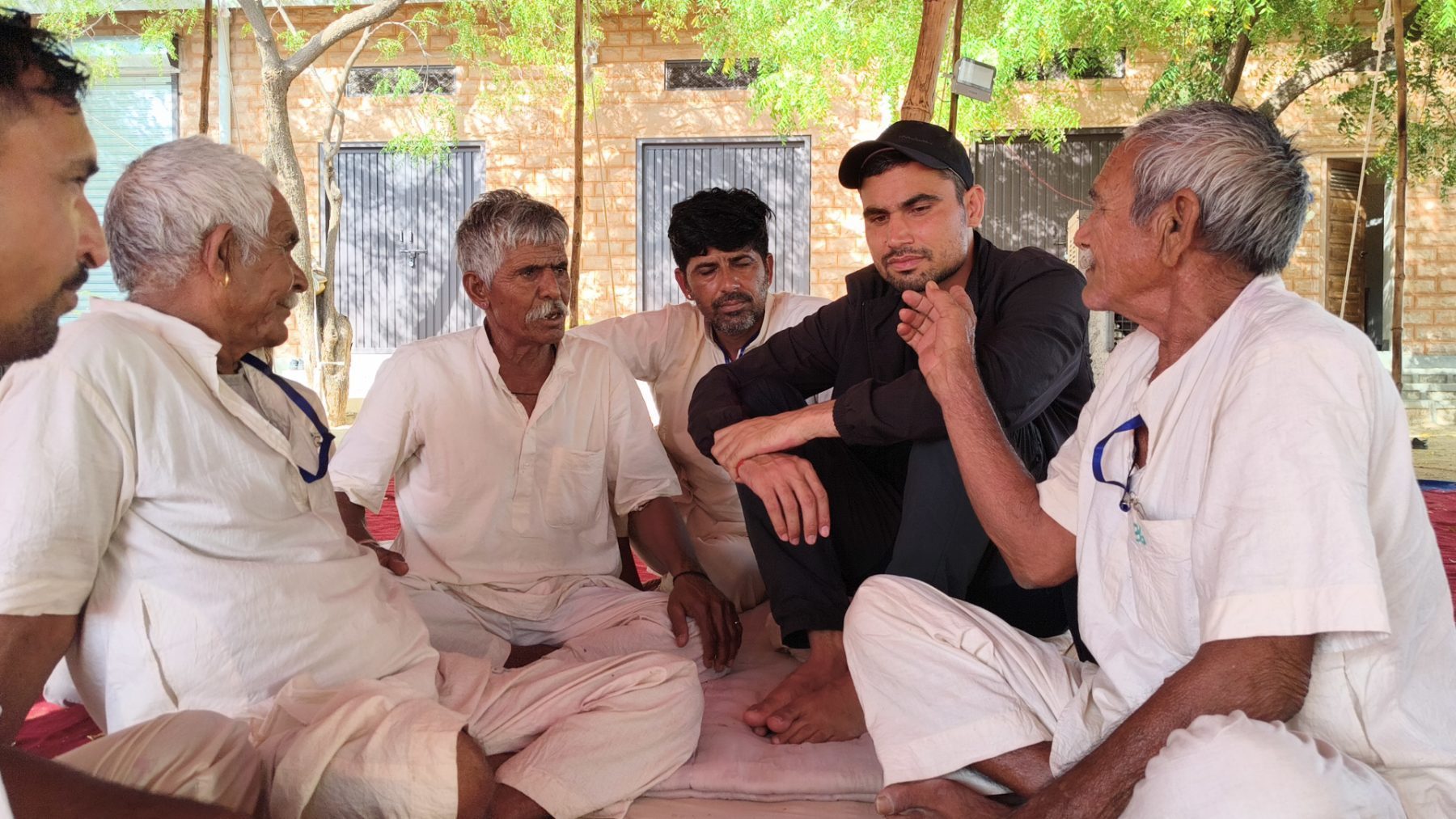
A trainer sitting cross-legged on the ground among a small group of older men, talking with them at eye level.
Nobody is standing. The man in the cap is staff; the others are trainees. The Protector Paradigm is mostly a claim about where you sit.
An honest debt, and one disagreement

The twelfth step was right.

Alcoholics Anonymous discovered something profound long before any of us: that carrying the message to another person suffering does more for the carrier than any amount of being cared for. Millions of lives rest on that insight. Our paradigm would be dishonest if it did not begin by acknowledging it.

Where we differ is on one word: identity.

"Once an addict, always an addict." Said in a room of people who need humility, it protects against complacency, and it has kept many people alive. But said to a labourer in western Rajasthan who has already been told by everyone that he is finished, it can confirm the sentence rather than lift it. A permanent label of vulnerability, plus a lifelong requirement to keep attending, can quietly become another dependence, this time on the programme.

We think the identity should be allowed to move. Not addict-forever, but: someone who went through the dark, learned it thoroughly, and now carries a light by which others can find their way out. The past is not denied and it is not worn as a wound. It is used.

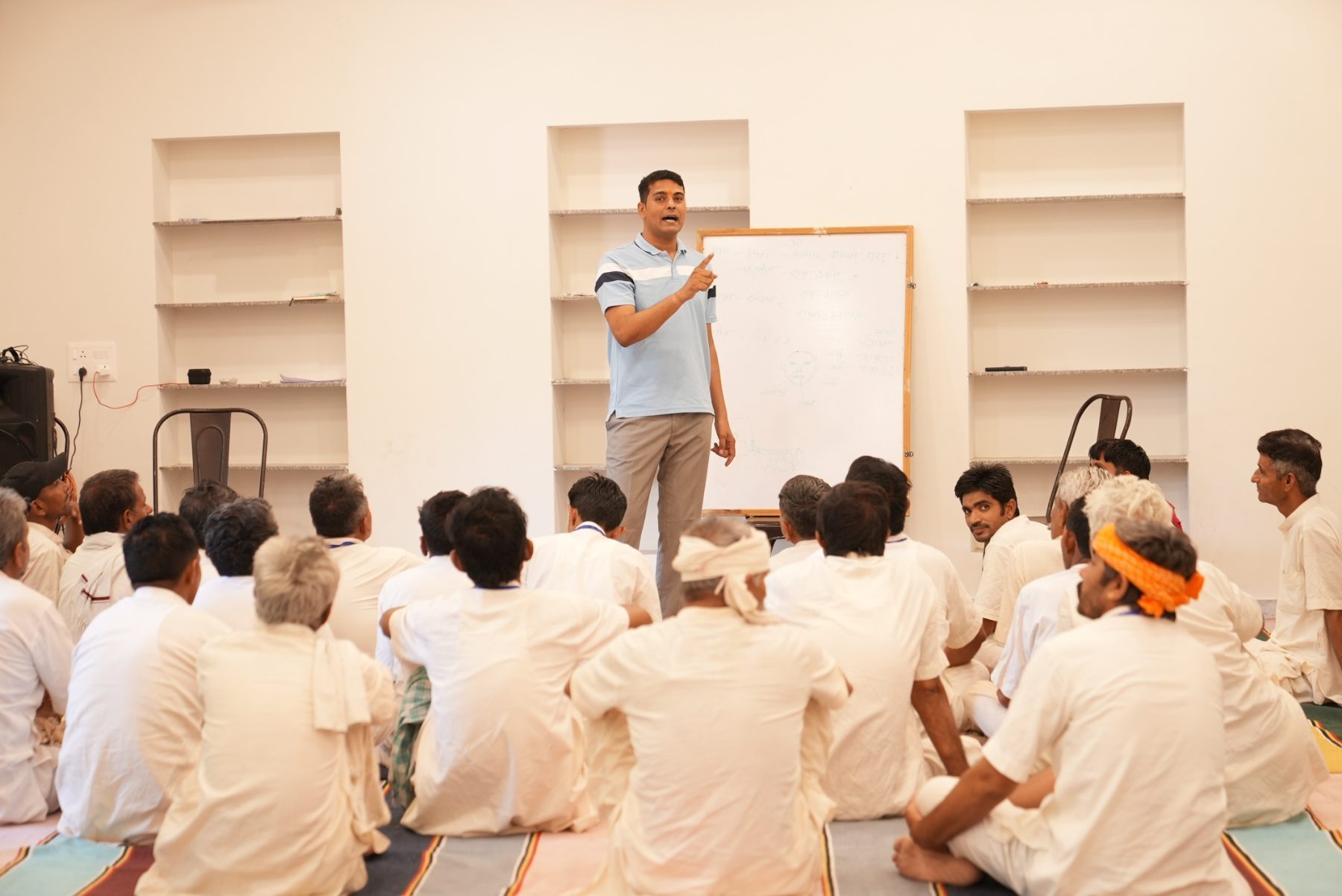
A teacher at a whiteboard covered in Hindi notes, explaining to men seated on the floor.
The second stage. Not instruction but explanation, in their own language, on a whiteboard rather than a screen.
The module

Six phases. One month. 150+ practices.

The paradigm is the reason. This is the method. Each phase opens what the next one needs. You do not sit for meditation in a body that cannot yet sit, and you do not lead others before you have steadied yourself.

1

Sūkṣma & Sthūla Vyāyāma

Loosening

The subtle and gross body movements as envisioned by Dhirendra Brahmachari, kept in their original form. We begin here because a body that has run on opium for decades cannot be asked for an āsana on day one. Joint by joint, the body is made available again. Five gross practices are on this site.

2

Breathing Practices & Ṣaṭkarma

Yogic detox

Breathing practices developed and researched at SVYASA, alongside the six classical cleansing kriyās. This is where the measured lung improvement begins, and where the body is cleared enough for everything that follows. The breathing practices are on this site.

3

Āsana: nine flows

Strength and stillness

Not a list of postures but nine groups, each arranged as a continuous flow. The idea is borrowed from vinyāsa; the sequencing is not. Each flow is ordered around what a body in withdrawal can actually sustain and what it needs to recover. All nine groups are on this site.

4

Prāṇāyāma

The breath as instrument

Craving arrives in the breath before it arrives in the mind. A person who can find his breath under pressure has a few seconds of warning, and a few seconds is the whole difference between using and not using. Both kinds are on this site: the breath counted on its own, and the breath carrying a mantra or a stotra.

5

Dhāraṇā & Dhyāna

Concentration and meditation

Addiction is attention captured. Concentration is attention taken back, deliberately, a minute at a time. Meditation is then sitting with what the substance was covering. It is the hardest phase, and the one that decides whether any of it lasts. Its education of the senses is on this site.

6

Peer Learning

The point of all of it

The phase the other five exist to make possible. The trainee turns around and begins to guide the men who arrived after him. This is not a graduation ceremony added at the end. It is the aim of the module, and the moment a person becomes Jyotirgana. How the sixth phase is built.

And for what the drug did to the body, each of twenty-three complications has a practice of its own, put together from the phases above. See all twenty-three.

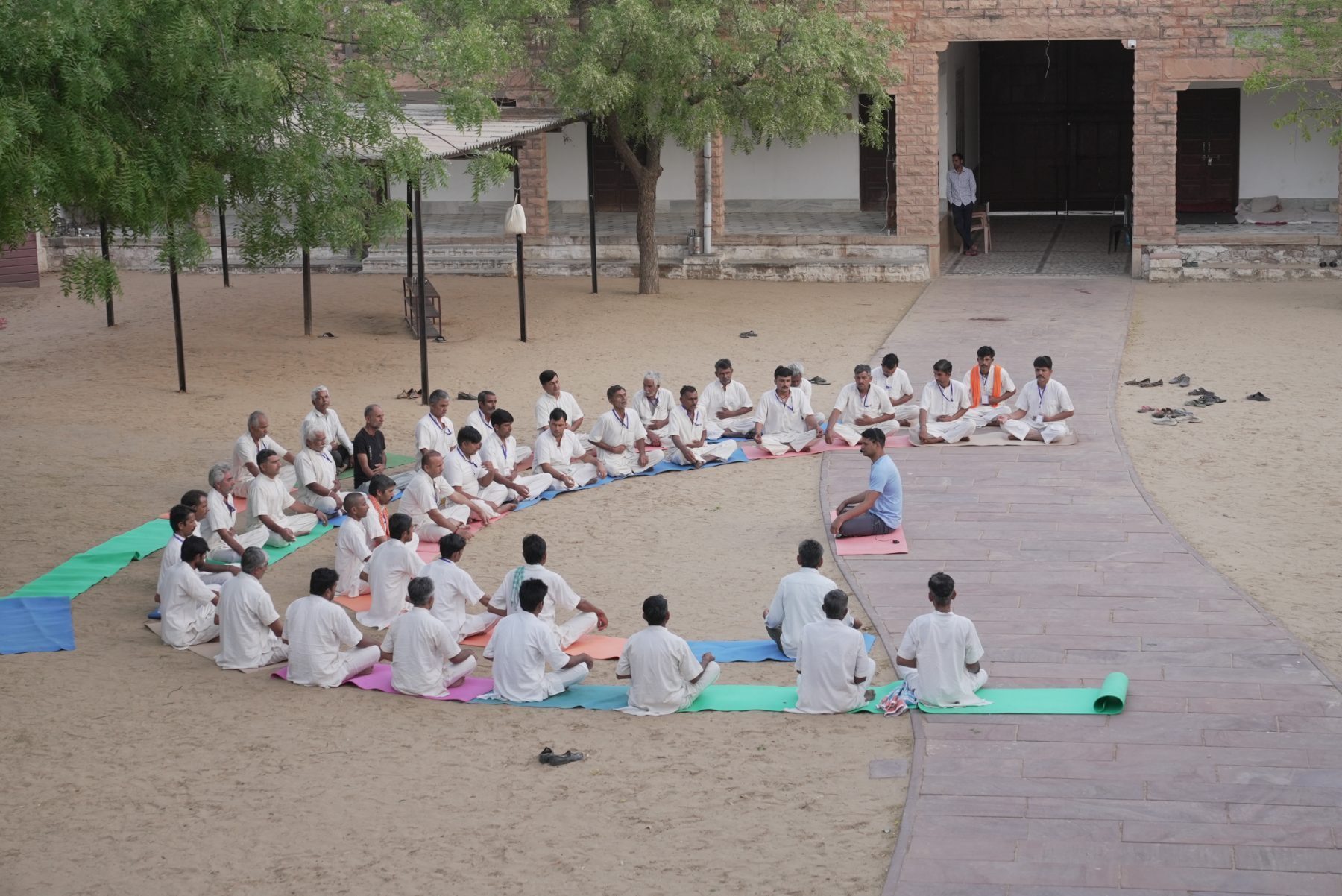
Men seated in rows on mats in a sand courtyard, facing a single instructor.
Seated practice, before the sun is high. The instructor sits where everyone can see him, not on a stage.
How each practice is taught

Do it. Understand it. Teach it.

Every one of the 150+ practices passes through the same three stages. A man who has only been instructed can follow. A man who understands can adapt. A man who can teach it will not lose it.

Stage One

Practice

The practice as instructed by the teacher. Body first, before explanation. You do it before you know why.

Stage Two

Understand

The educative session. What this practice is, why it is in the protocol, how it is to be performed, and exactly which complication it is working on. The trainee stops obeying instructions and starts knowing his own treatment. Every educative session, in one place.

Stage Three

Lead

He teaches it to someone who arrived after him. This is the aim of the module, not its reward. After one month he is equipped to help himself, and to help another.

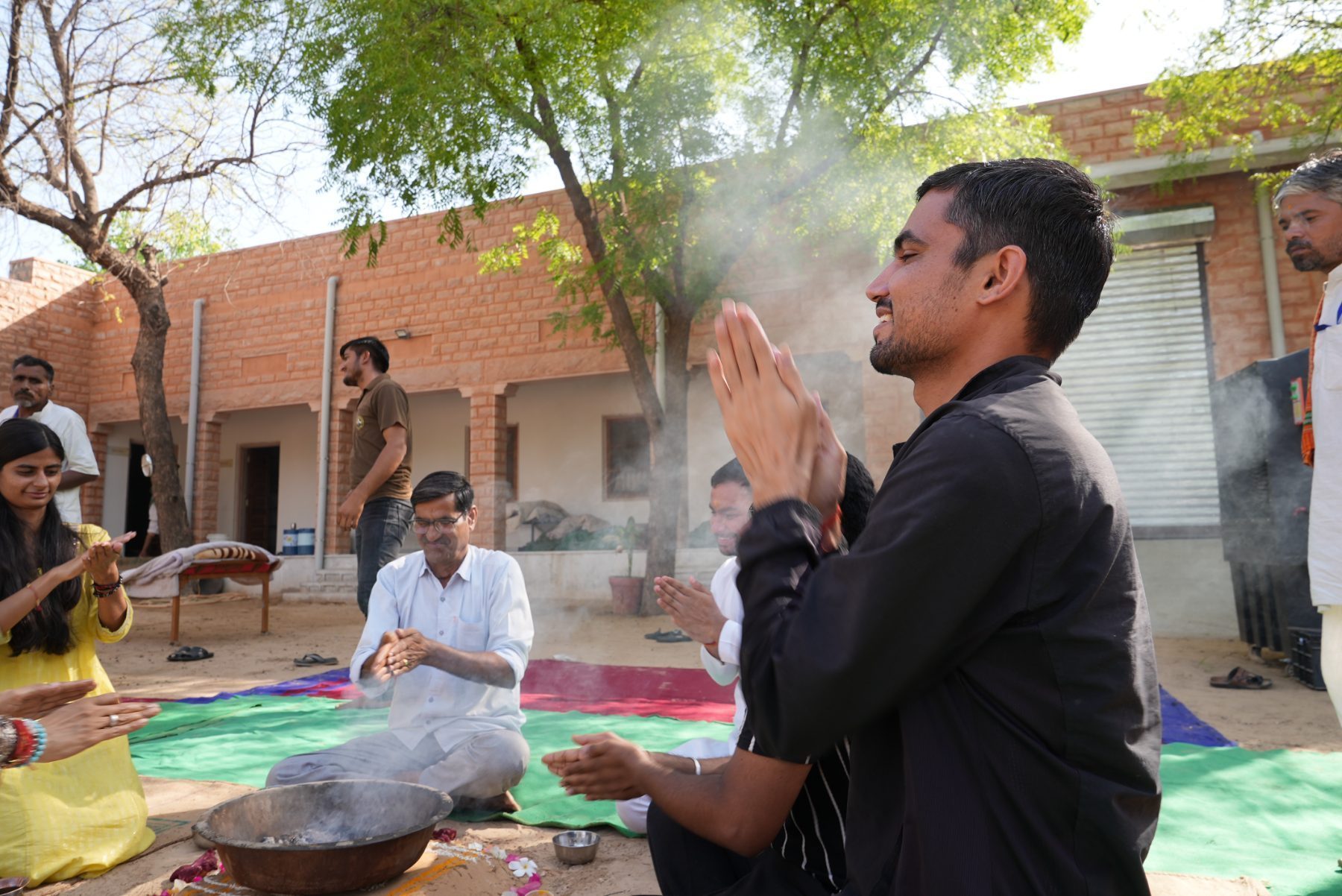
People seated around a small fire with hands raised in prayer, smoke rising between them.
A camp opens and closes with fire. Nobody is asked to believe anything; they are asked to sit down together.
What is established, and what is proposed. The physiological results of this protocol have been measured and published. See the findings. The Protector Paradigm itself is a theoretical framework, drawn from Sri Aurobindo's Savitri and from the peer-support literature, and it is currently being tested rather than proven. We describe it here because we think it is right, and because you deserve to know what we believe as well as what we have measured.

One man walked out of that month and lit a whole village.

Read how it happened
If today is bad

You do not have to finish reading this. Call now.

Free. Confidential. 24 hours. In your language.

Yoga supports recovery; it does not replace medical care. Withdrawal from opioids, alcohol and some sedatives can be dangerous without supervision. Do not stop a substance abruptly on your own. Call 14446 or see a doctor first.