Angry, frustrated, bitter
Anger is force that has not yet been given a direction. Here it is given one.
This is the wonder of the way of works that even enmity to God can be made an agency of salvation. Sometimes God draws and attaches us most swiftly to Him by wrestling with us as our fierce, invincible & irreconcilable enemy.
Sri Aurobindo, Thoughts and Aphorisms 372 (CWSA 12, p. 472) the whole of it →1the story
राहŚiśupāla, whose anger never let go of Him›
सभाThe hall
At Yudhiṣṭhira's great sacrifice, the rājasūya, every king of the land sat in one hall, and the sages with them. The first honour had to go to one of them, and it went to Kṛṣṇa. Yudhiṣṭhira washed His feet with his own hands, dressed Him in yellow silk and jewels, and his eyes filled so that he could not look at Him. The whole hall stood with joined palms. Namo, they said, jaya. Flowers fell. 10.74.28 to 29
क्रोधThe fury
One man did not stand. Śiśupāla, king of Cedi, son of Damaghoṣa, had listened to Kṛṣṇa's qualities being praised until he could not bear another word. He sprang up from his seat, flung his arm into the air, and in front of every king and every sage he hurled hard words at the Lord. He was not afraid of anyone in that hall. 10.74.30
इत्थं निशम्य दमघोषसुतः स्वपीठाद् उत्थाय कृष्णगुणवर्णनजातमन्युः।
उत्क्षिप्य बाहुमिदमाह सदस्यमर्षी संश्रावयन् भगवते परुषाण्यभीतः॥Bhāgavata 10.74.30
A cowherd, he said. A stain on his family. Outside every caste and every duty, a man who goes his own way and has not one quality to his name. Shall a crow eat the offering meant for the gods? He went on and on. None of it was new. Nārada says that from the day he could first lisp, his tongue had been turned against Kṛṣṇa. His whole life had been one anger, and it had one face. 10.74.31 to 37, 7.1.17
मौनThe silence
Kṛṣṇa said nothing at all. The kings could not bear to hear it; they covered their ears and walked out, cursing the king of Cedi. The Pāṇḍavas and their allies sprang up with their weapons raised to kill him. And Śiśupāla, not shaken for a moment, took up his sword and his shield and went on hurling his words at everyone who stood with Kṛṣṇa. 10.74.38 to 42
ज्योतिThe light
Then Kṛṣṇa rose. He held His own people back, and with His sharp-edged discus He took the head of the man who was coming at Him. The hall broke into uproar, and the kings who had followed Śiśupāla ran for their lives. And then something happened that no one in that hall had expected. 10.74.43 to 44
चैद्यदेहोत्थितं ज्योतिर्वासुदेवमुपाविशत्।
पश्यतां सर्वभूतानामुल्केव भुवि खाच्च्युता॥Bhāgavata 10.74.45
A light rose out of Śiśupāla's body and went into Vāsudeva, while every being there watched, like a meteor falling from the sky to the earth. Not into the ground. Not away into the dark. Into Him. 10.74.45
क्योंWhy
Yudhiṣṭhira could not understand it. A man who had reviled the Lord all his life, from the time he could speak, and he goes into Him before the eyes of the whole world? Why did his tongue not wither, why did he not fall into darkness? He turned to Nārada. 7.1.13 to 20
एतद्भ्राम्यति मे बुद्धिर्दीपार्चिरिव वायुना।
ब्रूह्येतदद्भुततमं भगवान्ह्यत्र कारणम्॥Bhāgavata 7.1.20
My mind wavers over this, he said, like the flame of a lamp in the wind. Tell me this greatest of wonders. The cause of it must be the Lord Himself. 7.1.20
Nārada's answer is the root of this whole house of lamps. Bind the mind to Him by enmity, or without enmity, by fear, by affection, by desire, in any way at all: He does not see these as apart from Him. And then he said what nobody would dare to say: 7.1.25 to 28
यथा वैरानुबन्धेन मर्त्यस्तन्मयतामियात्।
न तथा भक्तियोगेन इति मे निश्चिता मतिः॥Bhāgavata 7.1.26
As a man becomes one with Him through enmity held fast, so he does not even through the yoga of devotion: that is my settled mind. The insect shut up by the wasp in its cell thinks of nothing but the wasp, in rage and in fear, and so it comes to have the wasp's own form. Śiśupāla did not think of Kṛṣṇa less than a devotee does. He thought of nothing else, and Nārada says it was so for three lives. 7.1.26 to 27, 7.1.46
जन्मत्रयानुगुणितवैरसंरब्धया धिया।
ध्यायंस्तन्मयतां यातो भावो हि भवकारणम्॥Bhāgavata 10.74.46
With a mind seized by an enmity that had grown through three births, thinking of Him, he became one with Him. For the feeling is the cause of becoming. 10.74.46
हर राहEvery road
गोप्यः कामाद्भयात्कंसो द्वेषाच्चैद्यादयो नृपाः।
सम्बन्धाद्वृष्णयः स्नेहाद्यूयं भक्त्या वयं विभो॥Bhāgavata 7.1.30
The gopīs came to Him by desire, Kaṃsa by fear, Śiśupāla and the other kings by hatred, the Vṛṣṇis by kinship, you Pāṇḍavas by affection, and we by devotion. 7.1.30
कतमोऽपि न वेनः स्यात्पञ्चानां पुरुषं प्रति।
तस्मात्केनाप्युपायेन मनः कृष्णे निवेशयेत्॥Bhāgavata 7.1.31
None of these is a Vena. So let the mind be set on Kṛṣṇa by any means at all. Vena was the king who felt nothing toward Him, neither love nor hate, and he was the one who was lost. As Śrīdhara reads this verse, it was for want of intensity: there was nothing in him that burned toward the Lord. The kind of feeling did not decide it. Its force did. 7.1.31
उसके भीतर की आगThe fire in him
Every Jyotirgana knows this fire. Anger at the ones who would not understand, at the ones who sold it to him, at the years, at the village that talks, at himself. He has been told to put it out, as if the anger were the enemy, and he has tried, and it has come back hotter.
The Bhāgavata does not tell Śiśupāla to put out his fire. It does not praise it either: his words hurt a whole hall, and the story does not pretend they did not. What it says is stranger than either. A fire that never once let go of its object went where it was pointed. His anger was not his ruin. It was the most faithful thing in him.
So nothing in him has to be killed. The force that rises in him, sharp, fast, loud, is the same force a sage spends a life gathering. Thrown at the people round him, it burns them and comes back to burn him. Turned, and held on one point, steady, as the flame is held in this lamp's practice, it becomes a light that goes where he has pointed it.
The only one lost in this story is the one who felt nothing. He is not that one. Whatever is burning in him tonight is the material.
The story: the Bhāgavata Purāṇa, 10.74.28 to 46 and 7.1.13 to 46, read in Sanskrit in the GRETIL e-text (Ulrich Stiehl); the verse numbers are that text's, and in the seventh book they run one lower than some printed editions (7.1.30 here is 7.1.31 there). Why Vena was lost is as Śrīdhara Svāmī reads 7.1.31 in his Bhāvārthadīpikā. The telling in English is ours, and so is what it means for him.
4the word
A whole page of the Mother's diary, Prayers and Meditations, as she wrote it on this day: a prayer to the Divine, given entire. That it stands at this lamp is our choice.
The Mother · November 21, 1914
O Lord, Thou hast given me Thy Power that Thy Peace and Joy may reign over the world.
And this being is now only an embrace of peace enveloping the whole earth, an ocean of joy breaking over all things.
O you who are full of hatred, rancour shall be effaced from your hearts as the sea effaces an imprint upon the sands.
O you who feed upon vengeance, peace shall pass into your hearts as it enters the soul of a child rocked by its mother.
For the divine and universal Mother has turned her gaze upon the earth and she has blessed it.
The Mother, Prayers and Meditations, CWM 1, p. 278
This is the wonder of the way of works that even enmity to God can be made an agency of salvation. Sometimes God draws and attaches us most swiftly to Him by wrestling with us as our fierce, invincible & irreconcilable enemy.
Sri Aurobindo, Thoughts and Aphorisms 372 (CWSA 12, p. 472)From Thoughts and Aphorisms: about 1913 Sri Aurobindo wrote them in one notebook, under three headings, Knowledge, Works and Devotion, and never prepared them for publication. The Mother read them all aloud, one by one, from 1958 to 1970, and commented; that is On Thoughts and Aphorisms. Below: what stands beside this line, her comment on it, and why it is here.
Beside it, Sri Aurobindo
The path of works is in a way the most difficult side of God’s triune causeway; yet is it not also, in this material world at least, the easiest, widest & most delightful? For at every moment we clash against God the worker & grow into His being by a thousand divine touches.
Sri Aurobindo, Thoughts and Aphorisms 371 (CWSA 12, p. 472)The Mother, on it
In short, the divine grace is so marvellous that, whatever you do, it will lead you more or less quickly towards the Divine Goal.
The Mother, On Thoughts and Aphorisms, CWM 10, p. 317, 5 March 1970Why it is here
He speaks of enmity toward God, inside the way of works, the life of action; not of anger at people, and he does not praise anger. It stands here for one thing: even the fiercest movement in a man can become a road. That reading is ours.
Read every aphorism with the Mother’s comments, on the Ashram’s site →
one long breath
5the sitting
Each group's cautions come with its own steps (Group 9's neck caution and the others).
What will you carry?
The sitting
Begin the sitting →Choose what you will carry, and the sitting opens.
It begins aloud, sharp, fast, and slows a little in each posture, to about six breaths a minute. Each line is read in the mind as the breath comes in, white, and said aloud as it goes out, gold.
- ĀsanaSetting and Rising, each posture once
- BreathA · U · M · three sounds on one breath
- JapaThe same word, seated.
- RestŚaśāṅkāsana or Śavāsana, either. Nothing to count.
Or one piece alone: Āsana · Breath · Japa · Rest
विश्राम · Rest
Śaśāṅkāsana or Śavāsana, either. Nothing to count.
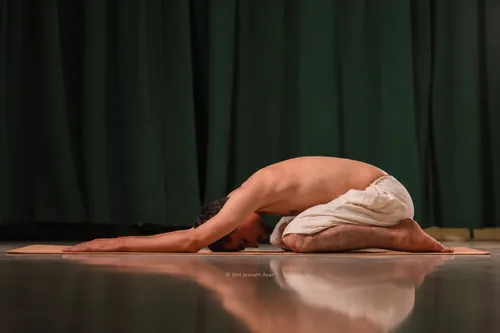 शशाङ्कासन
Sit the hips back onto the heels. Forehead to the mat, arms stretched forward. Now hum, with the mouth closed. Three times.
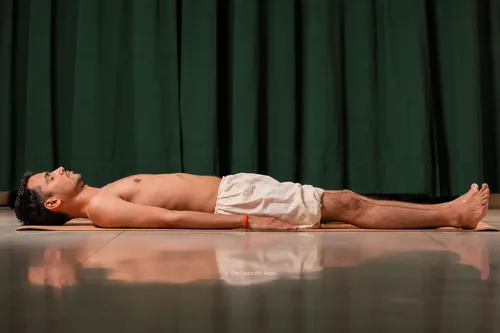 शवासन
Straighten the legs and lie down on your back. Legs a little apart, arms beside the body. Eyes closed. Now chant AUM three times, and feel the resonance travel the whole body.
Why this
In Bharata's Nāṭyaśāstra this is raudra rasa. Its lasting state is krodha, anger; its colour rakta, red; its deity Rudra; its notes ṣaḍja, ṛṣabha (Ghosh vol. 1: VI.17, VI.42 to 45, XIX.38 to 40). The lamp keeps that colour.
Bharata gives this state a quick tempo, druta laya; the excited intonation, dīpta kāku; and acute and quivering accents, udātta and kampita (Ghosh vol. 1: the tempo in the prose after XIX.58 to 59, p. 351; the intonation in XIX.58 to 59, p. 350; the accents in XIX.43, p. 347). So the sitting begins aloud, sharp, fast. Where it ends, slow, is the same for every state: about six breaths a minute, the pace at which the rosary and a yoga mantra settled the breath when they were recited (Bernardi and others, BMJ 2001, 323, pp. 1446 to 1449). Ending every state there is ours.
Bharata wrote for an actor and an audience. Here you are both, and all of it is turned toward God. That turn is ours, not Bharata's.
It is the breath of the strong states: anger, sadness, craving and wonder. None of them is asked to leave. Each is given a sound that goes out, and ends in silence.
शान्ति: May He protect us both together and nourish us both together; may we work together with vigour; may our study be full of light, and may we not hate each other.
On this site it serves: Shame, and being alone.
Of Prahlāda's nine ways of bhakti (Śrīmad Bhāgavatam 7.5.23), this sitting really contains these: कीर्तन, aloud · स्मरण, in the mind · वन्दन, bowing · आत्मनिवेदन, the whole self given. That every rasa can be turned toward God is Rūpa Gosvāmī's teaching, in his Bhaktirasāmṛtasindhu.