Restless, wanting to act
This restlessness is energy looking for a road. Here it is given one to walk.
O soldier and hero of God, where for thee is sorrow or shame or suffering? For thy life is a glory, thy deeds a consecration, victory thy apotheosis, defeat thy triumph.
Sri Aurobindo, Thoughts and Aphorisms 278 (CWSA 12, p. 460) the whole of it →1the story
राहAbhimanyu, who went into the wheel›
चक्रव्यूहThe wheel
Droṇa drew up the Kaurava army in the shape of a great wheel, the cakravyūha, ring inside ring, and set in it the finest warriors of the age: Droṇa himself, Karṇa, Kṛpa, Aśvatthāmā, Śalya, Duryodhana and his brothers, king after king. Jayadratha stood at its mouth. The Pāṇḍavas came at it and broke on it like water on a mountain. 7.33.12 to 20, 7.34.8
Yudhiṣṭhira said what was true. None of us knows how to break this. Four men do: Arjuna, Kṛṣṇa, Pradyumna, and you. There is no fifth. Arjuna was fighting far across the field, with Kṛṣṇa at his reins. Of the four, only the youngest was there. 7.34.14 to 17
द्वारThe door
He did not pretend. My father taught me how to break in, he said. If danger comes, I do not know the way out. 7.34.19
उपदिष्टो हि मे पित्रा योगोऽनीकस्य भेदने।
नोत्सहे तु विनिर्गन्तुमहं कस्यांचिदापदि॥Mahābhārata 7.34.19
Yudhiṣṭhira said: Break the array. Make a door for us. We will follow you, child, by the way you go. 7.34.20
भिन्ध्यनीकं युधा श्रेष्ठ द्वारं संजनयस्व नः।
वयं त्वानुगमिष्यामो येन त्वं तात यास्यसि॥Mahābhārata 7.34.20
He knew the way in and not the way out. And he chose to go, because somebody had to open the door.
हे तात ! तजिए सोच को, है काम ही क्या क्लेश का ?
मैं द्वार उद्घाटित करूँगा व्यूह-बीच प्रवेश का।
Father, put your worry away; what is there to grieve? I will open the door, and go into the array.
Maithilīśaraṇ Gupt, Jayadratha-vadh, p. 7Then he said: Today every creature will see the enemy’s hosts driven in herds by one child. And Yudhiṣṭhira answered: As you speak, may your strength grow. 7.34.26 to 27
शिशुनैकेन संग्रामे काल्यमानानि संघशः।
अद्य द्रक्ष्यन्ति भूतानि द्विषत्सैन्यानि वै मया॥Mahābhārata 7.34.26
His charioteer, Sumitra, begged him to think. The load is too heavy. Droṇa is a master of every weapon, and you were brought up in comfort. Abhimanyu laughed. Who is this Droṇa? I would fight Indra on his elephant with all the gods behind him. Drive. 7.35.3 to 8
मैं सत्य कहता हूँ, सखे ! सुकुमार मत मानो मुझे,
यमराज से भी युद्ध को प्रस्तुत सदा जानो मुझे !
I tell you the truth, friend: do not take me for tender. Know me always ready to fight Death himself.
Maithilīśaraṇ Gupt, Jayadratha-vadh, p. 8अकेलाAlone
ज्यों भेद जाता भानु का कर अन्धकार-समूह को,
वह पार्थ-नन्दन घुस गया त्यों भेद चक्रव्यूह को।
थे वीर लाखों पर किसीसे गति न उसकी रुक सकी,
सब शत्रुओं की शक्ति उसके सामने सहसा थकी॥
As the sun’s rays pierce the massed dark, so Pārtha’s son pierced the wheel and went in. There were warriors by the hundred thousand, and not one could stop him; before him the strength of all his enemies suddenly tired.
Maithilīśaraṇ Gupt, Jayadratha-vadh, p. 13Behind him the Pāṇḍavas rushed for the door he had opened, and Jayadratha held it against all of them. Not one got through. 7.35.15, 7.41.6, 7.42.17
पर साथ भी उसके न कोई जा सका निज शक्ति से,
था द्वार-रक्षक नृप जयद्रथ सबल शिव की भक्ति से।
But no one could go with him, whatever his strength: King Jayadratha kept the door, made strong by his devotion to Śiva.
Maithilīśaraṇ Gupt, Jayadratha-vadh, p. 13So he was alone inside the wheel, one against the best of the age. He did not wait for anyone. He went round them like a whirled firebrand, Droṇa, Karṇa, Kṛpa, Śalya, Aśvatthāmā, Duryodhana, the kings and the princes, and the great army shook, again and again. 7.38.5 to 8
His enemies said it themselves. Droṇa, his father’s own teacher, watched him with his eyes wide with joy and said: I know of no archer in battle who is his equal. 7.38.9 to 13
नास्य युद्धे समं मन्ये कंचिदन्यं धनुर्धरम्Mahābhārata 7.38.13
Later, again: only the circle of his bow can be seen; I see no difference between him and Arjuna. And Karṇa, struck again and again by his arrows: I am standing only because a warrior has to stand. 7.47.20 to 25
आचार्य ! देखो तो नया यह सिंह सोते से जगा !
रघुवर-विशिख से सिन्धु-सम सब सैन्य उससे व्यस्त है !
यह पार्थ-नन्दन पार्थ से भी धीर वीर प्रशस्त है !
Karṇa, in Gupt: Ācārya, look, a new lion has woken from sleep. The whole army is tossed by him like the sea by Rāma’s arrow. This son of Pārtha is steadier and braver than Pārtha himself.
Maithilīśaraṇ Gupt, Jayadratha-vadh, p. 16Then Droṇa told them the only way. With his bow in his hand, not the gods and the asuras together could conquer him. Take his bow and his chariot first. 7.47.30
सधनुष्को न शक्योऽयमपि जेतुं सुरासुरैः।
विरथं विधनुष्कं च कुरुष्वैनं यदीच्छसि॥Mahābhārata 7.47.30
So they did it together. Karṇa cut his bow. His horses were killed, and his charioteers. Six great chariot-warriors poured their arrows on one child, without pity. 7.47.31 to 33
त्वरमाणास्त्वराकाले विरथं षण्महारथाः।
शरवर्षैरकरुणा बालमेकमवाकिरन्॥Mahābhārata 7.47.33
अर्जुन-तनय अभिमन्यु तो भी अचल सम अविचल रहा,
उन सप्त रथियों का वहाँ आघात सब उसने सहा।
And still Abhimanyu, Arjuna’s son, stood unmoved as a mountain, and bore every blow of all of them.
Maithilīśaraṇ Gupt, Jayadratha-vadh, p. 16पहियाThe wheel he lifted
Bow gone, chariot gone, keeping to his own dharma, he took up a sword and a shield and leapt into the air, and moved through the sky like Garuḍa, the king of birds. 7.47.34 to 35
स छिन्नधन्वा विरथः स्वधर्ममनुपालयन्।
खड्गचर्मधरः श्रीमानुत्पपात विहायसम्॥Mahābhārata 7.47.34
जब तक शरीरागार में रहते जरा भी प्राण हैं,
करते समर से वीर जन पीछे कभी न प्रयाण हैं॥
While there is even a little breath in the house of the body, the brave never take one step back from the battle.
Maithilīśaraṇ Gupt, Jayadratha-vadh, p. 17Droṇa cut his sword off at the hilt. Karṇa broke his shield. There was nothing left in his hands. 7.47.37
कुछ प्राण-भिक्षा मैं न तुमसे माँगता हूँ भीति से,
बस शस्त्र ही मैं चाहता हूँ धर्म्म-पूर्वक नीति से॥
I do not beg you for my life out of fear. All I ask is a weapon, given as dharma gives it.
Maithilīśaraṇ Gupt, Jayadratha-vadh, p. 19Nobody gave him one. So he came down to the earth, lifted a chariot wheel, and ran at Droṇa with it. The dust of the wheel shone on him. He stood with the wheel raised high, his hair blown back by the wind, and the poet of the Mahābhārata saw Kṛṣṇa: adorned with Viṣṇu’s own weapon, he shone in the battle like a second Janārdana, hard to look at even for the gods. 7.47.38 to 39, 7.48.1 to 2
विष्णोः स्वसानन्दिकरः स विष्ण्वायुधभूषितः।
रराजातिरथः संख्ये जनार्दन इवापरः॥Mahābhārata 7.48.1
वीरगतिVīragati, the way a hero goes
They cut the wheel to pieces. He took up a mace and fought on, on foot. Duḥśāsana’s son came at him with a mace of his own; they struck each other and both went down. Duḥśāsana’s son rose first, and as Abhimanyu was rising, struck him on the head. One against many, he fell. 7.48.3 to 13
कहता हुआ वह वीर यों रण-भूमि में फिर गिर पड़ा,
हो भंग शृंग सुमेरु गिरि का गिर पड़ा हो ज्यों बड़ा॥
And so the hero fell on the field, as if a great peak of Mount Sumeru had broken and come down.
Maithilīśaraṇ Gupt, Jayadratha-vadh, p. 20Where he lay, the poet says, he was like a forest fire that has burned the whole forest through, and gone quiet at the end of winter. 7.48.15
तं तथा पतितं शूरं तावकाः पर्यवारयन्।
दावं दग्ध्वा यथा शान्तं पावकं शिशिरात्यये॥Mahābhārata 7.48.15
था यदपि अन्तिम दृश्य यह उसके अलौकिक कर्म का,
पर मुख्य परिचय भी यही था वीर जन के धर्म का॥
Though this was the last scene of his more than human deeds, it was also the truest showing of what a warrior’s dharma is.
Maithilīśaraṇ Gupt, Jayadratha-vadh, p. 17He did not lose. A man who goes into the wheel knowing there is no way out, who stands alone against the best in the world, who keeps his dharma when his bow is gone and his chariot is gone and his sword is gone, and lifts a wheel out of the dust when there is nothing else: that man has won before the end comes. Whether he falls is not the question. The standing was the victory.
मोड़The turn
हे तात ! हे मातुल ! जहाँ हो है प्रणाम तुम्हें वहीं,
अभिमन्यु का इस भाँति मरना भूल मत जाना कहीं !
His last words, in Gupt: Father! Uncle! Wherever you are, my salutation reaches you there. Never forget how Abhimanyu died.
Maithilīśaraṇ Gupt, Jayadratha-vadh, p. 20His father did not forget. That evening Arjuna came back from the far end of the field and was told. He cried out, my son, and fell to the ground. When he rose, shaking, with tears in his eyes, he made a vow before them all: tomorrow I will kill Jayadratha, who held the door. If the sun sets and he is alive, I will walk into the blazing fire myself. 7.51.16 to 37
यद्यस्मिन्नहते पापे सूर्योऽस्तमुपयास्यति।
इहैव संप्रवेष्टाहं ज्वलितं जातवेदसम्॥Mahābhārata 7.51.37
He drew his bow, Gāṇḍīva, and its sound rose over every other sound and touched the sky. Kṛṣṇa blew his conch, Pāñcajanya, and the world shook as it shakes at the end of an age. The next day Arjuna cut his way through the whole of Droṇa’s host, and before the sun went down it was done. 7.51.40 to 42, 7.121
This is where the Mahābhārata turns. The boy who went into the wheel alone woke the whole fire of Arjuna, and after that night the war was never the same war. One stand, inside the wheel, turned it.
चक्रव्यूह में तुमYou, in the wheel
Every Jyotirgana is Abhimanyu. He went into something that was eating at his village, his family and himself. He knew the way in. Nobody had taught him the way out. Perhaps he did not even know, going in, that it was a wheel.
And everyone else is outside. The family, the doctor, the counsellor, the police, the government: they do what they can, and they mean it, and they stand at the door like the Pāṇḍavas, held back. Inside the wheel there is only him. Every day inside is a battle, and he fights it alone.
The world outside called him a loser while he was in there. Abhimanyu was never a loser. He did not take his name from what was shouted at him. He did not let the army round him tell him who he was. He stood. When the bow went, he took a sword. When the sword went, he lifted a wheel.
So the one who went into the wheel is not the one who failed. He is the one who went in where no one else would go. That is what a warrior is. And the day he stands up inside it, whatever comes after, he has already won. That standing turns more than his own war. It wakes the fire in the ones who love him, and it makes a door for the ones who come after.
वीराग्रणी अभिमन्यु ! तुम हो धन्य इस संसार में,
हैं शत्रु भी यों मग्न जिसके शौर्य्य-पारावार में।
Abhimanyu, first among the brave, blessed are you in this world: even your enemies are lost in the ocean of your courage.
Maithilīśaraṇ Gupt, Jayadratha-vadh, p. 16The story: the Mahābhārata, Droṇaparvan, 7.33 to 7.51 and 7.121, in the critical edition of the Bhandarkar Oriental Research Institute, read in the GRETIL e-text; the verse numbers are that edition’s, and the telling in English is ours. The Hindi verse: Maithilīśaraṇ Gupt, Jayadratha-vadh (1910), the first sarga, as printed by Sahitya Sadan, Jhansi; the page numbers are that printing’s, and the English of his lines is ours. That the war turns here, and what it means for you, is our reading.
4the word
A whole page of the Mother's diary, Prayers and Meditations, as she wrote it on this day: a prayer to the Divine, given entire. That it stands at this lamp is our choice.
The Mother · July 8, 1914
O Divine Force, supreme Illuminator, hearken to our prayer, move not away from us, do not withdraw, help us to fight the good fight, make firm our strength for the struggle, give us the force to conquer!
O my sweet Master, Thou whom I adore without being able to know Thee, Thou who I am without being able to realise Thee, my entire conscious individuality prostrates itself before Thee and implores, in the name of the workers in their struggle, and of the earth in her agony, in the name of suffering humanity and of striving Nature; O my sweet Master, O marvellous Unknowable, O Dispenser of all boons. Thou who makest light spring forth in the darkness and strength to arise out of weakness, support our effort, guide our steps, lead us to victory.
The Mother, Prayers and Meditations, CWM 1, p. 196
O soldier and hero of God, where for thee is sorrow or shame or suffering? For thy life is a glory, thy deeds a consecration, victory thy apotheosis, defeat thy triumph.
Sri Aurobindo, Thoughts and Aphorisms 278 (CWSA 12, p. 460)From Thoughts and Aphorisms: about 1913 Sri Aurobindo wrote them in one notebook, under three headings, Knowledge, Works and Devotion, and never prepared them for publication. The Mother read them all aloud, one by one, from 1958 to 1970, and commented; that is On Thoughts and Aphorisms. Below: what stands beside this line, her comment on it, and why it is here.
The Mother, on it
For one who is totally consecrated to the Divine, there can be neither shame nor suffering, for the Divine is always with him and the Divine Presence changes all things into glory.
The Mother, On Thoughts and Aphorisms, CWM 10, p. 293, 9 January 1970Why it is here
The Mother says for whom it is written: one totally consecrated to the Divine. So it stands here as a call, not as a description of where anyone already stands. ‘Defeat thy triumph’ is Abhimanyu’s road, the story at this lamp. The soldier here has no enemy named. That reading is ours.
Read every aphorism with the Mother’s comments, on the Ashram’s site →
one long breath
5the sitting
With high blood pressure, a heart condition or pregnancy: no hold, no inversion, and the 1 : 4 : 2 without its hold.
Every hold is optional, and comes only after the ratio has been met without it.
Each group's cautions come with its own steps (Group 9's neck caution and the others).
What will you carry?
The sitting
Begin the sitting →Choose what you will carry, and the sitting opens.
It begins aloud, firm, fast, and slows a little in each posture, to about six breaths a minute. Each line is read in the mind as the breath comes in, white, and said aloud as it goes out, gold.
- ĀsanaDaring, each posture once
- Breath1 : 4 : 2 · Gheraṇḍa's measure, counted with the seed
- JapaThe same word, seated.
- RestŚaśāṅkāsana or Śavāsana, either. Nothing to count.
Or one piece alone: Āsana · Breath · Japa · Rest
विश्राम · Rest
Śaśāṅkāsana or Śavāsana, either. Nothing to count.
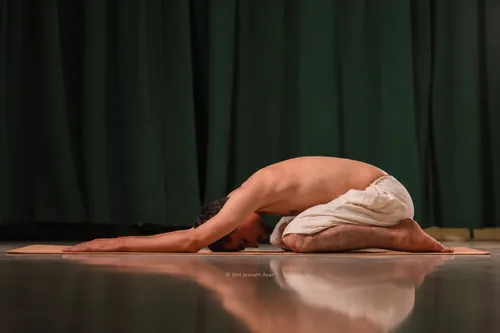 शशाङ्कासन
Sit the hips back onto the heels. Forehead to the mat, arms stretched forward. Now hum, with the mouth closed. Three times.
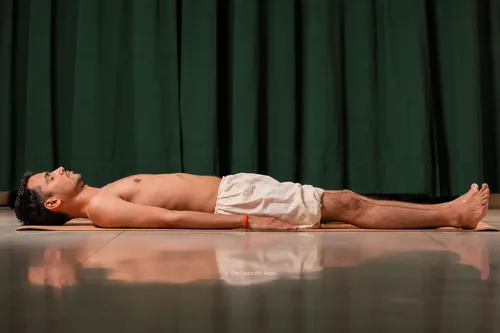 शवासन
Straighten the legs and lie down on your back. Legs a little apart, arms beside the body. Eyes closed. Now chant AUM three times, and feel the resonance travel the whole body.
Why this
In Bharata's Nāṭyaśāstra this is vīra rasa. Its lasting state is utsāha, energy; its colour gaura, light orange; its deity Indra; its notes ṣaḍja, ṛṣabha (Ghosh vol. 1: VI.17, VI.42 to 45, XIX.38 to 40). The lamp keeps that colour.
Bharata gives this state a quick tempo, druta laya; the excited intonation, dīpta kāku; and acute and quivering accents, udātta and kampita (Ghosh vol. 1: the tempo in the prose after XIX.58 to 59, p. 351; the intonation in XIX.58 to 59, p. 350; the accents in XIX.43, p. 347). So the sitting begins aloud, firm, fast. Where it ends, slow, is the same for every state: about six breaths a minute, the pace at which the rosary and a yoga mantra settled the breath when they were recited (Bernardi and others, BMJ 2001, 323, pp. 1446 to 1449). Ending every state there is ours.
Bharata wrote for an actor and an audience. Here you are both, and all of it is turned toward God. That turn is ours, not Bharata's.
It is the breath for restlessness. Energy that wants to act is given a measure to meet and a left and right to keep, and that is something to act on.
असतो मा: From the unreal, lead me to the real. From darkness, lead me to light. From death, lead me to the deathless.
Of Prahlāda's nine ways of bhakti (Śrīmad Bhāgavatam 7.5.23), this sitting really contains these: कीर्तन, aloud · स्मरण, in the mind · वन्दन, bowing. That every rasa can be turned toward God is Rūpa Gosvāmī's teaching, in his Bhaktirasāmṛtasindhu.