Overwhelmed, in wonder
Before what is too large, the hands rise, and then the head bows.
If mankind could but see though in a glimpse of fleeting experience what infinite enjoyments, what perfect forces, what luminous reaches of spontaneous knowledge, what wide calms of our being lie waiting for us in the tracts which our animal evolution has not yet conquered, they would leave all & never rest till they had gained these treasures. But the way is narrow, the doors are hard to force, and fear, distrust & scepticism are there, sentinels of Nature, to forbid the turning away of our feet from her ordinary pastures.
Sri Aurobindo, Thoughts and Aphorisms 5 (CWSA 12, p. 423) the whole of it →1the story
राहKauśalyā, who saw two children, and then the whole of Him›
निसि दिनDay and night
In Ayodhyā, Kauśalyā lived for her little son. She rocked him on her lap, laid him in his cradle and swung it, and sang of the things he did, and the days and nights went by without her noticing. 200
प्रेम मगन कौसल्या निसि दिन जात न जान।
सुत सनेह बस माता बालचरित कर गान॥
Lost in love, Kauśalyā did not notice the days and nights go by; held by love for her son, the mother sang of what the child did.
Rāmacaritamānasa, Bālakāṇḍa 200दो बालकTwo children
One day she bathed him, dressed him, and laid him in his cradle. Then she bathed herself and worshipped the Lord, the god of her family, set out the food offering, and went to the kitchen. When she came back to the shrine, she saw her son there, eating the offering. Frightened, she ran to the cradle. He was lying there, asleep. She came back to the shrine: her son was there. 201.1 to 3
गै जननी सिसु पहिं भयभीता। देखा बाल तहाँ पुनि सूता॥
बहुरि आइ देखा सुत सोई। हृदयँ कंप मन धीर न होई॥
इहाँ उहाँ दुइ बालक देखा। मतिभ्रम मोर कि आन बिसेषा॥
देखि राम जननी अकुलानी। प्रभु हँसि दीन्ह मधुर मुसुकानी॥
The mother went to the child, afraid, and saw the boy lying there asleep. She came back and saw her son, the same one; her heart shook and her mind could not be steady. Here and there she saw two children: is my mind deceived, or is this something else? Seeing his mother so shaken, the Lord laughed, and gave her a sweet smile.
Rāmacaritamānasa, Bālakāṇḍa 201.3 to 4रोम रोमEvery pore
देखरावा मातहि निज अद्भुत रूप अखंड।
रोम रोम प्रति लागे कोटि कोटि ब्रह्मंड॥
He showed his mother his own wondrous form, whole and unbroken: on every hair of his body hung millions upon millions of universes.
Rāmacaritamānasa, Bālakāṇḍa 201अगनित रबि ससि सिव चतुरानन। बहु गिरि सरित सिंधु महि कानन॥
काल कर्म गुन ग्यान सुभाऊ। सोउ देखा जो सुना न काऊ॥
Countless suns and moons, Śivas and four-faced Brahmās, many mountains, rivers, seas, lands and forests; time, action, the qualities, knowledge, the nature of things. She saw even what she had never so much as heard of.
Rāmacaritamānasa, Bālakāṇḍa 202.1She saw Māyā, dense in every way, standing in great fear with folded hands. She saw the soul that Māyā makes dance, and she saw the devotion that sets it free. 202.2
फिर शिशुSmall again
तन पुलकित मुख बचन न आवा। नयन मूदि चरननि सिरु नावा॥
बिसमयवंत देखि महतारी। भए बहुरि सिसुरूप खरारी॥
Her body thrilled; no word came to her lips. She shut her eyes and bowed her head at his feet. Seeing his mother overcome with wonder, Kharāri, the Lord, became a child again.
Rāmacaritamānasa, Bālakāṇḍa 202.3She could not even praise him; she was afraid. The Father of the world, and I took him for my son. And Hari comforted his mother in every way he could, and said: Do not tell this to anyone, Mother. 202.4
बार बार कौसल्या बिनय करइ कर जोरि।
अब जनि कबहूँ ब्यापै प्रभु मोहि माया तोरि॥
Again and again Kauśalyā prayed with folded hands: Lord, never let your Māyā take hold of me again.
Rāmacaritamānasa, Bālakāṇḍa 202बहुत अधिकToo much
This lamp is for the man who is overwhelmed. Something too big has come at once: the first clear morning in years, a feeling he has no name for, the size of what lies ahead, the size of what is behind. It shakes him the way it shook her. His heart trembles and his mind will not stay still.
Kauśalyā was not wrong to be afraid. Tulasī says it plainly: she trembled, she could not speak, she shut her eyes. Wonder this large comes with fear; the Bhāgavata's Yaśodā felt the same. Nobody in the story tells her to be braver.
And the Lord did not leave her there. He laughed first, gently, at her fright. Then, seeing her overcome, he became small again, a child she could hold. The whole of it was still there; it only took a size she could carry. That is the road from this lamp: not to stop the wonder, but to let it come down to the size of one breath, one line, one child in a cradle, and to go on from there.
The story: Tulasīdās, Rāmacaritamānasa, Bālakāṇḍa, dohās 200 to 202, read on the printed page of the Gita Press, Gorakhpur edition of the text alone (mūla), p. 89. The English of the verses and the telling are ours, and so is what it means for him.
4the word
A whole page of the Mother's diary, Prayers and Meditations, as she wrote it on this day: a prayer to the Divine, given entire. That it stands at this lamp is our choice.
The Mother · July 4, 1914
O Sovereign Force, O victorious Power, Purity, Beauty, supreme Love, grant that this being in its integrality, this body in all its totality may draw near to Thee solemnly and offer to Thee in a complete and humble surrender this means of manifestation abandoned perfectly to Thy Will, if not perfectly ready for this realisation. . . .
With the calm and strong certitude that Thou wilt one day accomplish the expected miracle and manifest in its fullness Thy sublime splendour, we turn to Thee in a profound rapture, and silently implore Thee. . . .
Immensity, Infinitude, Wonder. . . . Thou alone art and Thou shinest resplendent in all things. The hour of Thy fulfilment is near. All Nature is ingathered in a solemn concentration.
Thou answerest her ardent call.
The Mother, Prayers and Meditations, CWM 1, p. 192
If mankind could but see though in a glimpse of fleeting experience what infinite enjoyments, what perfect forces, what luminous reaches of spontaneous knowledge, what wide calms of our being lie waiting for us in the tracts which our animal evolution has not yet conquered, they would leave all & never rest till they had gained these treasures. But the way is narrow, the doors are hard to force, and fear, distrust & scepticism are there, sentinels of Nature, to forbid the turning away of our feet from her ordinary pastures.
Sri Aurobindo, Thoughts and Aphorisms 5 (CWSA 12, p. 423)From Thoughts and Aphorisms: about 1913 Sri Aurobindo wrote them in one notebook, under three headings, Knowledge, Works and Devotion, and never prepared them for publication. The Mother read them all aloud, one by one, from 1958 to 1970, and commented; that is On Thoughts and Aphorisms. Below: what stands beside this line, her comment on it, and why it is here.
The Mother, on it
What Sri Aurobindo has written, the words [“caught a glimpse”] which have been translated as entrevoyaient, means to see something in its totality, but for a very brief moment. It is obvious that a constant vision of all these wonders would automatically compel you to set out on the path. It is also certain that a little fragmentary glimpse is not enough — it would not have enough weight to compel you to follow the path. But if you had a total vision, however brief, you would not be able to resist the temptation of making the effort needed to realise it. But, in fact, the total vision is exceptional, and that is why Sri Aurobindo says to us: “If mankind only...”
Her talk goes on.
The Mother, On Thoughts and Aphorisms, CWM 10, p. 11Why it is here
Wonder at what is waiting, not at what was lost. Read whole, it also names fear, distrust and scepticism as what holds us to the old pastures, and the Mother’s talk goes on to that fear. The Mother read an earlier wording of the aphorism (“If mankind only caught a glimpse”), which is the one the Hindi translates. That reading is ours.
Read every aphorism with the Mother’s comments, on the Ashram’s site →
one long breath
5the sitting
Each group's cautions come with its own steps (Group 9's neck caution and the others).
What will you carry?
The sitting
Begin the sitting →Choose what you will carry, and the sitting opens.
It begins aloud, rising, fast, and slows a little in each posture, to about six breaths a minute. Each line is read in the mind as the breath comes in, white, and said aloud as it goes out, gold.
- ĀsanaOne posture of Daring, for as long as you stay. A rest is always one touch away.
- BreathA · U · M · three sounds on one breath
- JapaThe same word, seated.
- RestŚaśāṅkāsana or Śavāsana, either. Nothing to count.
Or one piece alone: Āsana · Breath · Japa · Rest
विश्राम · Rest
Śaśāṅkāsana or Śavāsana, either. Nothing to count.
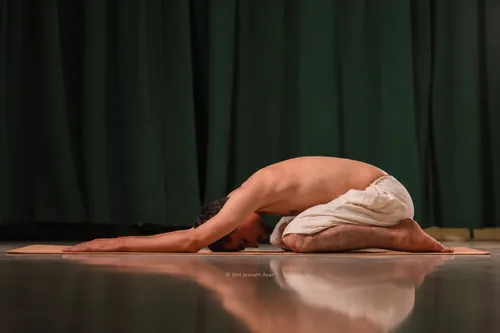 शशाङ्कासन
Sit the hips back onto the heels. Forehead to the mat, arms stretched forward. Now hum, with the mouth closed. Three times.
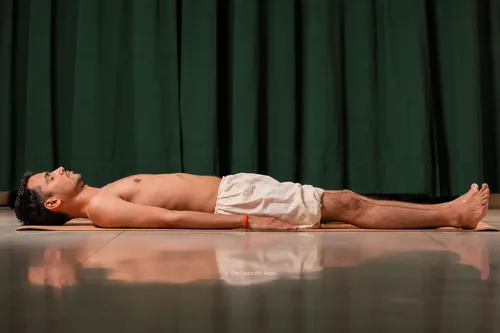 शवासन
Straighten the legs and lie down on your back. Legs a little apart, arms beside the body. Eyes closed. Now chant AUM three times, and feel the resonance travel the whole body.
Why this
In Bharata's Nāṭyaśāstra this is adbhuta rasa. Its lasting state is vismaya, astonishment; its colour pīta, yellow; its deity Brahman; its notes ṣaḍja, ṛṣabha (Ghosh vol. 1: VI.17, VI.42 to 45, XIX.38 to 40). The lamp keeps that colour.
Bharata gives this state a quick tempo, druta laya; the excited intonation, dīpta kāku; and acute and quivering accents, udātta and kampita (Ghosh vol. 1: the tempo in the prose after XIX.58 to 59, p. 351; the intonation in XIX.58 to 59, p. 350; the accents in XIX.43, p. 347). So the sitting begins aloud, rising, fast. Where it ends, slow, is the same for every state: about six breaths a minute, the pace at which the rosary and a yoga mantra settled the breath when they were recited (Bernardi and others, BMJ 2001, 323, pp. 1446 to 1449). Ending every state there is ours.
Bharata wrote for an actor and an audience. Here you are both, and all of it is turned toward God. That turn is ours, not Bharata's.
It is the breath of the strong states: anger, sadness, craving and wonder. None of them is asked to leave. Each is given a sound that goes out, and ends in silence.
ॐ नमो भगवते: The Mother's mantra, for the moment when what is here is too large to hold.
Of Prahlāda's nine ways of bhakti (Śrīmad Bhāgavatam 7.5.23), this sitting really contains these: कीर्तन, aloud · स्मरण, in the mind · वन्दन, bowing. That every rasa can be turned toward God is Rūpa Gosvāmī's teaching, in his Bhaktirasāmṛtasindhu.