Afraid, anxious
Fear is being awake too. Here it bows, and rises again.
Perfect love casts out fear; but still keep thou some tender shadow and memory of the exile and it will make the perfection more perfect.
Sri Aurobindo, Thoughts and Aphorisms 416 (CWSA 12, p. 482) the whole of it →1the story
राहGajendra, whose strength ran out in the lake›
झुंड का राजाThe king of the herd
On the mountain called Trikūṭa lived the lord of a herd of elephants. He went through the forest breaking whole trees as he walked, thorns, bamboo and all. At the mere scent of him lions and other elephants, tigers and rhinoceros, great serpents, wolves and boars fled, and the small creatures, the deer and the hares, wandered without fear because he let them. When he walked, the mountain shook. 8.2.20 to 23
One hot day, with his eyes rolling in the heat of his musth, he caught the scent of lotuses on the wind and led his thirsty herd down to a lake. He plunged in and drank deep, and the tiredness went out of him. He filled his trunk and sprayed his mates and his calves, giving them water to drink, bathing them, like a man looking after his house. Wild with his musth, he did not see what was coming. 8.2.24 to 26
स पुष्करेणोद्धृतशीकराम्बुभिर्निपाययन्संस्नपयन्यथा गृही।
घृणी करेणुः करभांश्च दुर्मदो नाचष्ट कृच्छ्रं कृपणोऽजमायया॥Bhāgavata 8.2.26
पकड़The grip
A crocodile, stronger than he was, took him by the foot in its anger. The mightiest creature of that mountain was caught. He fought with all the strength he had. His mates cried out to see their lord dragged away; the other elephants came to his aid, pulled at him from behind, and could not free him. 8.2.27 to 28
हज़ार बरसA thousand years
So the elephant and the crocodile fought, each dragging the other, in toward the water and out toward the shore, and a thousand years went by. The gods watched and could not believe that both were still alive. 8.2.29
ततो गजेन्द्रस्य मनोबलौजसां कालेन दीर्घेण महानभूद्व्ययः।
विकृष्यमाणस्य जलेऽवसीदतो विपर्ययोऽभूत्सकलं जलौकसः॥Bhāgavata 8.2.30
And in that long time his strength of mind, of body and of spirit was spent. He was dragged, he sank in the water, and for the one whose home the water was, all of it went the other way. 8.2.30
पुकारThe call
When he could do nothing more to free himself, a thought came to him, slowly, after long brooding. 8.2.31 to 33
न मामिमे ज्ञातय आतुरं गजाः कुतः करिण्यः प्रभवन्ति मोचितुम्।
ग्राहेण पाशेन विधातुरावृतोऽप्यहं च तं यामि परं परायणम्॥Bhāgavata 8.2.32
My own kin, these elephants, cannot free me in my distress; how could my mates? I am held by this crocodile as by the noose of fate. And still I go to Him, the highest refuge: the One who guards whoever comes to Him in fear, and from whose fear death itself runs. 8.2.32 to 33
And from the water he began to pray. His first words are the words this site gives to wonder: 8.3.2
ॐ नमो भगवते तस्मै यत एतच्चिदात्मकम्।
पुरुषायादिबीजाय परेशायाभिधीमहि॥Bhāgavata 8.3.2
Om, salutation to the Lord, from whom all this, which is consciousness, comes; to the Person, the first seed, the highest Lord, we turn our minds. The whole of his prayer is this lamp's hymn, the third door. 8.3.2 to 29
कमलThe lotus
His prayer was to the One without qualities, not to any one form, so Brahmā and the other gods, each taken up with his own form, did not come. Hari, who is all of them, came: carried by Garuḍa, whose body is the metres of the Vedas, the discus in His hand, quickly, to where Gajendra was. 8.3.30 to 31
सोऽन्तःसरस्युरुबलेन गृहीत आर्तो दृष्ट्वा गरुत्मति हरिं ख उपात्तचक्रम्।
उत्क्षिप्य साम्बुजकरं गिरमाह कृच्छ्रान्नारायणाखिलगुरो भगवन्नमस्ते॥Bhāgavata 8.3.32
Still in the middle of the lake, still held by that great strength, in pain, he saw Hari in the sky on Garuḍa, and he lifted his trunk with a lotus in it, and with difficulty he said: Nārāyaṇa, teacher of all, Lord, I bow to You. 8.3.32
With difficulty. Not a shout of victory. Not a fine hymn now. A few words, got out, and one lotus held up out of the water. It was all he had left, and it was enough.
तं वीक्ष्य पीडितमजः सहसावतीर्य सग्राहमाशु सरसः कृपयोज्जहार।
ग्राहाद्विपाटितमुखादरिणा गजेन्द्रं संपश्यतां हरिरमूमुचदुच्छ्रियाणाम्॥Bhāgavata 8.3.33
Seeing him in pain, the Unborn came down at once and drew him out of the lake, the crocodile and all, out of compassion. And while everyone watched, He freed Gajendra from the jaws. 8.3.33
उसका सरोवरHis lake
Every Jyotirgana has been the king of the herd. Strong, the one others leaned on, walking down to the water on a hot day because it was cool and it smelt of lotuses. Nobody goes into the lake to be caught.
Then the grip, and the years. The family pulled from behind and could not free him, and that was not their failure. The story is honest about it: a thousand years, his strength of mind and body and spirit spent. It does not call him weak for that. It calls him the king of the herd to the very end.
And the call did not come from his strength. It came when his strength was gone. That is the fear this lamp is for: the fear of the one who has tried everything and is still held. The story does not promise that the grip will loosen tomorrow. It tells what Gajendra did when nothing was left: he lifted the one lotus he had and said the few words he could. With difficulty is enough.
The story: the Bhāgavata Purāṇa, 8.2.20 to 8.3.33, read in Sanskrit in the GRETIL e-text (Ulrich Stiehl); the verse numbers are that text's. The telling in English is ours, and so is what it means for him.
3the hymn
Two hymns for this lamp. Either one; both end in the same page.
गजेन्द्रस्तुति · Gajendra's Stuti →The hymn of the king of elephants, held in the lake by a crocodile, when his strength was gone and only the call was left.Then a page of the Mother's diary, read in silence, and śānta.हनुमान चालीसा · Hanumān Cālīsā →Forty caupāīs to Hanumān, in Awadhi: no ghost comes near when his name is said, and every trouble is cut.Then a page of the Mother's diary, read in silence, and śānta.4the word
A whole page of the Mother's diary, Prayers and Meditations, as she wrote it on this day: a prayer to the Divine, given entire. That it stands at this lamp is our choice.
The Mother · December 3, 1912
Last night I had the experience of the effectivity of confident surrender to Thy guidance; when it is needful that something should be known, one knows it, and the more passive the mind to Thy illumination, the clearer and the more adequate is its expression.
I listened to Thee as Thou spokest in me, and I would have liked to write down what Thou saidst so that the formula in all its precision might not be lost, — for now I should not be able to repeat what was said. Then I thought that this care for conservation was again an insulting lack of confidence towards Thee, for Thou canst make of me all that I need to be, and in the measure in which my attitude allows Thee to act on me and in me, Thy omnipotence has no limits. To know that at each instant what must be surely is, as perfectly as is possible, for all those who know how to see Thee in everything and everywhere! No more fear, no more uneasiness, no more anguish; nothing but a perfect Serenity, an absolute Confidence, a supreme unwavering Peace.
The Mother, Prayers and Meditations, CWM 1, p. 9
Perfect love casts out fear; but still keep thou some tender shadow and memory of the exile and it will make the perfection more perfect.
Sri Aurobindo, Thoughts and Aphorisms 416 (CWSA 12, p. 482)From Thoughts and Aphorisms: about 1913 Sri Aurobindo wrote them in one notebook, under three headings, Knowledge, Works and Devotion, and never prepared them for publication. The Mother read them all aloud, one by one, from 1958 to 1970, and commented; that is On Thoughts and Aphorisms. Below: what stands beside this line, her comment on it, and why it is here.
Beside it, Sri Aurobindo
To fear God really is to remove oneself to a distance from Him, but to fear Him in play gives an edge to utter delightfulness.
Sri Aurobindo, Thoughts and Aphorisms 413 (CWSA 12, p. 482)Why it is here
These aphorisms are about the soul’s fear before God, inside love; not the fear of the street, of the night or of the body. It stands here for what it says plainly: fear is not driven out by force, and what is kept of it can be made tender. The Mother left no comment on this one. That reading is ours.
Read every aphorism with the Mother’s comments, on the Ashram’s site →
one long breath
5the sitting
With fear and anxiety, the breath is not held anywhere on this path.
Each group's cautions come with its own steps (Group 9's neck caution and the others).
What will you carry?
The sitting
Begin the sitting →Choose what you will carry, and the sitting opens.
It begins aloud, low and fast, and slows a little in each posture, to about six breaths a minute. Each line is read in the mind as the breath comes in, white, and said aloud as it goes out, gold.
- Āsana2 postures of Ascent, each with the word several times
- BreathHaṃsa · the breath's own two syllables
- JapaThe same word, seated.
- RestŚaśāṅkāsana or Śavāsana, either. Nothing to count.
Or one piece alone: Āsana · Breath · Japa · Rest
विश्राम · Rest
Śaśāṅkāsana or Śavāsana, either. Nothing to count.
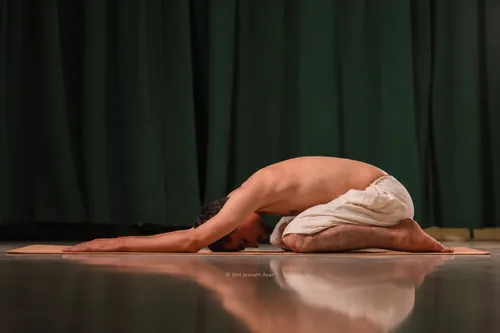 शशाङ्कासन
Sit the hips back onto the heels. Forehead to the mat, arms stretched forward. Now hum, with the mouth closed. Three times.
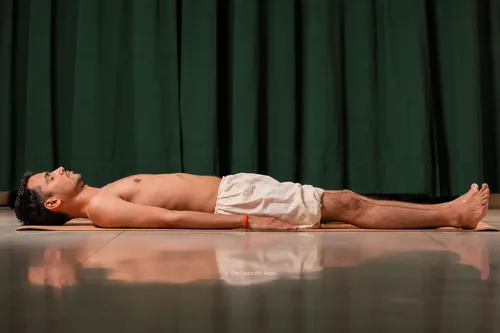 शवासन
Straighten the legs and lie down on your back. Legs a little apart, arms beside the body. Eyes closed. Now chant AUM three times, and feel the resonance travel the whole body.
Why this
In Bharata's Nāṭyaśāstra this is bhayānaka rasa. Its lasting state is bhaya, terror; its colour kṛṣṇa, black; its deity Yama (Kāla); its notes dhaivata (Ghosh vol. 1: VI.17, VI.42 to 45, XIX.38 to 40). The lamp keeps that colour.
Bharata gives this state a quick tempo, druta laya; an intonation fast and low; and grave, circumflex and quivering accents, anudātta, svarita and kampita (Ghosh vol. 1: the tempo in the prose after XIX.58 to 59, p. 351; the intonation in XIX.58 to 59, p. 350; the accents in XIX.43, p. 347). So the sitting begins aloud, low and fast. Where it ends, slow, is the same for every state: about six breaths a minute, the pace at which the rosary and a yoga mantra settled the breath when they were recited (Bernardi and others, BMJ 2001, 323, pp. 1446 to 1449). Ending every state there is ours.
Bharata wrote for an actor and an audience. Here you are both, and all of it is turned toward God. That turn is ours, not Bharata's.
It is the breath for fear and for shame, for lightness, and for the times you cannot tell what is here. In and out are the same length, and nothing on this page asks the breath to stop.
महामृत्युञ्जय: As a ripe cucumber comes away from its stalk, may I come away from death, and not from the deathless.
On this site it serves: The first days.
Of Prahlāda's nine ways of bhakti (Śrīmad Bhāgavatam 7.5.23), this sitting really contains these: कीर्तन, aloud · स्मरण, in the mind · वन्दन, bowing. That every rasa can be turned toward God is Rūpa Gosvāmī's teaching, in his Bhaktirasāmṛtasindhu.