Ashamed, disgusted with myself
Shame believes something was taken away. Even when the whole is taken from the whole, the whole remains.
There is no sin in man, but a great deal of disease, ignorance and misapplication.
Sri Aurobindo, Thoughts and Aphorisms 67 (CWSA 12, p. 430) the whole of it →1the story
राहBhartṛhari, who said: shame on all of them, and on me›
अमर फलThe fruit
Long ago, in Ujjayinī, King Bhartṛhari sat in his court among the kings who served him. A brahmin came in holding a flawless fruit, blessed him, and gave it to him. Where did this come from, the king asked; there are many fruits, but none like this. Lord, said the brahmin, I worshipped a goddess for twenty-one days, and she was pleased, and gave me this fruit and said: eat it, and you will never grow old and never die. Then I thought: what good is it in the world if I live for ever? Let the one by whom the world lives live for ever. So I have brought it to you. Dhanasāragaṇi on 1.1
हाथ से हाथHand to hand
The king rewarded him. But in his own mind he thought: if I live and the one I love dies, I shall live in sorrow. My chief queen is dearer to me than life. And he sent the fruit to her by a maid. The queen thought: there is one I love too; if he dies, what shall I do? And she gave it to the keeper of the royal elephants. He loved a maidservant of the palace, and gave it to her. And the maidservant thought: if I go on living for ever, living as I do, in misery, who is raised up by that? And she gave the fruit to the king. Dhanasāragaṇi on 1.1
सचThe truth
The king turned the fruit over and over in his hands and looked at it, and asked the maid: who gave you this? He pressed her, and she told the truth: the elephant-keeper. He asked the keeper, and the keeper said: the queen. Knowing what had happened, the king's heart turned. He went into the women's rooms and asked the queen for the fruit. With a faltering voice she said: Lord, I have eaten it. Dhanasāragaṇi on 1.1
Hearing that, the commentary says, his mind was filled with the waves of vairāgya. Ah, he said, the crooked play of this world. And he said: Dhanasāragaṇi on 1.1
यां चिन्तयामि सततं मयि सा विरक्ता साऽप्यन्यमिच्छति जनं स जनोऽन्यसक्तः।
अस्मत्कृते च परिशुष्यति काचिदन्या धिक् तां च तं च मदनं च इमां च मां च॥Bhartṛhari, Śatakatraya (Kosambi) 1.1
She of whom I think without end is turned away from me. She wants another man, and he is held by another. And some other woman wastes away for my sake. Shame on her, and on him, and on Love, and on this one, and on me. 1.1
और मुझ परAnd on me
In the wider tradition, Bhartṛhari then left his throne and lived as a yogī, and his name is on a cave in Ujjain. The commentary itself does not say he punished anyone. It says only that the world turned in him, and that he said this verse, which does not leave himself out.
उसकी घिनHis disgust
This lamp is for the man who is sick of himself. He has looked at the chain he is part of: what he gave away, who he gave it to, who gave him what, and what came back round to him in the end. He feels a disgust that does not spare anyone, and least of all himself.
Look at the fruit. It was the most precious thing in the kingdom, and every person who held it gave it away, each to the one they loved, and each of those loved someone else. Nobody in the story is a villain. Each one was looking for love in a place that was looking somewhere else. That is what craving is: a love pointed where it is not returned. And the fruit came back to the king's own hand.
Bhartṛhari's 'and on me' was not the end of him. It was where he began. The disgust that sees clearly, himself included, did not make him punish himself; it set him free of the chain. His disgust is not proof that he is worthless. It is the moment the chain becomes visible. What he does with that moment is this lamp's practice: the other answer.
The verse: Bhartṛhari, Nītiśataka 1, in D. D. Kosambi's edition with Dhanasāragaṇi's commentary, the oldest known (Singhi Jain Series 29, Bombay, 1959), read on the printed page, p. 1. The story of the fruit is the one that commentary tells under the verse, pp. 1 to 2, and is told here as the commentary's. That he became a yogī is the wider tradition. The telling in English is ours, and so is what it means for him.
4the word
A whole page of the Mother's diary, Prayers and Meditations, as she wrote it on this day: a prayer to the Divine, given entire. That it stands at this lamp is our choice.
The Mother · March 19, 1914
O Lord, eternal Teacher, Thou whom we can neither name nor understand, but whom we want to realise more and more at every moment, enlighten our intelligence, illumine our hearts, transfigure our consciousness; may everyone awaken to the true life, flee from egoism and its train of sorrow and anguish, and take refuge in Thy divine and pure Love, source of all peace and all happiness. My heart so full of Thee seems to expand into infinity and my intelligence, all illumined with Thy Presence, shines like the purest diamond. Thou art the wonderful magician, he who transfigures all things, from ugliness brings forth beauty, from darkness light, from the mud clear water, from ignorance knowledge and from egoism goodness.
In Thee, by Thee, for Thee we live and Thy law is the supreme master of our life.
May Thy will be done in every place, may Thy peace reign upon all the earth.
The Mother, Prayers and Meditations, CWM 1, p. 103
There is no sin in man, but a great deal of disease, ignorance and misapplication.
Sri Aurobindo, Thoughts and Aphorisms 67 (CWSA 12, p. 430)From Thoughts and Aphorisms: about 1913 Sri Aurobindo wrote them in one notebook, under three headings, Knowledge, Works and Devotion, and never prepared them for publication. The Mother read them all aloud, one by one, from 1958 to 1970, and commented; that is On Thoughts and Aphorisms. Below: what stands beside this line, her comment on it, and why it is here.
Beside it, Sri Aurobindo
The sense of sin was necessary in order that man might become disgusted with his own imperfections. It was God’s corrective for egoism. But man’s egoism meets God’s device by being very dully alive to its own sins and very keenly alive to the sins of others.
Sri Aurobindo, Thoughts and Aphorisms 68 (CWSA 12, p. 430)Why it is here
He writes of sin, not of a habit or a substance. It stands here because a man ashamed of himself has often been called a sinner for years; Sri Aurobindo’s word is disease, ignorance and misapplication, which can be healed, learned and turned. The aphorism after it says why the sense of sin came at all. The Mother read the two together; her comment that day (27 July 1961) is on egoism. That reading is ours.
Read every aphorism with the Mother’s comments, on the Ashram’s site →
one long breath
5the sitting
Each group's cautions come with its own steps (Group 9's neck caution and the others).
What will you carry?
The sitting
Begin the sitting →Choose what you will carry, and the sitting opens.
It begins aloud, low and fast, and slows a little in each posture, to about six breaths a minute. Each line is read in the mind as the breath comes in, white, and said aloud as it goes out, gold.
- Āsana3 postures of Daring, each with the word several times
- BreathHaṃsa · the breath's own two syllables
- JapaThe same word, seated.
- RestŚaśāṅkāsana or Śavāsana, either. Nothing to count.
Or one piece alone: Āsana · Breath · Japa · Rest
विश्राम · Rest
Śaśāṅkāsana or Śavāsana, either. Nothing to count.
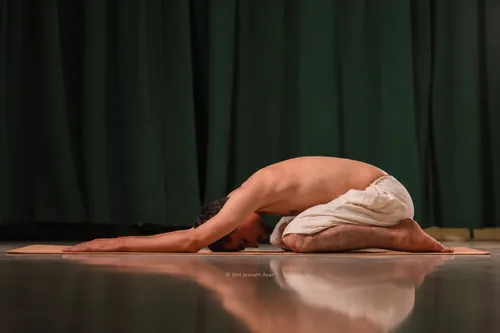 शशाङ्कासन
Sit the hips back onto the heels. Forehead to the mat, arms stretched forward. Now hum, with the mouth closed. Three times.
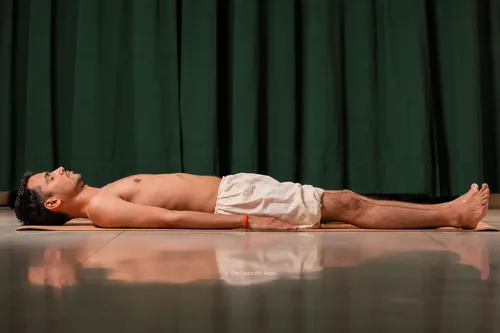 शवासन
Straighten the legs and lie down on your back. Legs a little apart, arms beside the body. Eyes closed. Now chant AUM three times, and feel the resonance travel the whole body.
Why this
In Bharata's Nāṭyaśāstra this is bībhatsa rasa. Its lasting state is jugupsā, disgust; its colour nīla, blue; its deity Śiva (Mahākāla); its notes dhaivata (Ghosh vol. 1: VI.17, VI.42 to 45, XIX.38 to 40). The lamp keeps that colour.
Bharata gives this state a quick tempo, druta laya; an intonation fast and low; and grave, circumflex and quivering accents, anudātta, svarita and kampita (Ghosh vol. 1: the tempo in the prose after XIX.58 to 59, p. 351; the intonation in XIX.58 to 59, p. 350; the accents in XIX.43, p. 347). So the sitting begins aloud, low and fast. Where it ends, slow, is the same for every state: about six breaths a minute, the pace at which the rosary and a yoga mantra settled the breath when they were recited (Bernardi and others, BMJ 2001, 323, pp. 1446 to 1449). Ending every state there is ours.
Bharata wrote for an actor and an audience. Here you are both, and all of it is turned toward God. That turn is ours, not Bharata's.
It is the breath for fear and for shame, for lightness, and for the times you cannot tell what is here. In and out are the same length, and nothing on this page asks the breath to stop.
पूर्णमदः: That is whole. This is whole. From the whole, the whole arises. When the whole is taken from the whole, the whole alone remains.
On this site it serves: Shame, and being alone.
Of Prahlāda's nine ways of bhakti (Śrīmad Bhāgavatam 7.5.23), this sitting really contains these: कीर्तन, aloud · स्मरण, in the mind · वन्दन, bowing. That every rasa can be turned toward God is Rūpa Gosvāmī's teaching, in his Bhaktirasāmṛtasindhu.