Amused, light
Lightness is practice too. Here it plays, and calls its mother.
To the soul that has hold of the highest beatitude, life cannot be an evil or a sorrowful illusion; rather all life becomes the rippling love and laughter of a divine Lover & Playfellow.
Sri Aurobindo, Thoughts and Aphorisms 491 (CWSA 12, p. 492) the whole of it →1the story
राहThe child who ate earth, and his mother who could not scold him›
कीचड़ में दो बालकTwo boys in the mud
In Gokula, Rāma and Keśava, Balarāma and Kṛṣṇa, were crawling on their hands and knees. They dragged their little feet through the mud of the cow-pens, loved the jingle of their own anklets, followed any stranger who passed, then took fright and scrambled back to their mothers. Their mothers picked them up, mud and all, as if the mud were sandal paste. When they could walk, they caught the calves by the tail and were dragged round the yard, and the women left their housework to watch and laughed. 10.8.21 to 24
उलाहनेThe complaints
The gopīs came to Yaśodā in a crowd, where she could hear them, and made their complaints. 10.8.28 to 29
वत्सान्मुञ्चन्क्वचिदसमये क्रोशसञ्जातहासः स्तेयं स्वाद्वत्त्यथ दधिपयः कल्पितैः स्तेययोगैः।
मर्कान्भोक्ष्यन्विभजति स चेन्नात्ति भाण्डं भिन्नत्ति द्रव्यालाभे सगृहकुपितो यात्युपक्रोश्य तोकान्॥Bhāgavata 10.8.29
He lets the calves loose before milking time, and when we shout, he laughs. He steals our curd and milk, by tricks he has worked out, and eats the sweet things he has stolen. He shares it out to the monkeys, and if a monkey will not eat, he breaks the pot. If there is nothing to steal, he is angry with the whole house, and makes the babies cry, and goes. If the pot hangs too high, he piles up stools and the mortar. He makes holes in the hanging pots. In a dark storeroom the jewels on his own body give him light. 10.8.29 to 30
And after all that, they said, there he sits, looking as good as gold. And as they told it, the women kept glancing at his lovely frightened face; and Yaśodā laughed, and could not bring herself to scold him. 10.8.31
मिट्टीThe mud
One day, while they were playing, the boys, Balarāma among them, ran to his mother: Kṛṣṇa has eaten mud! Yaśodā took him by the hand. She was afraid for him, and her eyes showed it. Why did you eat mud in secret, you naughty boy? Your friends all say so, and so does your elder brother. 10.8.32 to 34
नाहं भक्षितवानम्ब सर्वे मिथ्याभिशंसिनः।
यदि सत्यगिरस्तर्हि समक्षं पश्य मे मुखम्॥Bhāgavata 10.8.35
I didn't eat it, Mother. They are all lying about me. If they are telling the truth, look in my mouth yourself. Then open it, she said. And Hari, the Lord whose power nothing can stop, a little boy playing at being a little boy, opened his mouth. 10.8.35 to 36
उसके मुँह मेंIn his mouth
सा तत्र ददृशे विश्वं जगत्स्थास्नु च खं दिशः।
साद्रिद्वीपाब्धिभूगोलं सवाय्वग्नीन्दुतारकम्॥Bhāgavata 10.8.37
There she saw the whole universe: all that moves and all that stands, the sky and the directions, the round earth with its mountains, islands and oceans, the wind and fire, the moon and the stars, the senses and the mind, time and the nature of things. And in it she saw Vraja, and herself. She was afraid. Is this a dream, she asked, or the Lord's illusion, or has my own mind gone wrong? And she bowed to That which no thought can reach. 10.8.37 to 42
Then the Lord spread over her His own māyā, the one made of a mother's love. At once she forgot what she had seen. She took her son on her lap, and her heart was full of love for him, as before. 10.8.43 to 44
उसकी हँसीHis laughter
Most of what a Jyotirgana has heard for years is scolding. From the house, from the village, from the clinic, from himself. He has forgotten that he is allowed to laugh, or he laughs and feels he has no right to.
In this story the Lord of all the worlds is a boy who steals butter, lies to his mother with a straight face and gets caught. The Bhāgavata tells it with a smile, and the women who complain are laughing while they complain. And Yaśodā, who had every reason to scold, laughed instead, and could not. The laughter was not his excuse. It was how she saw him.
And when she looked into the mouth of the boy who had eaten dirt, the whole universe was in it. That is where this lamp's road goes: from a laugh to wonder, and from wonder back into love. He is allowed to laugh, at the world and at himself. A God who plays in the mud is not far from the man who has been in it.
The story: the Bhāgavata Purāṇa, 10.8.21 to 45, read in Sanskrit in the GRETIL e-text (Ulrich Stiehl); the verse numbers are that text's. The telling in English is ours, and so is what it means for him.
4the word
A whole page of the Mother's diary, Prayers and Meditations, as she wrote it on this day: a prayer to the Divine, given entire. That it stands at this lamp is our choice.
The Mother · May 17, 1914
O Lord, deliver me from the mental influences which weigh upon me, so that, completely free, I may soar towards Thee.
O Thou, Universal Being, Supreme Unity in perceptible form, through an irresistible aspiration I nestled within Thy heart, then I was Thy heart itself, and I knew then that Thy heart is no other than the Child who plays and creates the worlds. Thou didst tell me, “One day thou wilt be my head but for the moment turn thy gaze towards the earth.” And on the earth now I am the joyful child who plays.
These were the two sentences I wrote yesterday by a kind of absolute necessity. The first, as though the power of the prayer would not be complete unless it were traced on paper. The second, as though the stability of the experience could not be had unless I unburdened my mind of it by noting it down in writing.
The Mother, Prayers and Meditations, CWM 1, p. 145
To the soul that has hold of the highest beatitude, life cannot be an evil or a sorrowful illusion; rather all life becomes the rippling love and laughter of a divine Lover & Playfellow.
Sri Aurobindo, Thoughts and Aphorisms 491 (CWSA 12, p. 492)From Thoughts and Aphorisms: about 1913 Sri Aurobindo wrote them in one notebook, under three headings, Knowledge, Works and Devotion, and never prepared them for publication. The Mother read them all aloud, one by one, from 1958 to 1970, and commented; that is On Thoughts and Aphorisms. Below: what stands beside this line, her comment on it, and why it is here.
Beside it, Sri Aurobindo
Living in Krishna, even enmity becomes a play of love and the wrestling of brothers.
Sri Aurobindo, Thoughts and Aphorisms 490 (CWSA 12, p. 492)The Mother, on it
To know how to keep the Divine contact in all circumstances is the secret of beatitude.
The Mother, On Thoughts and Aphorisms, CWM 10, p. 348, 21 April 1970Why it is here
The laughter here is the soul’s, at the heart of life, not a joke at anyone’s expense. The aphorism before it and the Mother’s comment say where it comes from: living in Krishna, keeping the Divine contact. That reading is ours.
Read every aphorism with the Mother’s comments, on the Ashram’s site →
one long breath
5the sitting
Each group's cautions come with its own steps (Group 9's neck caution and the others).
What will you carry?
This state's own word is माँ.
The sitting
Begin the sitting →Choose what you will carry, and the sitting opens.
It begins aloud, bright, unhurried, and slows a little in each posture, to about six breaths a minute. Each line is read in the mind as the breath comes in, white, and said aloud as it goes out, gold.
- ĀsanaWidening, each posture once
- BreathHaṃsa · the breath's own two syllables
- JapaThe same word, seated.
- RestŚaśāṅkāsana or Śavāsana, either. Nothing to count.
Or one piece alone: Āsana · Breath · Japa · Rest
विश्राम · Rest
Śaśāṅkāsana or Śavāsana, either. Nothing to count.
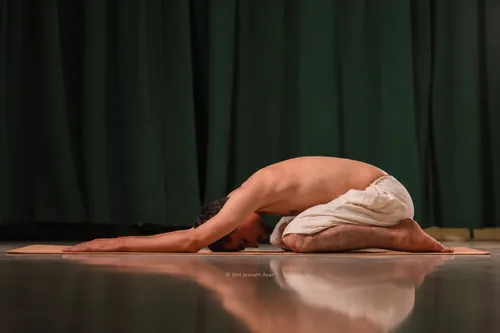 शशाङ्कासन
Sit the hips back onto the heels. Forehead to the mat, arms stretched forward. Now hum, with the mouth closed. Three times.
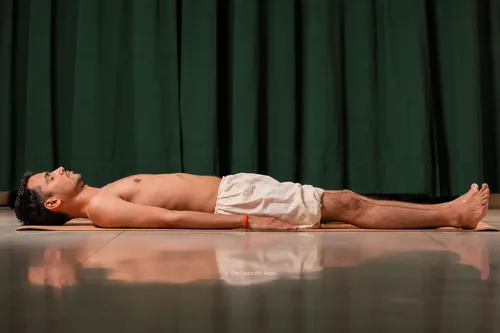 शवासन
Straighten the legs and lie down on your back. Legs a little apart, arms beside the body. Eyes closed. Now chant AUM three times, and feel the resonance travel the whole body.
Why this
In Bharata's Nāṭyaśāstra this is hāsya rasa. Its lasting state is hāsa, mirth; its colour sita, white; its deity the Pramathas; its notes madhyama, pañcama (Ghosh vol. 1: VI.17, VI.42 to 45, XIX.38 to 40). The lamp keeps that colour.
Bharata gives this state a medium tempo, madhya laya; a slow intonation; and acute and circumflex accents, udātta and svarita (Ghosh vol. 1: the tempo in the prose after XIX.58 to 59, p. 351; the intonation in XIX.58 to 59, p. 350; the accents in XIX.43, p. 347). So the sitting begins aloud, bright, unhurried. Where it ends, slow, is the same for every state: about six breaths a minute, the pace at which the rosary and a yoga mantra settled the breath when they were recited (Bernardi and others, BMJ 2001, 323, pp. 1446 to 1449). Ending every state there is ours.
Bharata wrote for an actor and an audience. Here you are both, and all of it is turned toward God. That turn is ours, not Bharata's.
It is the breath for fear and for shame, for lightness, and for the times you cannot tell what is here. In and out are the same length, and nothing on this page asks the breath to stop.
माँ: A child calling its mother.
On this site it serves: Nothing feels good.
Of Prahlāda's nine ways of bhakti (Śrīmad Bhāgavatam 7.5.23), this sitting really contains these: कीर्तन, aloud · स्मरण, in the mind · वन्दन, bowing. That every rasa can be turned toward God is Rūpa Gosvāmī's teaching, in his Bhaktirasāmṛtasindhu.