Sad
Sadness knows how to bow. Here it bows with the whole body on the ground.
Pain is the touch of our Mother teaching us how to bear and grow in rapture. She has three stages of her schooling, endurance first, next equality of soul, last ecstasy.
Sri Aurobindo, Thoughts and Aphorisms 93 (CWSA 12, p. 433) the whole of it →1the story
राहVālmīki, whose grief became the first verse›
तमसाThe river
Nārada had just told Vālmīki the story of Rāma and gone back to the sky. A little later the sage walked down to the Tamasā, not far from the Gaṅgā, with his pupil Bharadvāja beside him. He looked at the bathing place and stopped. 1.2.1 to 8
अकर्दममिदं तीर्थं भरद्वाज निशामय।
रमणीयं प्रसन्नाम्बु सन्मनुष्यमनो यथा॥Rāmāyaṇa 1.2.5
Look, Bharadvāja, there is no mud at this ford. The water is lovely and clear, like the mind of a good man. He took his bark cloth from the boy's hands and walked along the bank, looking at the wide forest all round. 1.2.5 to 8
क्रौञ्चThe pair
Near him a pair of krauñca birds were moving together, never apart, calling sweetly to each other. And while he watched, a hunter, a man set on harm, shot the male. 1.2.9 to 10
तं शोणितपरीताङ्गं वेष्टमानं महीतले।
भार्या तु निहतं दृष्ट्वा रुराव करुणां गिरम्॥Rāmāyaṇa 1.2.11
He lay writhing on the ground, his body covered in blood, and his mate saw him struck down and cried out, a cry full of grief. And seeing the bird brought down by the hunter, compassion came over the sage. 1.2.11 to 12
आहThe cry
Hearing the hen weep, the words came out of him before he knew it: 1.2.13
मा निषाद प्रतिष्ठां त्वमगमः शाश्वतीः समाः।
यत्क्रौञ्चमिथुनादेकमवधीः काममोहितम्॥Rāmāyaṇa 1.2.14
Hunter, may you find no rest for endless years, for you have killed one of a pair of krauñcas, lost in their love. 1.2.14
श्लोकThe verse
Then he stopped, troubled. What is this I have said, stricken with grief for a bird? He thought about it, and he heard what it was, and he turned to his pupil. 1.2.15 to 16
पादबद्धोऽक्षरसमस्तन्त्रीलयसमन्वितः।
शोकार्तस्य प्रवृत्तो मे श्लोको भवतु नान्यथा॥Rāmāyaṇa 1.2.17
Bound in feet, even in its syllables, fit for the lute and the beat: what came out of me in my grief, let it be a śloka, and nothing else. The boy learned it by heart, glad, and his teacher was glad of it. Vālmīki bathed and walked back to his hermitage, still turning it over. 1.2.17 to 19
ब्रह्मा हँसेBrahmā laughs
Then Brahmā himself came to see him. Vālmīki bowed, gave him a seat, and sat before him; but his mind was still on the bird. A cruel thing, he thought, to kill a creature that sang so sweetly, for no reason. And grieving for the hen again and again, lost in his grief, he sang the verse once more, there in front of Brahmā. 1.2.22 to 28
तमुवाच ततो ब्रह्मा प्रहसन्मुनिपुंगवम्।
श्लोक एव त्वया बद्धो नात्र कार्या विचारणा॥Rāmāyaṇa 1.2.29
And Brahmā laughed and said to him: it is a śloka you have made; there is nothing to doubt. It was by my will that this speech came to you. Now tell the whole story of Rāma, as you heard it from Nārada, in verse like this. As long as the mountains stand and the rivers run on the earth, the story of Rāma will go on among people. 1.2.29 to 35
शोक श्लोक बनाGrief became verse
Brahmā vanished. Vālmīki and his pupils were left in wonder. And the pupils sang the verse again and again, delighted, astonished, and said to each other: 1.2.37 to 38
समाक्षरैश्चतुर्भिर्यः पादैर्गीतो महर्षिणा।
सोऽनुव्याहरणाद्भूयः शोकः श्लोकत्वमागतः॥Rāmāyaṇa 1.2.39
What the great sage sang in four feet of even syllables, by being said again and again, the grief became a verse. And he made the whole Rāmāyaṇa in such verses. 1.2.39 to 41
उसका शोकHis grief
Every Jyotirgana carries grief. Some of it is his own: the years, the work, the name he had in the village. Some of it is for others: a friend who did not come back, a mother's face, a child who grew up while he was away inside it. He has been told to get over it, as if grief were a road to be got to the end of.
Vālmīki did not get over his grief. He gave it feet and a beat. He said it again, and again, and the grief became the first verse there ever was, and the whole Rāmāyaṇa grew out of it. Brahmā did not tell him to stop grieving. Brahmā laughed, with joy, and told him to go on.
That is this lamp's practice, शोक से श्लोक: the grief given a measure, tapped out, said again, until it sings. It does not make the grief small or pretend it is pleasant. It gives it a shape that can be carried, and sung, and passed on. The grief he carries is not what is wrong with him. It may be the first line of his own song.
The story: the Vālmīki Rāmāyaṇa, Bālakāṇḍa 1.2.1 to 41, in the critical edition (Baroda), read in the GRETIL e-text; the verse numbers are that edition's. The robber Ratnākara is a later tradition and is not told here. The telling in English is ours, and so is what it means for him.
4the word
A whole page of the Mother's diary, Prayers and Meditations, as she wrote it on this day: a prayer to the Divine, given entire. That it stands at this lamp is our choice.
The Mother · February 2, 1914
O Lord, I would like to be so ardent a love that all lonelinesses may be filled up by it and all sorrows soothed.
O Lord, I cry unto Thee: Make me a burning brazier which consumes all suffering and transforms it into joyous light irradiating the hearts of all! . . .
Grant my prayer: Transform me into a brazier of pure love and boundless compassion.
The Mother, Prayers and Meditations, CWM 1, p. 65
Pain is the touch of our Mother teaching us how to bear and grow in rapture. She has three stages of her schooling, endurance first, next equality of soul, last ecstasy.
Sri Aurobindo, Thoughts and Aphorisms 93 (CWSA 12, p. 433)From Thoughts and Aphorisms: about 1913 Sri Aurobindo wrote them in one notebook, under three headings, Knowledge, Works and Devotion, and never prepared them for publication. The Mother read them all aloud, one by one, from 1958 to 1970, and commented; that is On Thoughts and Aphorisms. Below: what stands beside this line, her comment on it, and why it is here.
The Mother, on it
As far as moral things are concerned, this is absolutely obvious, it is indisputable — all moral suffering moulds your character and leads you straight to ecstasy, when you know how to take it. But when it comes to the body...
Her talk goes on.
The Mother, On Thoughts and Aphorisms, CWM 10, p. 169Beside it, Sri Aurobindo
Yet, O soul of man, seek not after pain, for that is not His will, seek after His joy only; as for suffering, it will come to thee surely in His providence as often and as much as is needed for thee. Then bear it that thou mayst find out at last its heart of rapture.
Sri Aurobindo, Thoughts and Aphorisms 501 (CWSA 12, p. 493)Why it is here
Pain is met as a touch that teaches, in three stages, and the Mother adds: when you know how to take it. The same book says the other half, given above: seek not after pain. So it does not say that grief is good or should be sought. That reading is ours.
Read every aphorism with the Mother’s comments, on the Ashram’s site →
one long breath
5the sitting
Each group's cautions come with its own steps (Group 9's neck caution and the others).
What will you carry?
The sitting
Begin the sitting →Choose what you will carry, and the sitting opens.
It begins aloud, low and slow, and slows a little in each posture, to about six breaths a minute. Each line is read in the mind as the breath comes in, white, and said aloud as it goes out, gold.
- Āsana3 postures of Setting and Rising, each with the word several times
- BreathA · U · M · three sounds on one breath
- JapaThe same word, seated.
- RestŚaśāṅkāsana or Śavāsana, either. Nothing to count.
Or one piece alone: Āsana · Breath · Japa · Rest
विश्राम · Rest
Śaśāṅkāsana or Śavāsana, either. Nothing to count.
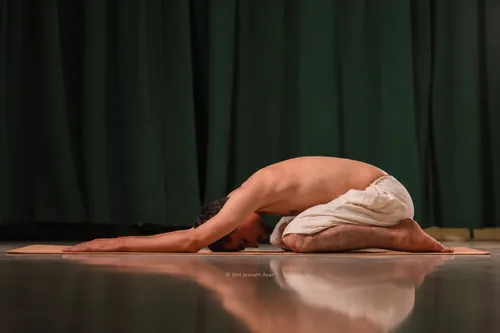 शशाङ्कासन
Sit the hips back onto the heels. Forehead to the mat, arms stretched forward. Now hum, with the mouth closed. Three times.
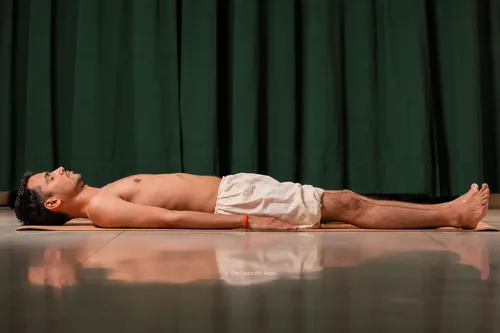 शवासन
Straighten the legs and lie down on your back. Legs a little apart, arms beside the body. Eyes closed. Now chant AUM three times, and feel the resonance travel the whole body.
Why this
In Bharata's Nāṭyaśāstra this is karuṇa rasa. Its lasting state is śoka, sorrow; its colour kapota, ash-coloured (kapota, the dove); its deity Yama; its notes gāndhāra, niṣāda (Ghosh vol. 1: VI.17, VI.42 to 45, XIX.38 to 40). The lamp keeps that colour.
Bharata gives this state a slow tempo, vilambita laya; a slow intonation; and grave, circumflex and quivering accents, anudātta, svarita and kampita (Ghosh vol. 1: the tempo in the prose after XIX.58 to 59, p. 351; the intonation in XIX.58 to 59, p. 350; the accents in XIX.43, p. 347). So the sitting begins aloud, low and slow. Where it ends, slow, is the same for every state: about six breaths a minute, the pace at which the rosary and a yoga mantra settled the breath when they were recited (Bernardi and others, BMJ 2001, 323, pp. 1446 to 1449). Ending every state there is ours.
Bharata wrote for an actor and an audience. Here you are both, and all of it is turned toward God. That turn is ours, not Bharata's.
It is the breath of the strong states: anger, sadness, craving and wonder. None of them is asked to leave. Each is given a sound that goes out, and ends in silence.
कृष्णाय वासुदेवाय: To Kṛṣṇa, son of Vasudeva, to Hari, the Supreme Self, to Govinda, who destroys the distress of those who bow to Him: salutation, again and again.
On this site it serves: Pain, The heavy mind.
Of Prahlāda's nine ways of bhakti (Śrīmad Bhāgavatam 7.5.23), this sitting really contains these: कीर्तन, aloud · स्मरण, in the mind · वन्दन, bowing · आत्मनिवेदन, the whole self given. That every rasa can be turned toward God is Rūpa Gosvāmī's teaching, in his Bhaktirasāmṛtasindhu.