Craving, longing
Craving is delight looked for in a place that cannot hold it. Here it walks toward Delight.
Life, Life, Life, I hear the passions cry; God, God, God, is the soul’s answer. Unless thou seest and lovest Life as God only, then is Life itself a sealed joy to thee.
Sri Aurobindo, Thoughts and Aphorisms 447 (CWSA 12, p. 485) the whole of it →1the story
राहTulasīdās, whose love ran through the night, and turned›
फिर वाल्मीकिVālmīki again
Nābhādās, of Tulasī's own time, in his garland of the devotees, put him at its head, the jewel at the top of the rosary, and said who he was:
कलि कुटिल जीव निस्तार हित, बाल्मीकि तुलसी भयौ॥
त्रेता काव्य निबन्ध, करी सतकोटि रमायन।
इक अक्षर उद्धरैं, ब्रह्म हत्यादि परायन॥
अब भक्तनि सुखदैन, बहुरि लीला विस्तारी।
रामचरन रसमत्त, रहत अहनिसि व्रतधारी॥
संसार अपार के पार को, सुगम रूप नवका लयौ।
कलि कुटिल जीव निस्तार हित, बाल्मीकि तुलसी भयौ॥
To free the crooked souls of this age of Kali, Vālmīki became Tulasī. In the Tretā age he made the Rāmāyaṇa in a hundred million verses, a single syllable of which lifts even the slayer of a brahmin. Now, to give joy to the devotees, he has spread the play out again, drunk on the taste of Rāma's feet, keeping his vow day and night. He has taken the form of an easy boat across the shoreless world. To free the crooked souls of this age, Vālmīki became Tulasī.
Nābhādās, Bhaktamāla, chappay 126 (Śrī Bhaktamāla, Malūk Pīṭh, Vrindavan, p. 131)So the grief of karuṇa's lamp, the grief that became the first verse, comes back here. But before Tulasī was Vālmīki again, he was a young man so in love with his wife that he could not bear one night without her.
हाड़-चामBone and skin
तिया सौं सनेह, बिन पूछे पिता गेह गई, भूली सुधि देह, भजे वाही ठौर आये हैं।
बधू अति लाज भई, रिस सौं निकसि गई, प्रीति राम नई, तन हाड़-चाम छाये हैं॥
सुनी जब बात, मानौ ह्वै गयौ प्रभात, वह पाछे पछितात, तजि काशीपुरी धाये हैं।
कियौ तहाँ वास, प्रभुसेवा लै प्रकास कीनौ, लीनौ दृढभाव, नैन रूप के तिसाये हैं॥
He loved his wife. She went to her father's house without asking him; he forgot his own body and ran to that very place. The young wife was deeply ashamed, and in anger it came out of her: love for Rāma is ever new; this body is bone and skin. When he heard it, it was as if dawn had come. She was sorry afterwards; he left everything and ran to Kāśī. He lived there, gave himself to serving the Lord and made it shine, took up a firm devotion, and his eyes thirsted for His form.
Priyādās, Bhaktirasabodhinī, kavitt 508 (Śrī Bhaktamāla, Malūk Pīṭh, Vrindavan, p. 131)Priyādās tells it in four lines and does not stop to judge anyone. Not the man who ran through the night after his wife. Not the wife whose words came out in anger and shame, and who was sorry afterwards. He says only what happened, and that it was like dawn.
अब न नसैहौंNo more wasted
Years later, in his Vinaya-patrikā, his book of petitions to Rāma, Tulasī wrote this:
अबलौं नसानी, अब न नसैहौं।
राम-कृपा भव-निसा सिरानी, जागे फिरि न डसैहौं॥
पायेउँ नाम चारु चिंतामनि, उर कर तें न खसैहौं।
स्यामरूप सुचि रुचिर कसौटी, चित कंचनहिं कसैहौं॥
परबस जानि हँस्यो इन इंद्रिन, निज बस ह्वै न हँसैहौं।
मन मधुकर पनकै तुलसी रघुपति-पद-कमल बसैहौं॥
Till now it was wasted; now I will not waste it. By Rāma's grace the night of the world is over; awake, I will not spread my bed again. I have found the Name, a lovely wish-fulfilling jewel; I will not let it slip from the hand of my heart. On the pure, lovely touchstone of His dark form I will test the gold of my mind. Knowing I was in their power, these senses laughed at me; master of myself, I will not let them laugh again. Making my mind a bee that has taken a vow, Tulasī will live in the lotus of Raghupati's feet.
Tulasīdās, Vinaya-patrikā 105 (Gita Press, p. 171)वही प्रेमThe same love
Every Jyotirgana knows a longing that will not wait for morning. He has crossed whatever had to be crossed in the dark for it, and forgotten his own body on the way. He has been told that this hunger is what is wrong with him.
Tulasī's love was not killed. Nothing in this story asks him to stop loving. The force that ran through the night to a woman's house is the same force that wrote the Rāmacaritamānasa, the book that is sung in every village of this land. It only found an object that was ever new, one that would not end in bone and skin.
And when he looked back, he did not curse the years. He wrote: till now it was wasted; now I will not waste it. The senses had laughed at him while he was in their power. He did not hate them; he simply would not let them laugh again. That is this lamp's practice: not touching. The longing stays whole. It is only turned toward what does not run out.
Nābhādās, Bhaktamāla, chappay 126, and Priyādās, Bhaktirasabodhinī (1712), kavitt 508, read on the printed page of Śrī Bhaktamāla, edited by Rājendradās, Malūk Pīṭh, Vrindavan, p. 131 (one word under the scan's watermark read in the Vrindavan 2002 printing, p. 701). Tulasīdās, Vinaya-patrikā 105, read on the printed page of the Gita Press, Gorakhpur edition, p. 171. The English of the verses and the telling are ours, and so is what it means for him.
4the word
A whole page of the Mother's diary, Prayers and Meditations, as she wrote it on this day: a prayer to the Divine, given entire. That it stands at this lamp is our choice.
The Mother · January 23, 1917
Thou didst fill my being with so complete, so intense a love and beauty and joy that it seemed impossible to me that this would not be communicated. It was like a glowing hearth whence the breath of thought wafted far many sparks which, entering the secrecy of men’s hearts, kindled other similar fires, fires of Thy divine Love, O Lord, that Love which impels and draws all human beings irresistibly to Thee. O my sweet Lord, grant that this may not be only a vision of my enrapt consciousness, but indeed a reality, effectively transforming all beings and things.
Grant that this love, this beauty and joy which flood all my being that is hardly strong enough to bear their intensity, may also flood the consciousness of all those I have seen, all those I have thought of and all those also whom I have never thought of or seen . . . Grant that all may awake to the consciousness of Thy infinite Bliss!
O my sweet Lord, fill their hearts with joy, love and beauty.
The Mother, Prayers and Meditations, CWM 1, p. 351
Life, Life, Life, I hear the passions cry; God, God, God, is the soul’s answer. Unless thou seest and lovest Life as God only, then is Life itself a sealed joy to thee.
Sri Aurobindo, Thoughts and Aphorisms 447 (CWSA 12, p. 485)From Thoughts and Aphorisms: about 1913 Sri Aurobindo wrote them in one notebook, under three headings, Knowledge, Works and Devotion, and never prepared them for publication. The Mother read them all aloud, one by one, from 1958 to 1970, and commented; that is On Thoughts and Aphorisms. Below: what stands beside this line, her comment on it, and why it is here.
Beside it, Sri Aurobindo
“He loves her”, the senses say; but the soul says “God God God”. That is the all-embracing formula of existence.
Sri Aurobindo, Thoughts and Aphorisms 448 (CWSA 12, p. 485)The Mother, on it
In this way Sri Aurobindo reveals and formulates the secret of existence. All that remains is to understand and live it.
The Mother, On Thoughts and Aphorisms, CWM 10, p. 337, 4 April 1970Why it is here
The passions’ cry for life is not refused; the soul answers it. It stands here because longing is not wrong, it is looking for its true object. It does not say that every craving should be fed. That reading is ours.
Read every aphorism with the Mother’s comments, on the Ashram’s site →
one long breath
5the sitting
Each group's cautions come with its own steps (Group 9's neck caution and the others).
What will you carry?
The sitting
Begin the sitting →Choose what you will carry, and the sitting opens.
It begins aloud, warm, unhurried, and slows a little in each posture, to about six breaths a minute. Each line is read in the mind as the breath comes in, white, and said aloud as it goes out, gold.
- ĀsanaThe Spark, each posture once
- BreathA · U · M · three sounds on one breath
- JapaThe same word, seated.
- RestŚaśāṅkāsana or Śavāsana, either. Nothing to count.
Or one piece alone: Āsana · Breath · Japa · Rest
विश्राम · Rest
Śaśāṅkāsana or Śavāsana, either. Nothing to count.
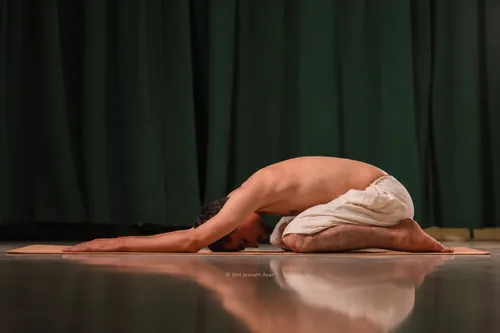 शशाङ्कासन
Sit the hips back onto the heels. Forehead to the mat, arms stretched forward. Now hum, with the mouth closed. Three times.
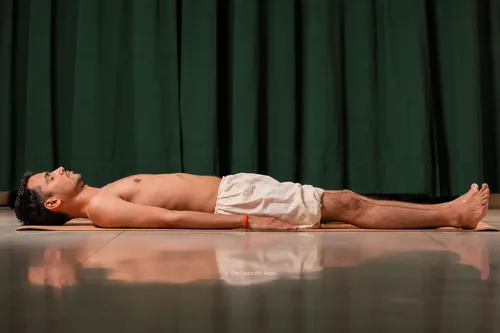 शवासन
Straighten the legs and lie down on your back. Legs a little apart, arms beside the body. Eyes closed. Now chant AUM three times, and feel the resonance travel the whole body.
Why this
In Bharata's Nāṭyaśāstra this is śṛṅgāra rasa. Its lasting state is rati, love; its colour śyāma, light green; its deity Viṣṇu; its notes madhyama, pañcama (Ghosh vol. 1: VI.17, VI.42 to 45, XIX.38 to 40). The lamp keeps that colour.
Bharata gives this state a medium tempo, madhya laya; a slow intonation; and acute and circumflex accents, udātta and svarita (Ghosh vol. 1: the tempo in the prose after XIX.58 to 59, p. 351; the intonation in XIX.58 to 59, p. 350; the accents in XIX.43, p. 347). So the sitting begins aloud, warm, unhurried. Where it ends, slow, is the same for every state: about six breaths a minute, the pace at which the rosary and a yoga mantra settled the breath when they were recited (Bernardi and others, BMJ 2001, 323, pp. 1446 to 1449). Ending every state there is ours.
Bharata wrote for an actor and an audience. Here you are both, and all of it is turned toward God. That turn is ours, not Bharata's.
It is the breath of the strong states: anger, sadness, craving and wonder. None of them is asked to leave. Each is given a sound that goes out, and ends in silence.
ॐ आनन्दमयि: Sri Aurobindo's mantra to the Mother, and it begins with Delight.
On this site it serves: Craving.
Of Prahlāda's nine ways of bhakti (Śrīmad Bhāgavatam 7.5.23), this sitting really contains these: कीर्तन, aloud · स्मरण, in the mind · वन्दन, bowing. That every rasa can be turned toward God is Rūpa Gosvāmī's teaching, in his Bhaktirasāmṛtasindhu.